Why this works
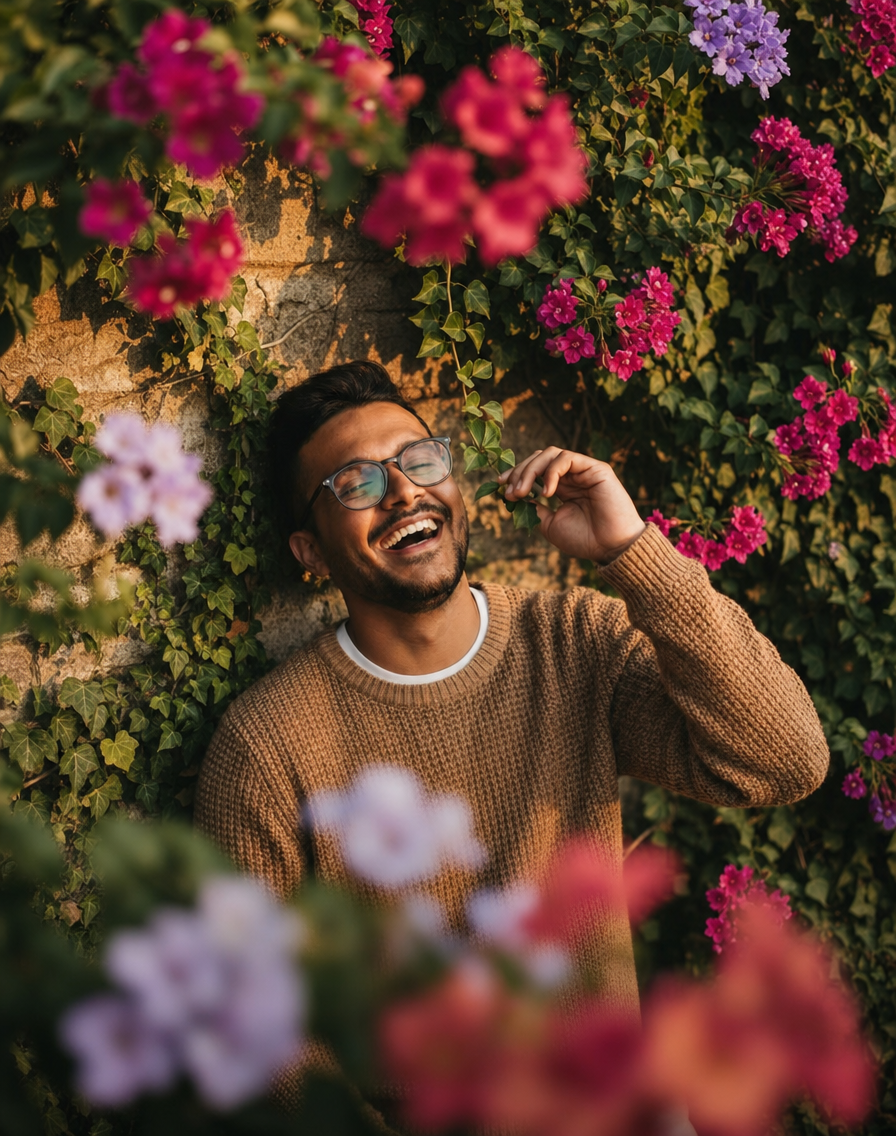
“Warm golden-hour cinematic natural light” supplies the warm, joyful mood, while “deep magenta and violet” blossoms keep the palette from collapsing into orange; the image’s pink, purple, and brown balance comes directly from those flowers against the rustic stone wall. “Portrait-full-body” and the instruction to keep the “same subject pose and proximity to the wall” establish the stable framing, with “soft, out-of-focus flowers” in the foreground adding depth around the person. “Dreamy shallow depth of field,” “gentle bokeh background,” and “realistic skin texture” separate the sharp, candid subject from the softened foliage without losing a photorealistic finish.
FAQ
→How do I change this prompt to make the portrait mood cooler and more contemplative?
Replace “warm golden-hour cinematic natural light” and “warm, joyful” with “cool overcast blue-hour light, muted highlights, and a quiet contemplative mood.” Change “deep magenta and violet” to “desaturated blue, lavender, and slate blossoms” to carry the cooler tone into the wall-side foliage.
→How do I make the person more prominent than the wall and flowers?
Replace “portrait-full-body” with “medium portrait from the waist up,” and change “standing beside a rustic stone wall” to “subject centered in the frame, facing camera, with the wall receding softly behind.” Keep “dreamy shallow depth of field,” but replace “soft, out-of-focus flowers blur in the foreground” with “minimal foreground obstruction” so blossoms do not cover the subject.
→How do I build a variation series while preserving this composition?
Keep “same subject pose and proximity to the wall,” “portrait-full-body,” and “realistic skin texture” unchanged, then swap only the setting and palette phrases. For example, replace “rustic stone wall covered in lush climbing foliage” with “weathered garden gate covered in dense ivy,” and replace “deep magenta and violet blossoms” with “pale yellow and white blossoms” for a controlled location-and-color variation.
Learn the technique behind this
- Why can't AI spell, and how do I get readable text in an image? — Older diffusion models had no character-level representation of text, so they produced letterform-shaped texture instead of words.
- How should a prompt be structured, and does word order matter? — A prompt that behaves predictably names one subject first, then what it is doing, then where, then the light, then the lens or medium, then the style.
- How do I keep the same character across multiple images? — Text prompts alone won't hold a face across images — a description defines a type, not a person.
Related prompts
Woman in Teal Light, Shadowed Fashion Portrait
Eerie Elegance Among Marble Busts
Charcoal turtleneck with red eye-beam
Dreamy Macro Portrait in Cool Water