Why this works
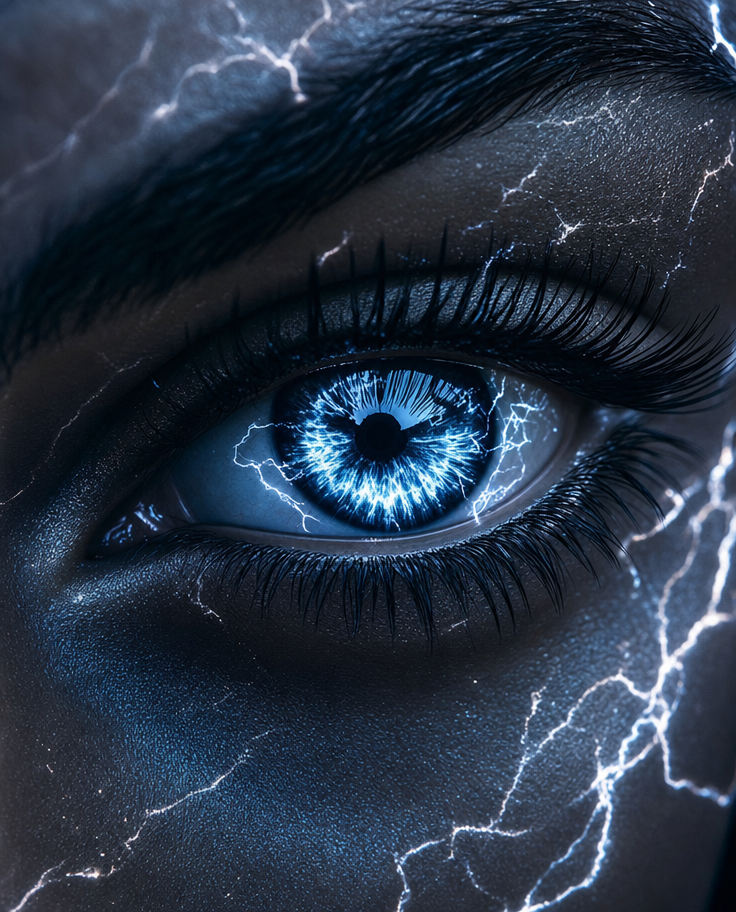
“Extreme close-up macro” and “portrait-closeup” remove distractions and make the eye fill the frame, while “shallow depth of field” isolates the glowing iris from the surrounding skin. “Glowing electric-blue iris,” paired with the vivid blue and deep charcoal palette, creates the dominant cold color contrast; “subtle cracked ember-like light patterns” add a supernatural surface detail without introducing objects. “High-contrast cinematic lighting with sharp focus” supplies the intense dramatic mood, and “ultra-detailed eyelashes” plus “macro texture clarity” make the photorealistic fantasy realism readable at very close range.
FAQ
→How do I make the cracked light patterns more prominent than the iris?
Replace “subtle cracked ember-like light patterns” with “bright branching ember-like fissures radiating across the surrounding skin, clearly visible and nearly as luminous as the iris,” and change “glowing electric-blue iris” to “steady electric-blue iris glow” so the cracks carry more visual weight.
→How do I shift this from an otherworldly dramatic image to a colder, clinical mood?
Replace “otherworldly dramatic mood” with “sterile clinical mood,” change “cinematic high-contrast lighting” to “flat cool-white examination lighting,” and replace “deep charcoal color palette” with “pale gray and icy white palette.” Keep “sharp focus” and “macro texture clarity” to preserve the forensic detail.
→How do I create a matching series with different eye colors while keeping the same composition?
Keep “extreme close-up macro,” “portrait-closeup,” “shallow depth of field,” and “surrounding skin texture around the eye only” unchanged. Swap “glowing electric-blue iris” for variants such as “glowing emerald-green iris,” “luminous violet iris,” or “molten amber iris,” then replace “vivid blue and deep charcoal color palette” with a palette built around the new iris color and charcoal.
Learn the technique behind this
- Why can't AI spell, and how do I get readable text in an image? — Older diffusion models had no character-level representation of text, so they produced letterform-shaped texture instead of words.
- How should a prompt be structured, and does word order matter? — A prompt that behaves predictably names one subject first, then what it is doing, then where, then the light, then the lens or medium, then the style.
- How do I keep one consistent style across a whole set of images? — Style consistency is more achievable than character consistency because style lives in describable attributes.
Related prompts
Young girl with dog in tornado
Headless sitter atop a giant head
Crimson-Cloaked Specter in Candlelit Ballroom
Violet Holographic Hands Almost Touching