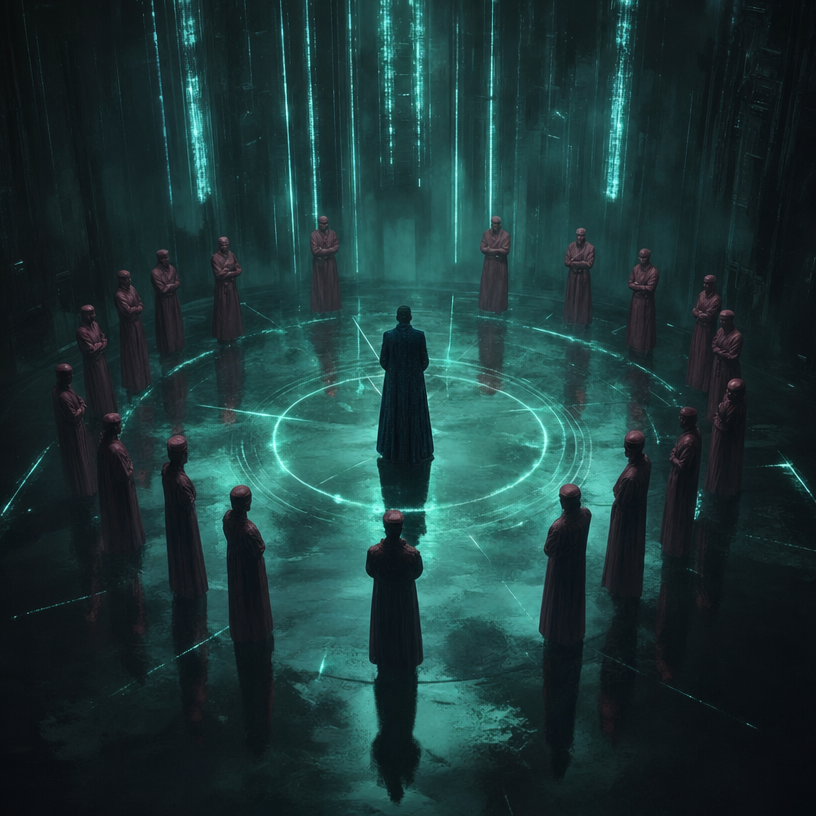
Why this works
The centered figure and radial arrangement are locked in by “stands at the center,” “symmetrical ring,” and “dramatic centered composition,” producing the image’s rigid, symmetrical read. The ominous mood comes from “eerie ominous ritual atmosphere,” reinforced by “hard rim light and long shadows,” while “glowing teal holographic lines” against “muted burgundy” supplies the key color contrast even though the rendered image is dominated by black and gray. “Glossy wet floor” and “reflecting across” extend the chamber vertically, giving the low-contrast dark scene a mirrored sense of depth and scale.
FAQ
→How do I make the central figure more dominant and imposing?
Replace “A cloaked central figure stands at the center” with “a towering cloaked figure fills the foreground, viewed from a low angle,” and change “symmetrical ring of other cloaked figures” to “small, distant figures forming a receding circle.” Keep “dramatic centered composition,” but add “central figure sharply in focus, surrounding figures partially obscured.”
→How do I shift this from ominous ritual to a colder, clinical sci-fi mood?
Replace “eerie ominous ritual atmosphere” with “sterile clinical atmosphere, controlled and impersonal,” and change “muted burgundy” robes to “desaturated white and pale gray robes.” Replace “long shadows” with “soft uniform illumination” and “glowing teal holographic lines” with “cold white-blue interface grids.”
→How do I create a set of variations while preserving the same visual identity?
Keep “cinematic centered framing,” “high-contrast palette,” “circular futuristic chamber,” and “symmetrical ring,” then vary one structural element per prompt: replace the chamber with “a vast orbital observation deck,” “an underground reactor hall,” or “a flooded cathedral-like data vault.” Retain “deep blue-black” for the central cloak, “teal holographic lines,” and “glossy wet reflective floor” so the series keeps its color and reflection motifs.
Learn the technique behind this
- Why can't AI spell, and how do I get readable text in an image? — Older diffusion models had no character-level representation of text, so they produced letterform-shaped texture instead of words.
- How should a prompt be structured, and does word order matter? — A prompt that behaves predictably names one subject first, then what it is doing, then where, then the light, then the lens or medium, then the style.
- Do negative prompts work, and what should go in one? — Negative prompts work on models that support a separate negative conditioning channel — mainly Stable Diffusion and FLUX-family models.
Related prompts
Young girl with dog in tornado
Headless sitter atop a giant head
Crimson-Cloaked Specter in Candlelit Ballroom
Charcoal-suited man on teal plane