Why this works
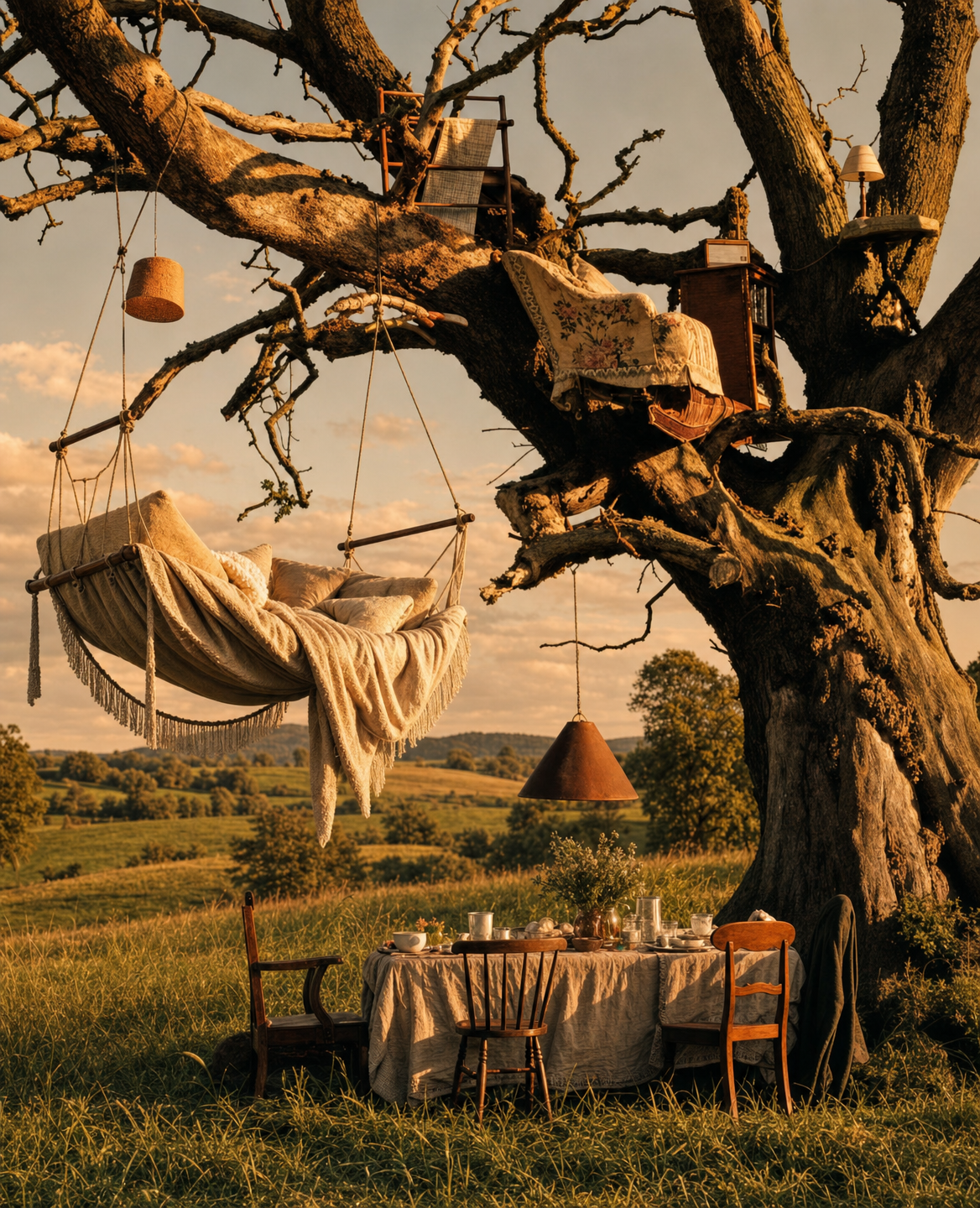
The wide-shot framing makes the massive ancient tree and its sprawling bare branches the clear architectural anchor, while the rolling hills and scattered hedgerows extend the scene into a readable countryside. The whimsical, dreamy mood comes from the specific contrast between a “hammock-style suspended bed” and “rustic wooden furniture” tucked into the tree’s crevices, with “small lanterns” adding storybook detail. “Soft beige fabric,” “lush green meadow,” and the “warm golden-hour sky” create a restrained beige-green-gold harmony, while “natural daylight look” and “highly detailed” preserve photorealistic texture instead of turning the fantasy setting into an illustration.
FAQ
→How do I make the suspended bedroom more central and prominent?
Replace “wide-shot” with “medium-wide shot centered tightly on the suspended bedroom,” and change “a massive ancient tree with sprawling bare branches” to “the suspended bedroom as the dominant focal point, framed by the ancient tree’s branches.” Add “hammock bed in sharp foreground focus” so the soft beige bed receives more visual priority than the distant hills.
→How do I shift this from dreamy golden-hour warmth to a mysterious nighttime mood?
Replace “warm golden-hour natural daylight” and “warm golden-hour sky” with “cool moonlight, deep blue night sky, and soft lantern glow.” Keep “small lanterns” but change them to “many glowing amber lanterns illuminating the tree crevices,” and replace “natural daylight look” with “cinematic nocturnal realism with deep shadows.”
→How do I create a series of variations while keeping the same tree-house concept?
Keep “massive ancient tree with sprawling bare branches” and “a hammock-style suspended bed,” then swap the setting phrase “lush meadow with taller grass” for variations such as “misty mountain valley,” “autumn woodland clearing,” or “coastal cliff meadow.” Replace “weathered dining table” with a recurring activity prop, such as “small writing desk,” “tea table,” or “artist’s easel,” while retaining “cinematic composition” and “highly detailed” for visual consistency.
Learn the technique behind this
- Why can't AI spell, and how do I get readable text in an image? — Older diffusion models had no character-level representation of text, so they produced letterform-shaped texture instead of words.
- How should a prompt be structured, and does word order matter? — A prompt that behaves predictably names one subject first, then what it is doing, then where, then the light, then the lens or medium, then the style.
- Do negative prompts work, and what should go in one? — Negative prompts work on models that support a separate negative conditioning channel — mainly Stable Diffusion and FLUX-family models.
Related prompts
Young girl with dog in tornado
Headless sitter atop a giant head
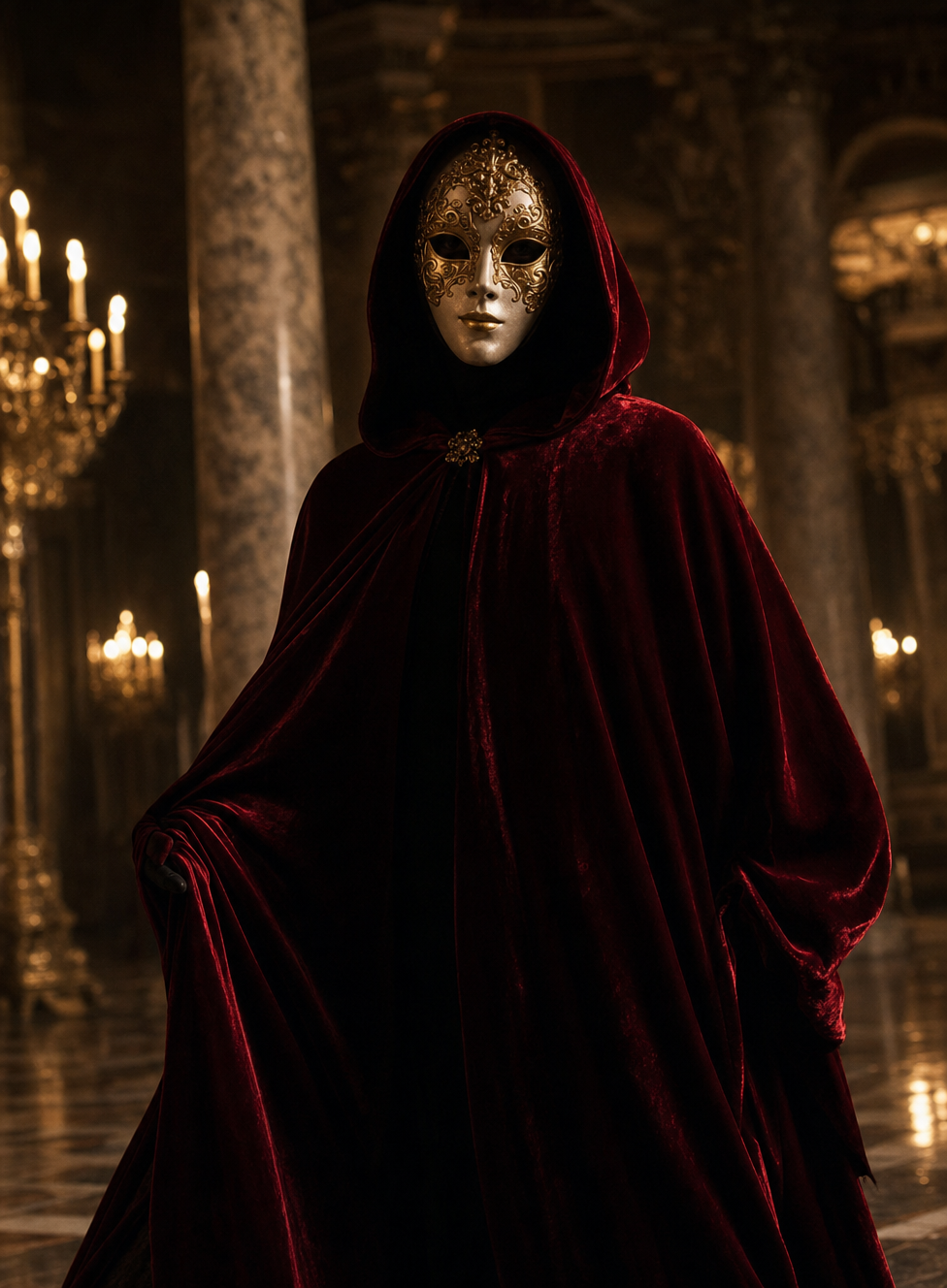
Crimson-Cloaked Specter in Candlelit Ballroom

Violet Holographic Hands Almost Touching