Why this works
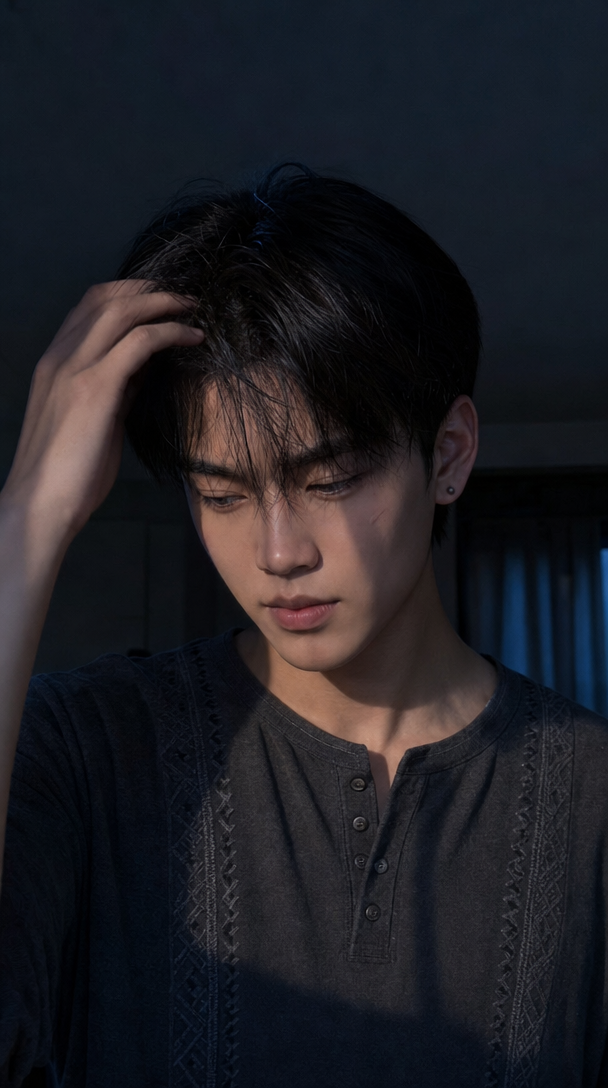
The navy and gray palette in the actual render traces directly back to 'cool blue-hour twilight' and the 'charcoal-grey henley shirt' rather than any generic color grading instruction. The intimate, closed-in feel comes from stacking 'close-up portrait' with 'shallow depth of field,' which forces the background to fall away and pins attention on the face. 'Looking downward' combined with 'contemplative introspective mood' is what sells the private, self-absorbed moment, not the lighting alone, since a downward gaze under bright even light would read as boredom instead of reflection. The small specific details, 'subtle scar on his cheekbone' and 'small ear piercing,' give the shallow-focus face something to lock onto so the eye doesn't just slide off a generic portrait.
FAQ
→How do I make the mood warmer instead of cool and blue?
Swap 'cool blue-hour twilight' for something like 'warm late-afternoon golden light' and change 'charcoal-grey henley shirt' to a warmer tone like 'rust-orange henley shirt' so the wardrobe doesn't fight the new light temperature. Keep 'natural window lighting from the side' as is since the directionality still works fine with warm light.
→How do I shift focus onto the hand gesture instead of the face?
Move 'one hand raised to adjust his hair' earlier in the sentence and add 'focus on fingers against dark hair' right after it, then loosen 'shallow depth of field' to 'medium depth of field' so both the hand and face stay sharp enough to read as a pair. You could also add 'hand slightly blurred with motion' if you want it to feel like a candid mid-gesture snap.
→How do I turn this into a series with different subjects but the same mood?
Keep 'cool blue-hour twilight,' 'contemplative introspective mood,' and 'shallow depth of field' untouched since those three phrases are doing the heavy lifting on atmosphere, then just swap the subject line, e.g. 'young man with straight black hair' becomes 'middle-aged woman with silver bob' or 'teenage boy with curly red hair.' Change small physical details like 'subtle scar on his cheekbone' or 'small ear piercing' each time so every image in the series still has one distinct identifying feature.
Learn the technique behind this
- Why can't AI spell, and how do I get readable text in an image? — Older diffusion models had no character-level representation of text, so they produced letterform-shaped texture instead of words.
- How should a prompt be structured, and does word order matter? — A prompt that behaves predictably names one subject first, then what it is doing, then where, then the light, then the lens or medium, then the style.
- Why does AI get hands and faces wrong, and how do I fix it? — Hands fail because they're small in frame, extremely variable in pose, and self-occluding — the model has less usable signal per pixel than for any other body part.
Related prompts
Woman in Teal Light, Shadowed Fashion Portrait
Eerie Elegance Among Marble Busts
Charcoal turtleneck with red eye-beam
Dreamy Macro Portrait in Cool Water