Why this works
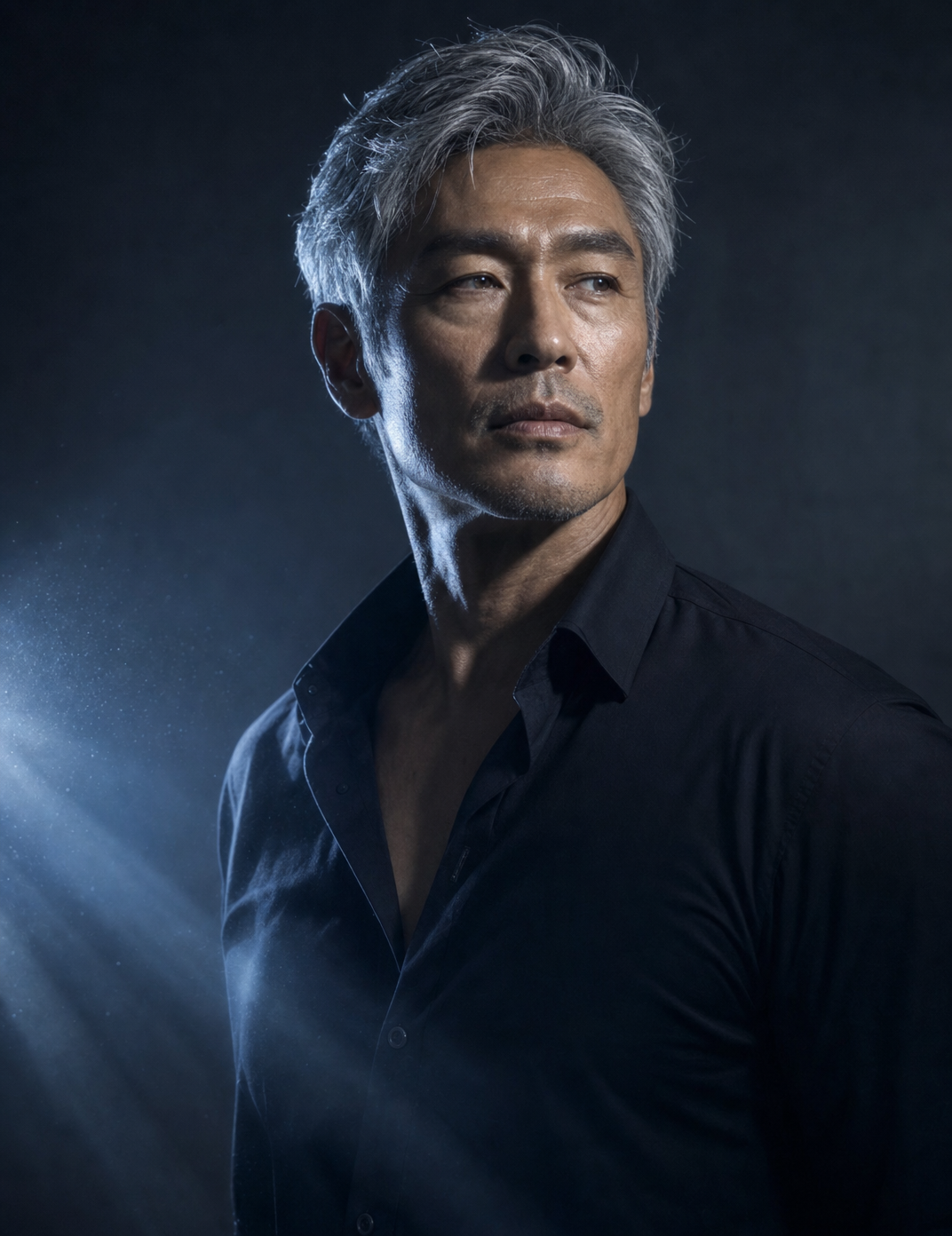
The phrase 'rim light catching the contours of his face' is what separates the man from the 'deep charcoal background', producing the navy-to-black contrast that dominates the palette. 'Volumetric light rays streaming from the lower side' combined with 'sparkling practical light particles' is the exact language responsible for the celestial, dust-lit quality rather than a flat studio shot. The mood reads as mysterious because of 'chiaroscuro lighting' explicitly named alongside 'cool blue-toned sidelighting' - that pairing is what pushes skin tones toward sky-blue instead of warm flesh tones. And 'shallow depth of field' plus '85mm portrait lens' is what forces the tight close-up composition, keeping the background a soft charcoal void with nothing to compete with the face.
FAQ
→How do I make the light particles the main focal point instead of the face?
Move 'sparkling practical light particles' earlier in the prompt and intensify it to something like 'dense swirling light particles surrounding him like a galaxy' and add 'particles in sharp focus, face slightly softer' - right now the particles are a background accent to the rim-lit face, so reordering and adding a focus cue shifts weight onto them.
→How do I shift this from a cool, mysterious mood to something warmer and more inviting?
Replace 'cool blue-toned sidelighting' with 'warm amber-toned sidelighting' and swap 'deep charcoal background' for 'soft warm brown background'. Also drop 'chiaroscuro lighting' in favor of 'soft diffused lighting' since chiaroscuro is what's driving the dramatic, shadowy tone.
→How do I create a series of variations using this same lighting setup on different subjects?
Keep 'cool blue-toned sidelighting with dramatic backlighting, rim light... volumetric light rays streaming from the lower side, sparkling practical light particles' untouched since that's the signature look, and only swap the subject clause - change 'Mature man with short, silver-grey hair' to things like 'young woman with braided black hair' or 'elderly woman with deep wrinkles and white curly hair' to build a consistent set.
Learn the technique behind this
- Why can't AI spell, and how do I get readable text in an image? — Older diffusion models had no character-level representation of text, so they produced letterform-shaped texture instead of words.
- How should a prompt be structured, and does word order matter? — A prompt that behaves predictably names one subject first, then what it is doing, then where, then the light, then the lens or medium, then the style.
- Why does AI get hands and faces wrong, and how do I fix it? — Hands fail because they're small in frame, extremely variable in pose, and self-occluding — the model has less usable signal per pixel than for any other body part.
Related prompts
Woman in Teal Light, Shadowed Fashion Portrait
Eerie Elegance Among Marble Busts
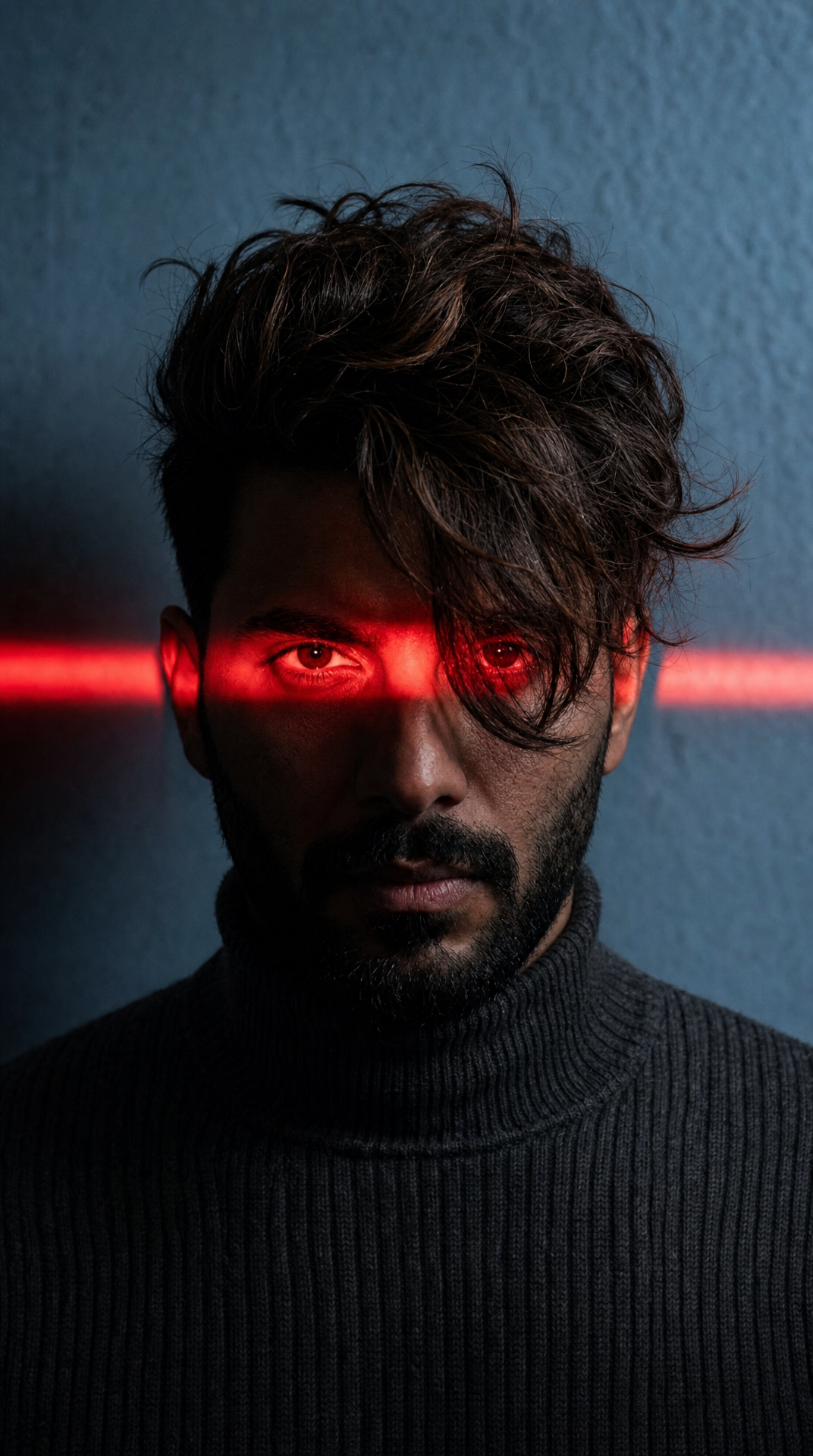
Charcoal turtleneck with red eye-beam
Dreamy Macro Portrait in Cool Water