Why this works
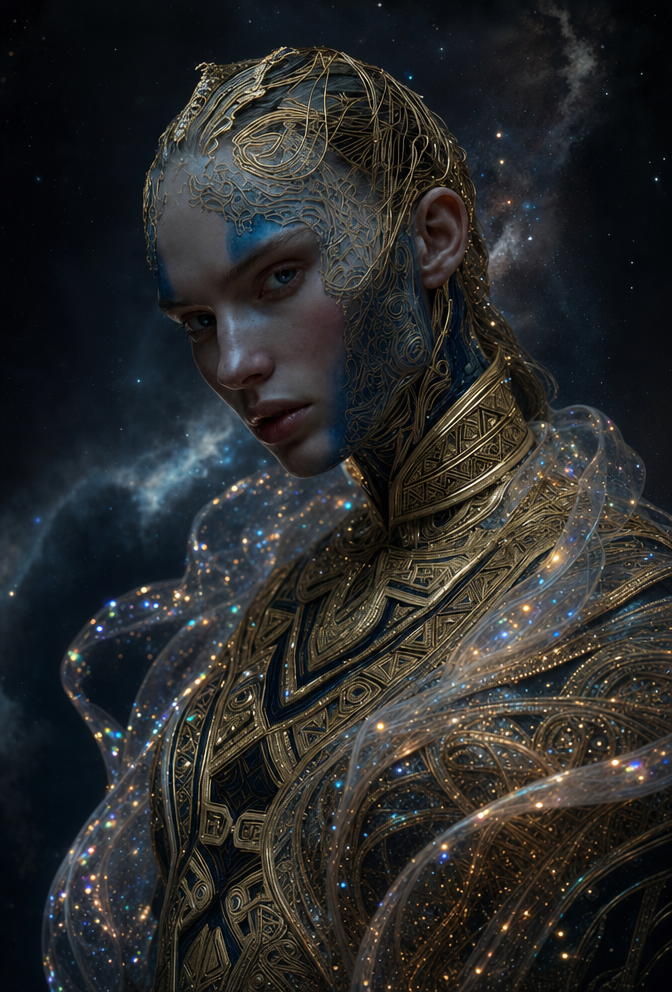
The centered bust framing makes the androgynous humanoid’s face, gold head-and-neck filigree, and pale skin the immediate focal point, while shallow depth of field separates those details from the starfield and faint nebula haze. “Dramatic rim lighting with deep shadows” supplies the mysterious, high-contrast mood by carving the silhouette against the blue-gray cosmic background, while the gold biomechanical plating and “small prismatic embedded lights” create controlled color contrast rather than a flat blue scene. The reduced number of glowing ribbon-like tendrils keeps their looping forms readable around the shoulders without letting them overwhelm the portrait.
FAQ
→How do I make the face and eyes more prominent than the biomechanical plating?
Replace “intricate gold biomechanical filigree plating the head, neck, and upper torso” with “sparser gold filigree framing the temples and jaw, leaving the face unobstructed,” and add “direct eye-level key light on the eyes, crisp facial focus.” Keep “centered bust framing” and “shallow depth of field” so the gaze remains the sharpest point.
→How do I make this portrait feel colder and more threatening?
Replace “ethereal starfield atmosphere with faint nebula haze” with “storm-dark blue nebula clouds with sparse stars,” and change “dramatic rim lighting with deep shadows” to “icy blue backlight, severe underlighting, and near-black facial shadows.” Replace the gold emphasis in “gold biomechanical filigree” with “tarnished gunmetal filigree with faint cold-gold accents” to reduce warmth while preserving the metallic structure.
→How do I create a consistent series of variations from this image?
Keep the fixed anchors “androgynous humanoid,” “centered bust framing,” “photorealistic,” “dramatic rim lighting,” and “shallow depth of field,” then change only one modular block per image. For setting variations, replace “ethereal starfield with faint nebula haze” with “abandoned orbital cathedral,” “frozen alien canyon,” or “black glass laboratory”; for subject variations, replace “glowing translucent ribbon-like tendrils” with “floating metallic petals,” “smoke-like energy bands,” or “segmented mechanical wings.”
Learn the technique behind this
- Why can't AI spell, and how do I get readable text in an image? — Older diffusion models had no character-level representation of text, so they produced letterform-shaped texture instead of words.
- How do I keep the same character across multiple images? — Text prompts alone won't hold a face across images — a description defines a type, not a person.
- How should a prompt be structured, and does word order matter? — A prompt that behaves predictably names one subject first, then what it is doing, then where, then the light, then the lens or medium, then the style.
Related prompts
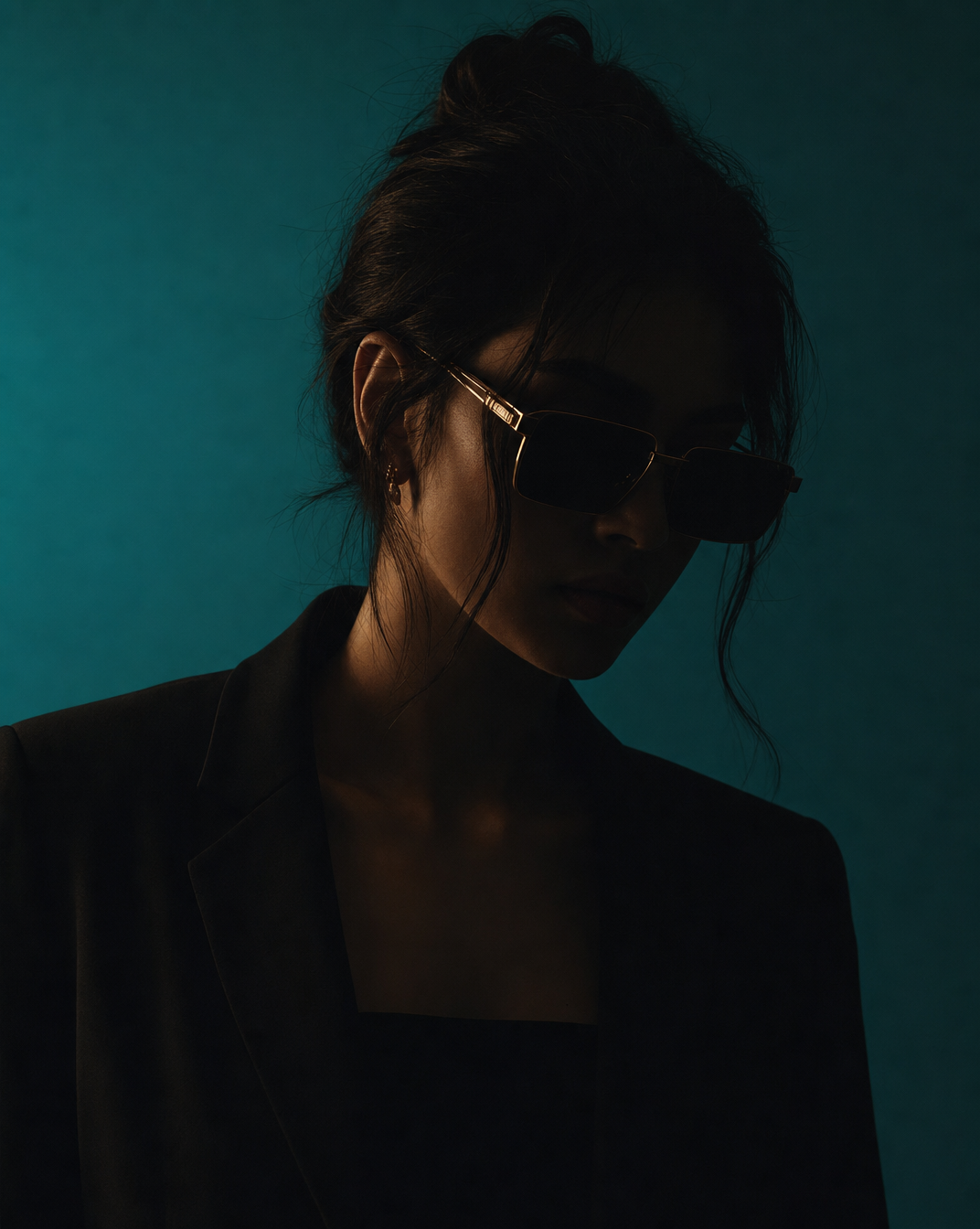
Woman in Teal Light, Shadowed Fashion Portrait
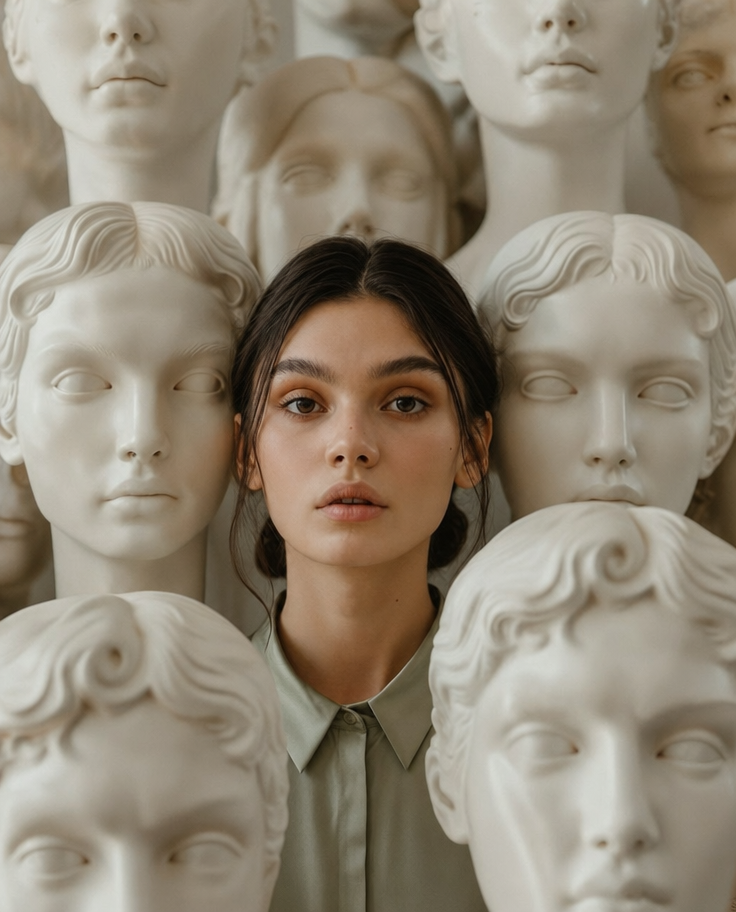
Eerie Elegance Among Marble Busts
Charcoal turtleneck with red eye-beam
Dreamy Macro Portrait in Cool Water