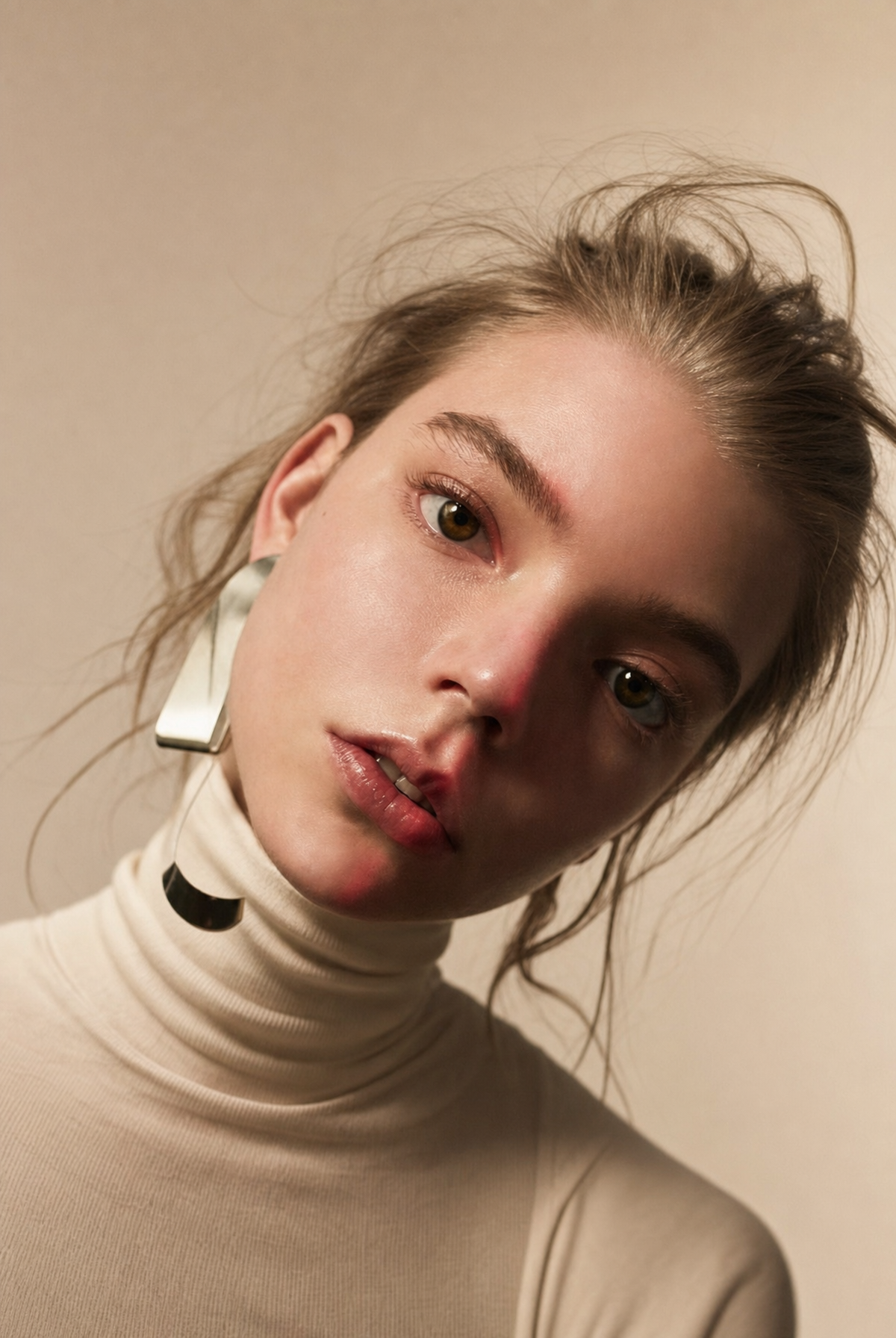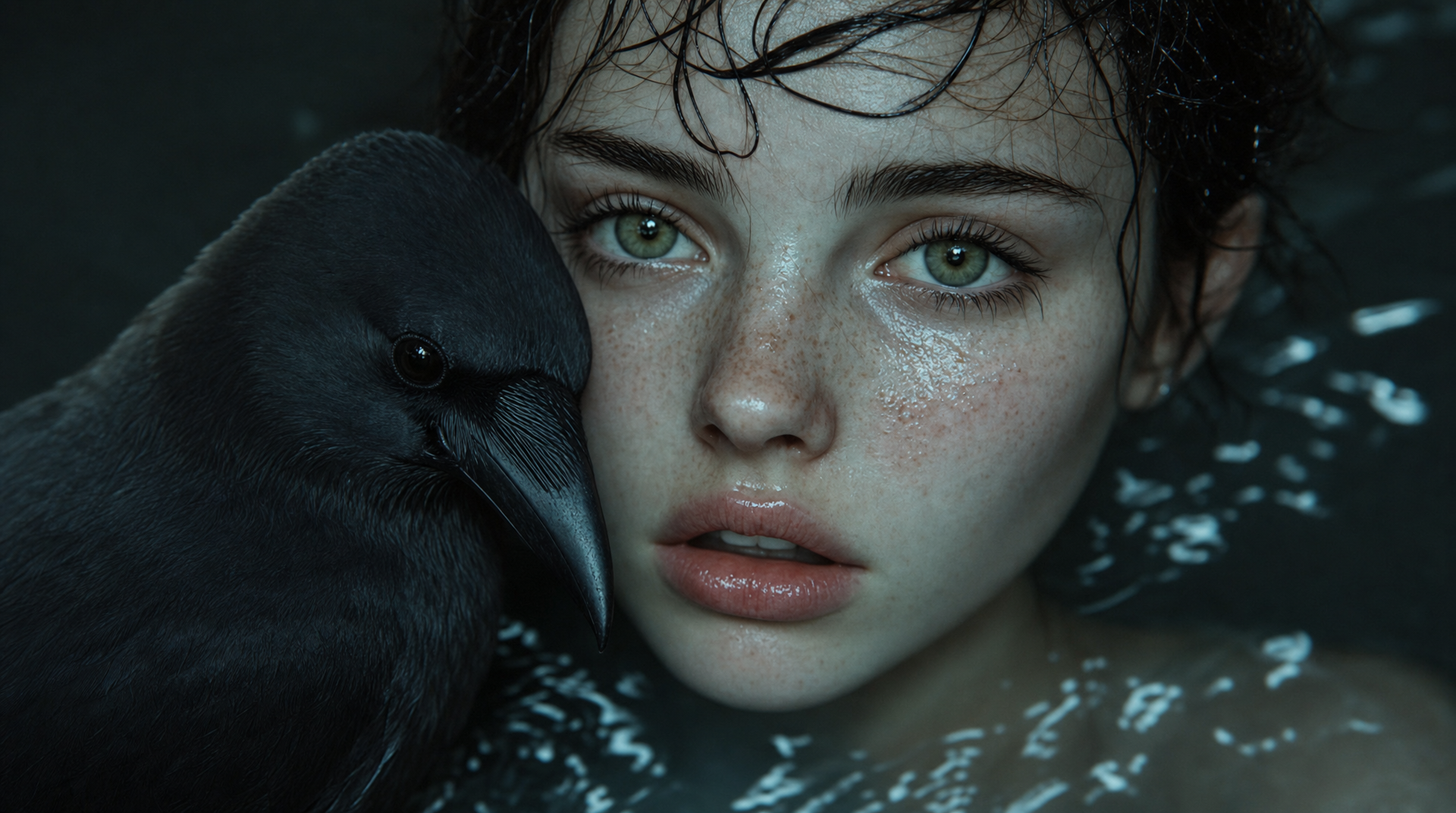
Same prompt, generated with each model separately — click one to see how it holds up.
Why this works
The intimate framing comes directly from “cinematic close-up portrait” and “the crow pressed close to her cheek,” which makes the green eyes, freckles, and bird’s tilted head compete within one tight focal area. “Dramatic low-key lighting with a faint rim light” supplies the dark, eerie intensity by burying the indistinct background in shadow while separating the silhouettes at the edges. The cool gray-blue palette reinforces that tension, while “shallow depth of field,” “hyper-realistic skin texture,” and “subtle filmic grain” keep attention on tactile facial detail rather than the background.
FAQ
→How do I make the crow more central and visually dominant?
Replace “a matte black crow pressed close to her cheek” with “a large matte black crow occupying the foreground beside her face, its eye sharply in focus,” and change “shallow depth of field” to “deep enough focus to keep both the crow’s eye and her piercing green eyes razor sharp.”
→How do I shift this from eerie to elegant and restrained?
Replace “dark eerie atmosphere” and “dramatic low-key lighting with a faint rim light” with “quiet, sophisticated atmosphere” and “soft directional studio lighting with a narrow silver rim light.” Keep “photorealistic editorial fashion photography,” but change “subtle filmic grain” to “clean, polished high-fashion finish” for a less ominous surface.
→How do I build a matching series with different animals or subjects?
Keep the fixed structure “cinematic close-up portrait,” “freckled young woman with piercing green eyes,” “Sony Alpha A7 III,” and “photorealistic editorial fashion photography,” then replace “a matte black crow” with a controlled subject slot such as “a white barn owl pressed close to her cheek” or “a red fox resting beside her temple.” Match each variation’s identity by swapping “gray, blue” for a subject-specific palette while retaining “dramatic low-key lighting” and “shallow depth of field.”
Learn the technique behind this
- Why can't AI spell, and how do I get readable text in an image? — Older diffusion models had no character-level representation of text, so they produced letterform-shaped texture instead of words.
- How should a prompt be structured, and does word order matter? — A prompt that behaves predictably names one subject first, then what it is doing, then where, then the light, then the lens or medium, then the style.
- Why does AI get hands and faces wrong, and how do I fix it? — Hands fail because they're small in frame, extremely variable in pose, and self-occluding — the model has less usable signal per pixel than for any other body part.
Related prompts
Woman in Teal Light, Shadowed Fashion Portrait
Eerie Elegance Among Marble Busts
Charcoal turtleneck with red eye-beam
Dreamy Macro Portrait in Cool Water