Why this works
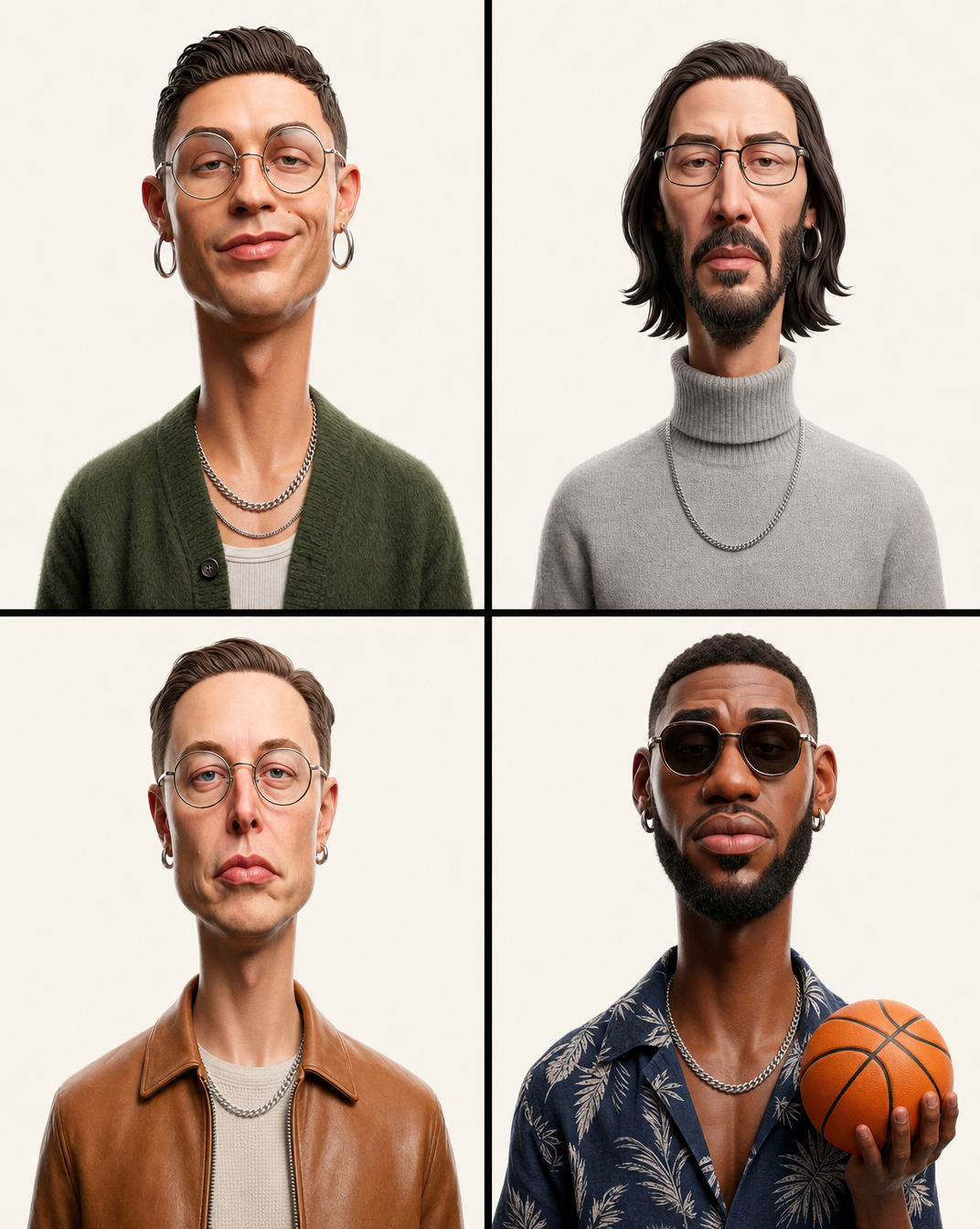
The phrase “front-facing bust framing in a tight 2x2 grid layout” makes the four faces read as a balanced, centered set, while “exaggerated long necks” supplies the comic distortion that keeps the realistic CGI from feeling ordinary. “Forest-green cardigan,” “light gray turtleneck,” “tan leather jacket,” and “navy patterned shirt” create controlled wardrobe variation, reflected in the image’s green, gray, brown, and dark tones without breaking the unified studio presentation. “Studio lighting,” “realistic skin shading,” and “subtle subsurface skin scattering” are load-bearing for the polished highlights and lifelike faces; “confident expressions” and “playful yet stylish overall” establish the intended attitude rather than relying on color alone.
FAQ
→How do I make one bust more prominent than the other three?
Replace “tight 2x2 grid layout” with “three smaller busts surrounding one larger central bust,” and change “centered” to “hero subject centered and closest to camera.” Add “slightly larger head scale, stronger facial detail, and brighter key light on the central figure” to direct hierarchy toward that panel.
→How do I shift the portraits from playful and stylish to darker and more dramatic?
Replace “clean light background” with “deep charcoal studio background,” and change “studio lighting” to “dramatic low-key lighting with hard side shadows and a narrow rim light.” Swap “playful yet stylish overall” for “brooding, intense, fashion-editorial mood,” while keeping “realistic skin shading” so the faces remain detailed rather than becoming flat or overly graphic.
→How do I build a coordinated series with different character themes?
Keep “2x2 grid,” “photorealistic 3D CGI caricature render,” and “exaggerated long necks” unchanged, then replace the four outfit phrases with a consistent theme such as “red racing jacket, white mechanic jumpsuit, black biker vest, and blue flight suit.” Replace the accessory instruction with theme-specific variations such as “aviator glasses, headset, goggles, and metallic ear cuff,” while retaining “shorter layered silver chains” for continuity across images.
Learn the technique behind this
- Why can't AI spell, and how do I get readable text in an image? — Older diffusion models had no character-level representation of text, so they produced letterform-shaped texture instead of words.
- How should a prompt be structured, and does word order matter? — A prompt that behaves predictably names one subject first, then what it is doing, then where, then the light, then the lens or medium, then the style.
- How do I keep the same character across multiple images? — Text prompts alone won't hold a face across images — a description defines a type, not a person.
Related prompts
Woman in Teal Light, Shadowed Fashion Portrait
Eerie Elegance Among Marble Busts
Charcoal turtleneck with red eye-beam
Dreamy Macro Portrait in Cool Water