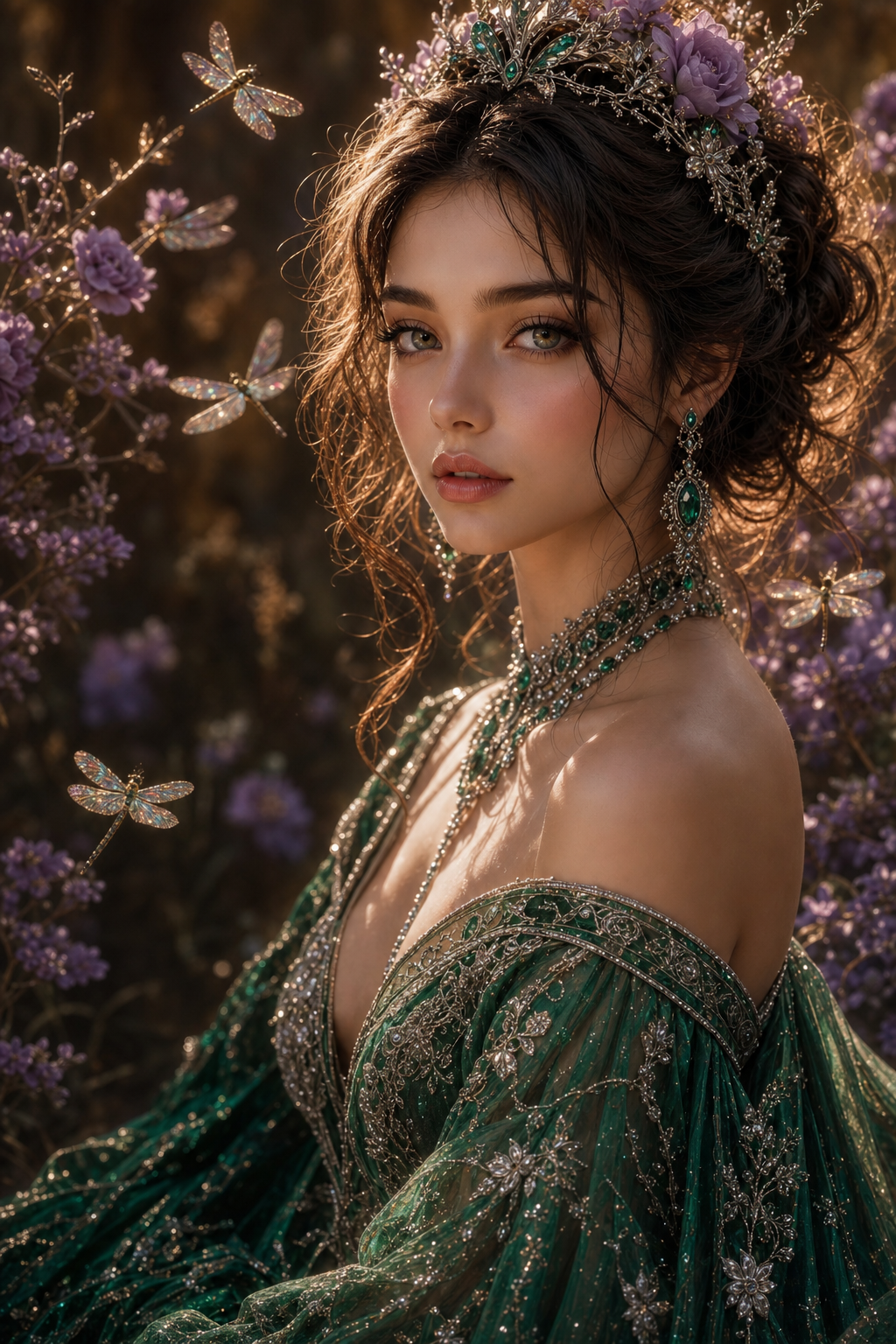
Why this works
The color harmony you see (gold, violet, emerald) traces directly to 'emerald and silver dress' clashing productively against 'purple flowers' while 'soft warm amber lighting' unifies both into gold. That amber lighting phrase is also what's doing the ethereal-glow work, not the 'ethereal atmosphere' style tag, which is too vague on its own to produce the warm haze in the image. The regal mood comes from stacking 'intricate jewelry and crown' with 'elegant' as an adjective on the dress, giving the model two separate cues to render ornamentation rather than a plain gown. Portrait-closeup framing follows from naming the queen as the subject first and burying the garden setting in a secondary clause, so the model prioritizes face and dress detail over wide environmental shots even without an explicit 'close-up' instruction.
FAQ
→How do I make the dragonflies and flowers more prominent instead of the queen's face filling the frame?
Move 'surrounded by purple flowers and iridescent dragonflies' earlier in the prompt, ahead of the queen description, and add 'wide shot' or 'full body, garden visible in frame' to the camera component. Right now the setting clause is grammatically secondary, which is why it reads as background blur instead of a real element.
→How do I shift this from a warm regal mood to something colder and more sinister?
Swap 'soft warm amber lighting' for 'cold blue moonlight' and change 'emerald and silver dress' to 'black and silver dress' or 'obsidian and silver.' Also replace 'purple flowers' with 'black roses' or 'withered violet flowers' since the purple currently reads as magical rather than menacing without a darker anchor color.
→How do I turn this into a series with different queens or seasons while keeping the same visual DNA?
Keep 'ornate crown, intricate jewelry' and 'soft warm amber lighting, cinematic' fixed as your anchor phrases, then cycle the dress color and setting together as a pair: try 'ruby and gold dress' with 'autumn maple leaves' or 'sapphire and white dress' with 'snow-covered pine branches.' Changing dress and setting in matched pairs keeps the amber lighting doing the same unifying job across every variant.
Learn the technique behind this
- Why can't AI spell, and how do I get readable text in an image? — Older diffusion models had no character-level representation of text, so they produced letterform-shaped texture instead of words.
- How should a prompt be structured, and does word order matter? — A prompt that behaves predictably names one subject first, then what it is doing, then where, then the light, then the lens or medium, then the style.
- Do negative prompts work, and what should go in one? — Negative prompts work on models that support a separate negative conditioning channel — mainly Stable Diffusion and FLUX-family models.
Related prompts
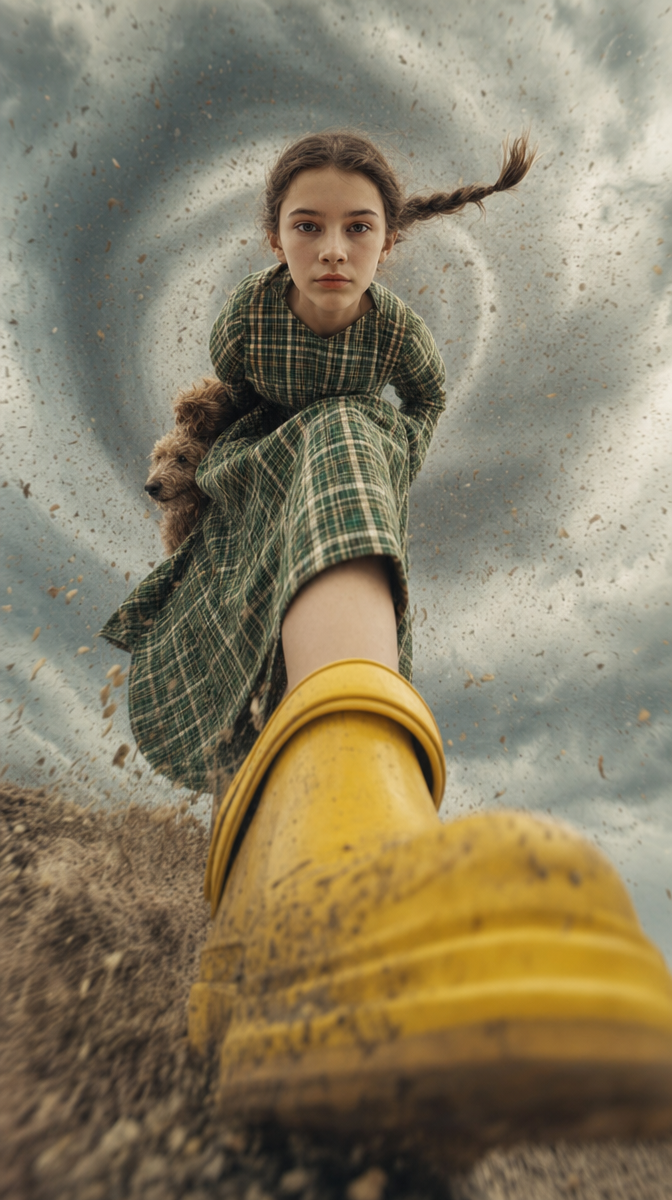
Young girl with dog in tornado
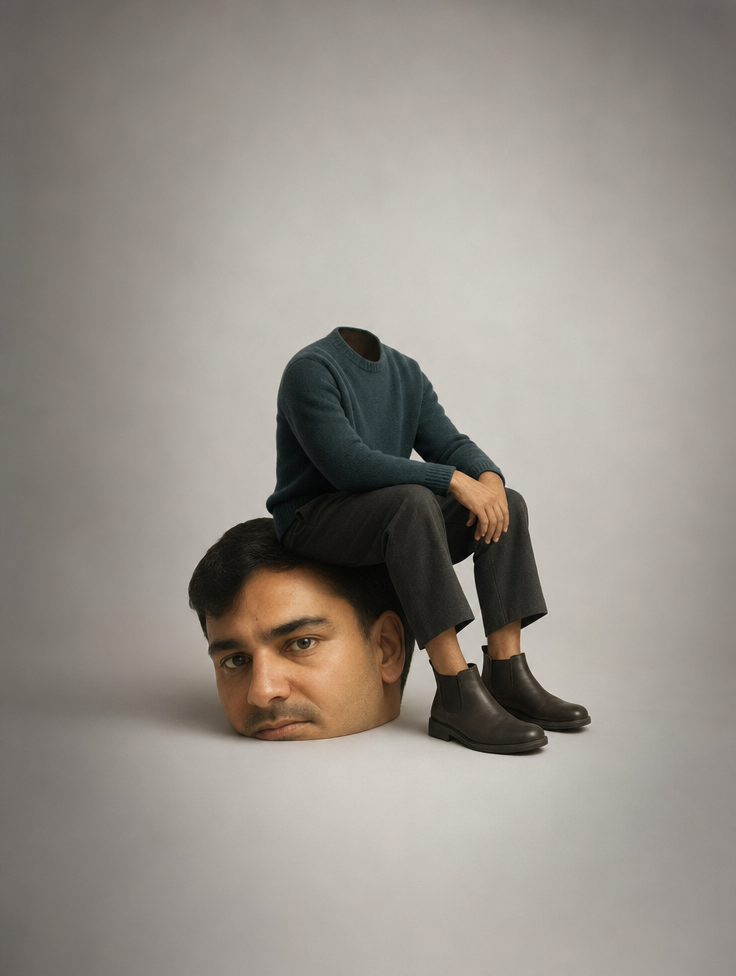
Headless sitter atop a giant head
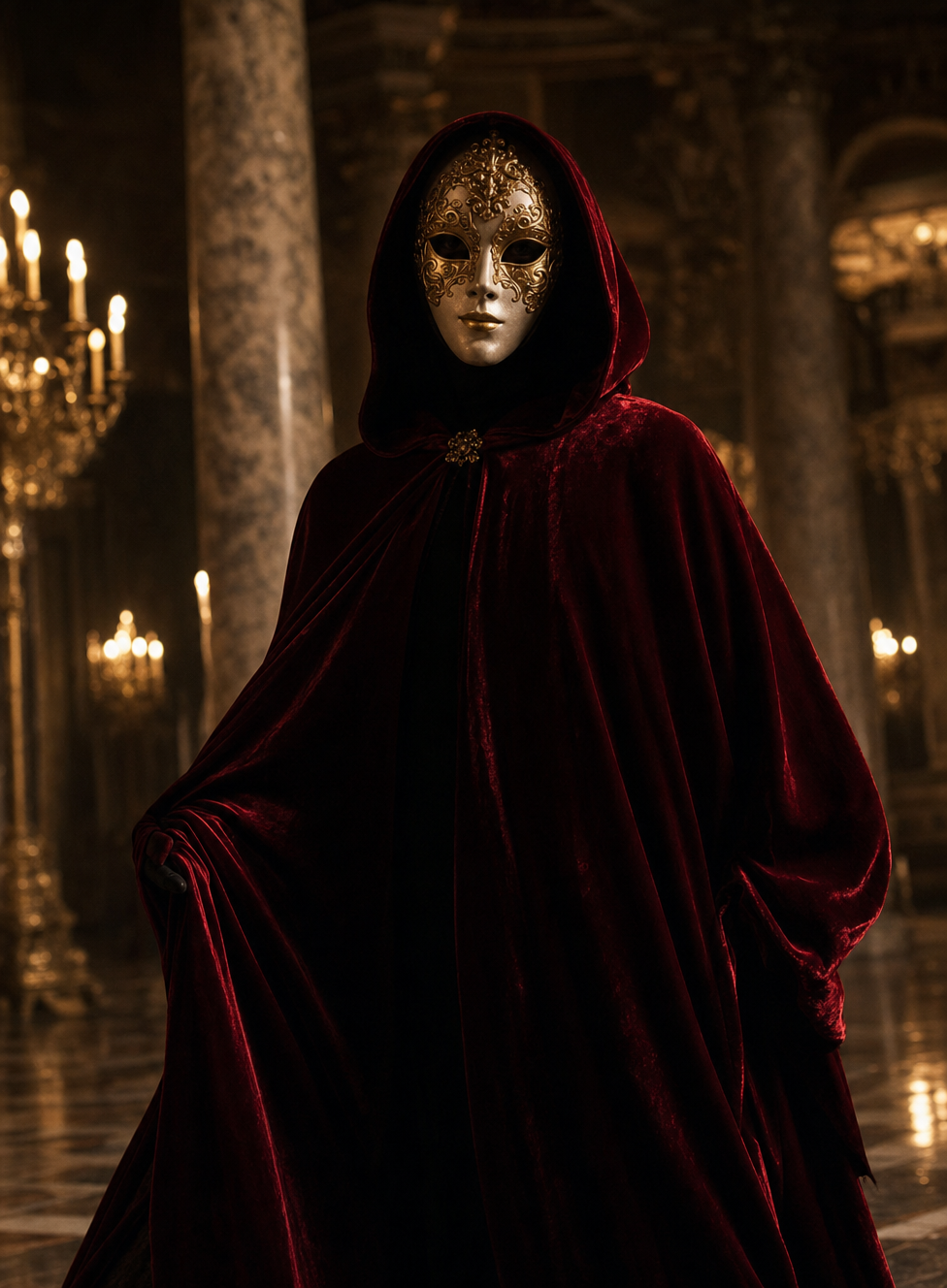
Crimson-Cloaked Specter in Candlelit Ballroom

Violet Holographic Hands Almost Touching