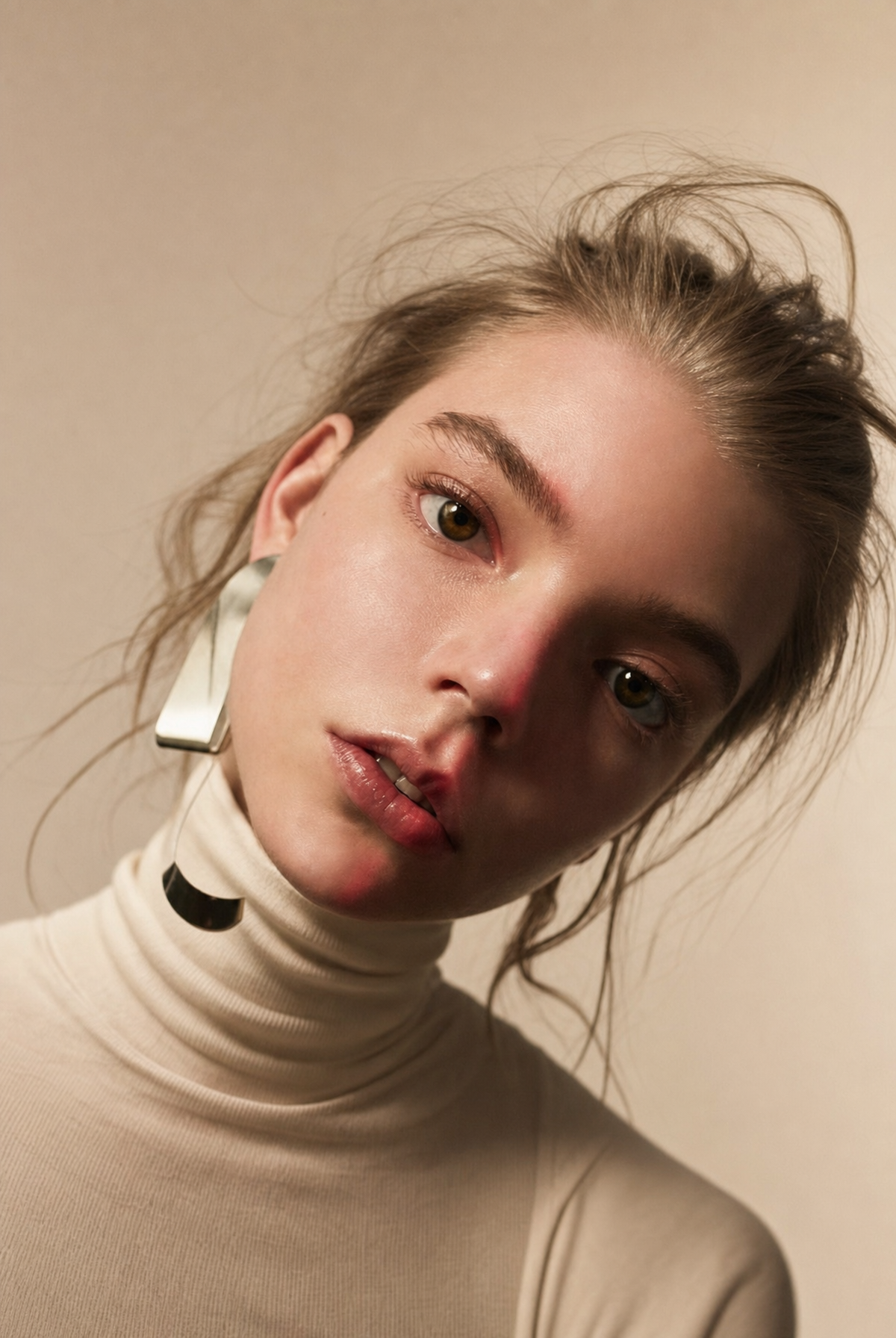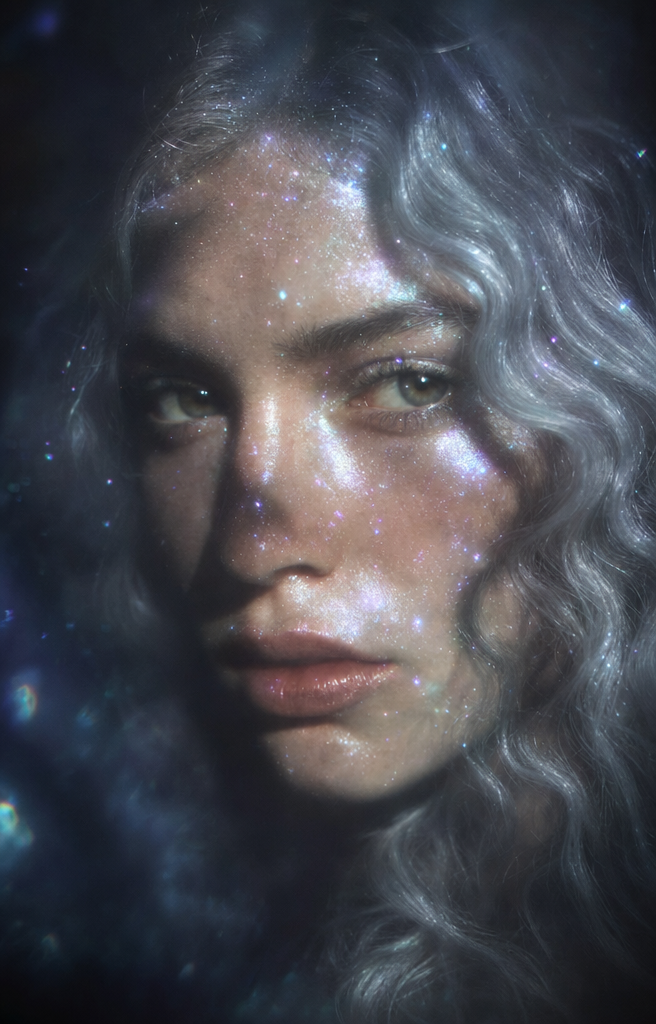
Why this works
“Tight close-up face framing” makes the woman’s face and hyperreal skin texture the clear focal point, while “gentle soft-focus background bokeh” keeps the cosmic setting subordinate. The dreamy, mysterious tone comes from the combination of “faint violet and cyan cosmic particles,” “thin mist around her face,” and “subtle refraction light effects,” with “dramatic low-key cinematic lighting with soft shadows” adding controlled contrast. “Long wavy silver hair” and the image’s dominant gray-and-white palette create a cool, coherent visual harmony against the restrained violet and cyan accents.
FAQ
→How do I make the cosmic particles and mist more prominent than the face?
Replace “Tight close-up face framing” with “medium close-up portrait with visible shoulders and surrounding space,” and change “faint cosmic particles” and “thin mist” to “dense swirling violet and cyan cosmic particles filling the frame” and “radiant layered nebula mist encircling her entire body.” Keep “soft-focus background bokeh” if you want the woman to remain readable while enlarging the environment.
→How do I shift this from mysterious and cool to warm, enchanted, and romantic?
Replace “faint violet and cyan cosmic particles” with “soft rose, peach, and warm gold cosmic particles,” and change “dramatic low-key cinematic lighting” to “warm diffused key light with gentle golden rim lighting.” For a clearer romantic expression, replace “mysterious mood” with “tender, hopeful romantic mood” and “soft shadows” with “delicate luminous shadows.”
→How do I build a consistent series with different fairy-like characters?
Keep the fixed anchors “photorealistic surreal sci-fi portrait,” “tight close-up face framing,” “hyperreal skin and hair texture,” and “gentle soft-focus background bokeh.” Create variations by replacing “fairy-like woman with long wavy silver hair” with specific subjects such as “androgynous forest elf with braided copper hair” or “blue-skinned lunar fairy with short white hair,” while assigning each version a controlled particle palette such as “emerald and teal” or “indigo and magenta.”
Learn the technique behind this
- Why can't AI spell, and how do I get readable text in an image? — Older diffusion models had no character-level representation of text, so they produced letterform-shaped texture instead of words.
- How do I keep the same character across multiple images? — Text prompts alone won't hold a face across images — a description defines a type, not a person.
- How should a prompt be structured, and does word order matter? — A prompt that behaves predictably names one subject first, then what it is doing, then where, then the light, then the lens or medium, then the style.
Related prompts
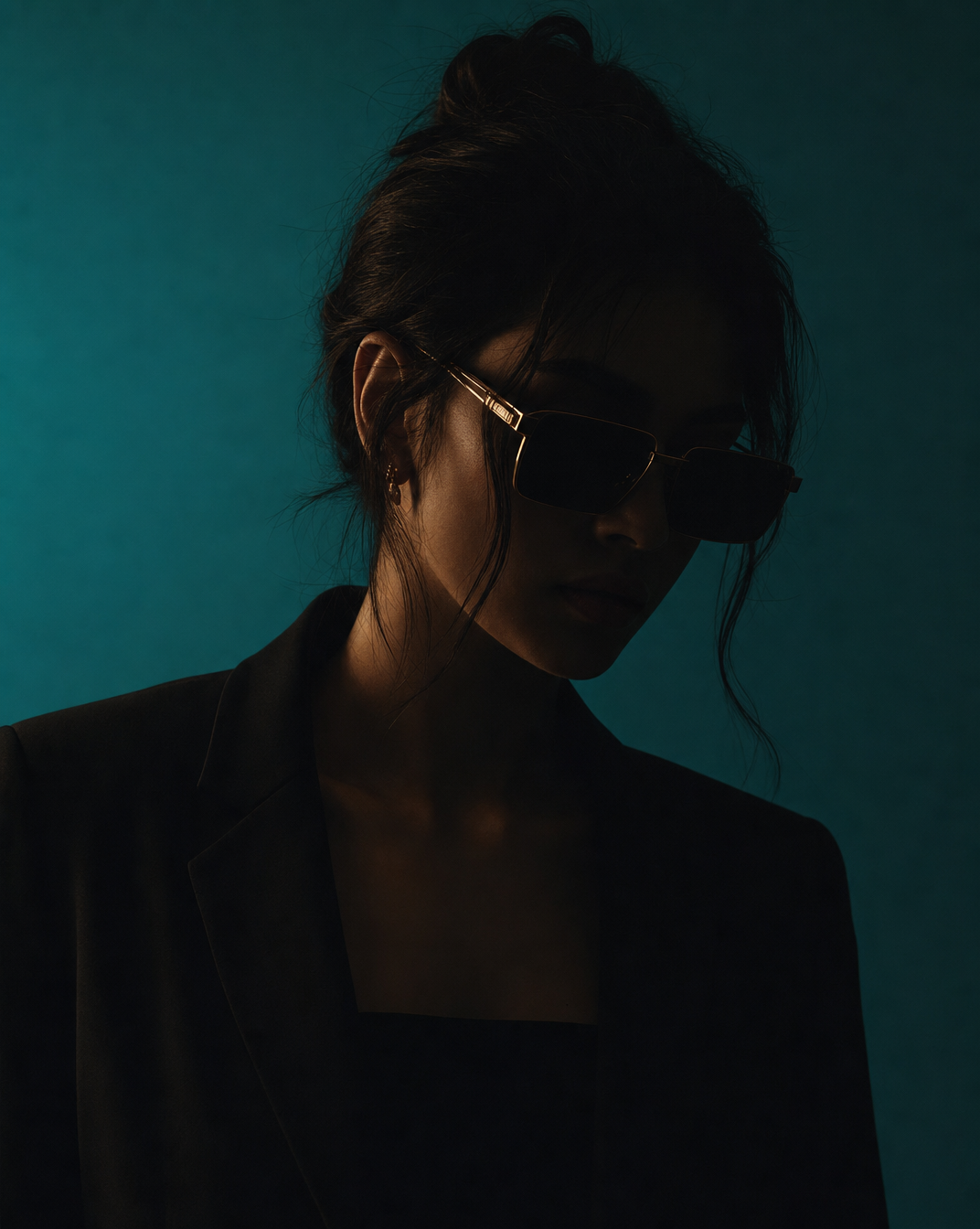
Woman in Teal Light, Shadowed Fashion Portrait
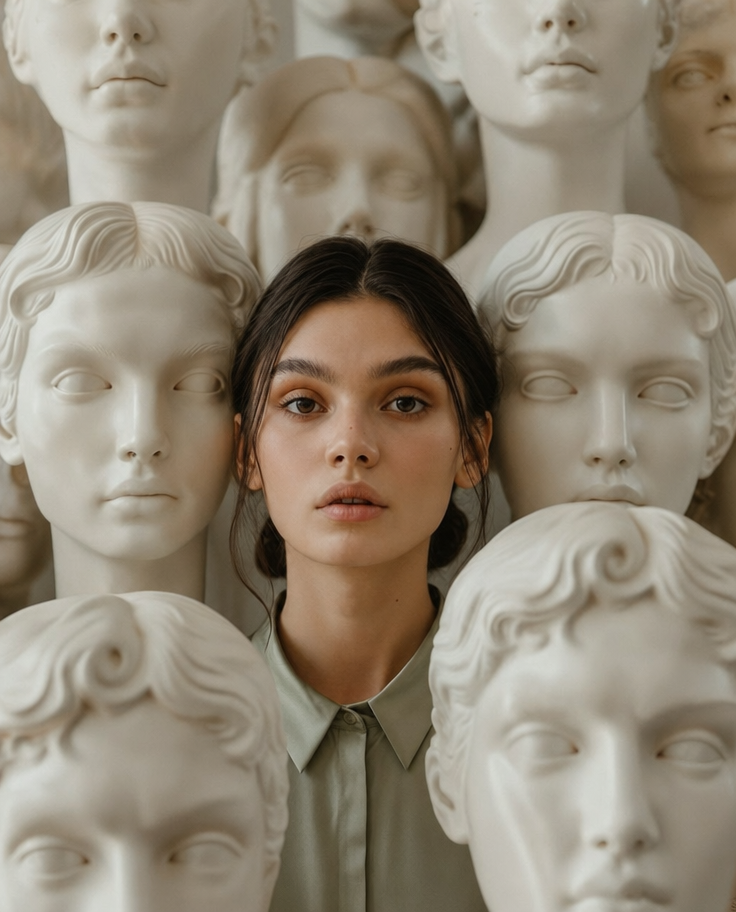
Eerie Elegance Among Marble Busts
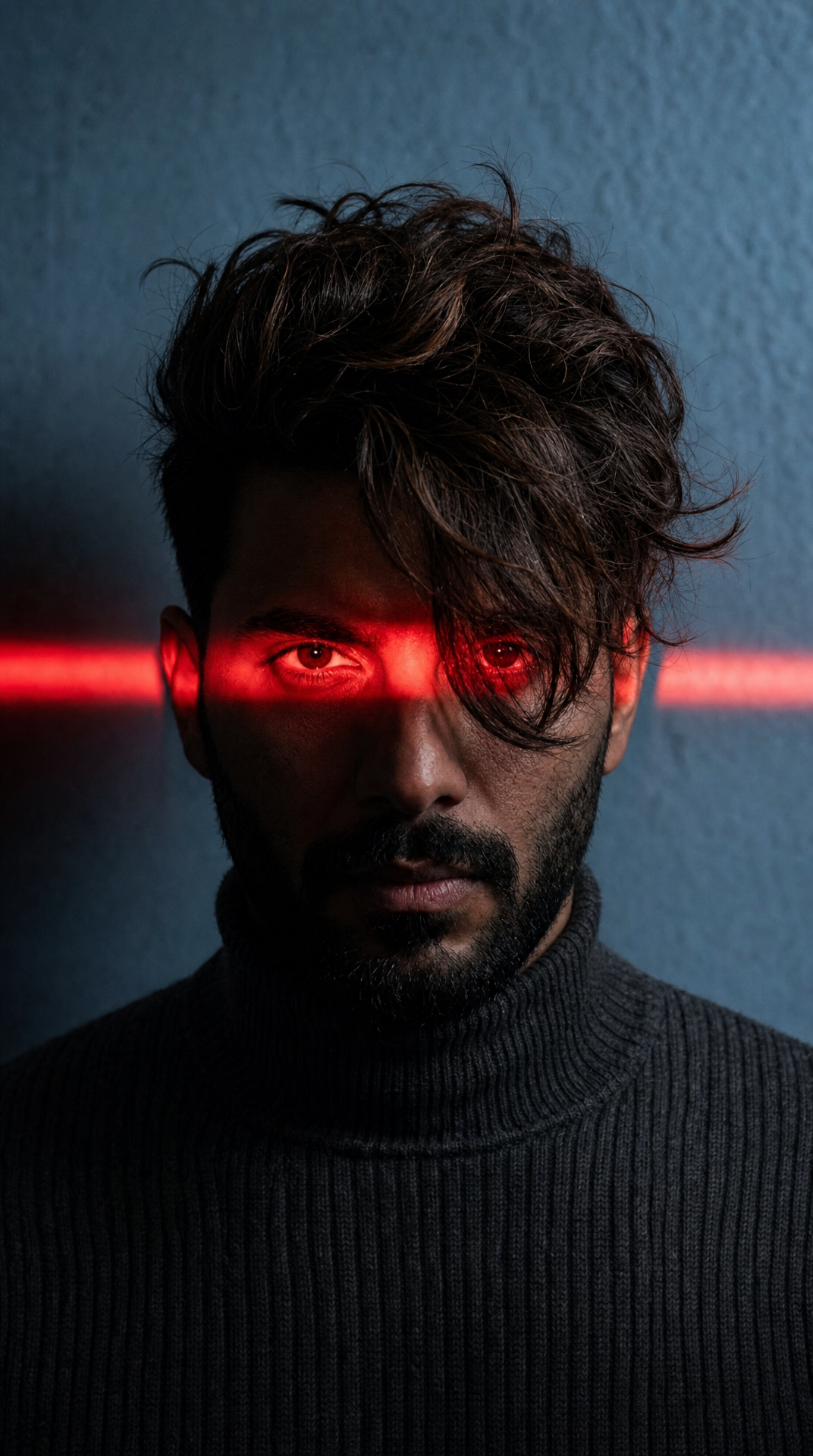
Charcoal turtleneck with red eye-beam
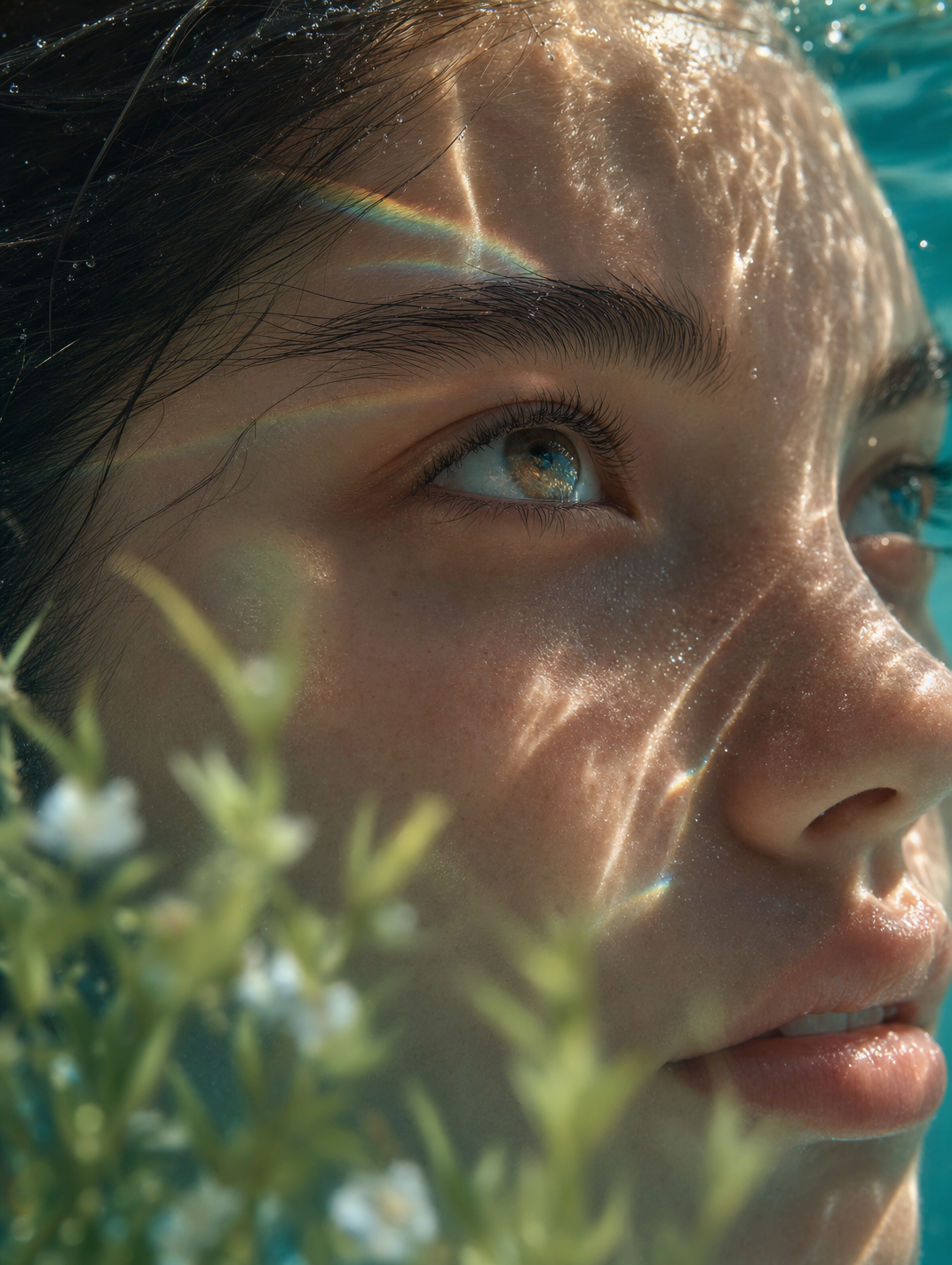
Dreamy Macro Portrait in Cool Water