Why this works
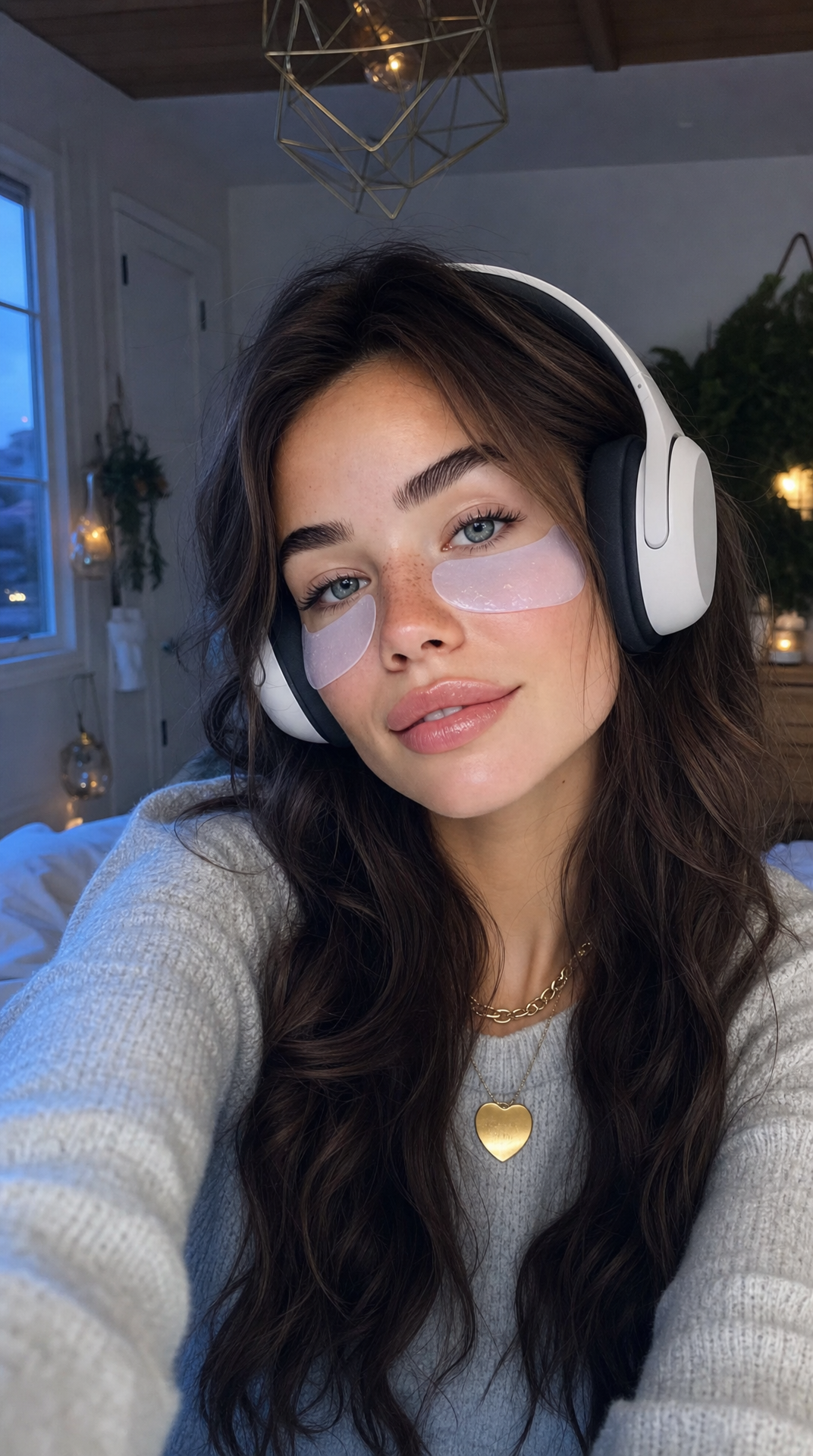
The intimate framing comes directly from “hyperrealistic close-up portrait” and “shallow depth of field,” which keep the woman’s face dominant while reducing the tidy bed, plants, and geometric ceiling light to soft context. The calm, cozy mood is pinned by “soft evening window light with a cooler blue tint” balanced against “warm indoor ambient light,” while the brown hair and neutral bedroom sit between the image’s cool blue highlights and white-gray clothing. “Ultra-detailed skin,” “subtle freckles,” and “softly glossy lips” give the close portrait tactile realism without disrupting the relaxed lifestyle-photography tone.
FAQ
→How do I make the headphones and lavender under-eye patches more visually central?
Replace “hyperrealistic close-up portrait” with “tight beauty close-up centered on the headphones and under-eye patches,” and add “headphones and translucent lavender patches occupy the visual center.” Keep “shallow depth of field,” but change the background wording to “bedroom details dissolve into indistinct blur” so the props do not compete with her face.
→How do I shift this from calm evening relaxation to a brighter, more energetic morning mood?
Replace “soft evening window light with a cooler blue tint plus warm indoor ambient light” with “bright morning sunlight streaming through the window with crisp golden highlights.” Change “calm expression” to “fresh, alert smile” and the “warm-neutral and cool-blue color palette” to “sunny cream, pale yellow, and sky-blue palette.”
→How do I build a series of variations while keeping the same portrait style?
Keep “hyperrealistic close-up portrait,” “shallow depth of field,” “ultra-detailed skin,” and “photorealistic lifestyle photography” unchanged, then swap only the scene and accent details. For example, replace “cozy modern bedroom” with “quiet reading nook,” “translucent lavender under-eye patches” with “soft mint-green eye mask,” and “soft evening window light” with “overcast afternoon window light” to create a related variation with a cooler, quieter setting.
Learn the technique behind this
- Why can't AI spell, and how do I get readable text in an image? — Older diffusion models had no character-level representation of text, so they produced letterform-shaped texture instead of words.
- How should a prompt be structured, and does word order matter? — A prompt that behaves predictably names one subject first, then what it is doing, then where, then the light, then the lens or medium, then the style.
- Why does AI get hands and faces wrong, and how do I fix it? — Hands fail because they're small in frame, extremely variable in pose, and self-occluding — the model has less usable signal per pixel than for any other body part.
Related prompts
Woman in Teal Light, Shadowed Fashion Portrait
Eerie Elegance Among Marble Busts
Charcoal turtleneck with red eye-beam
Dreamy Macro Portrait in Cool Water