Why this works
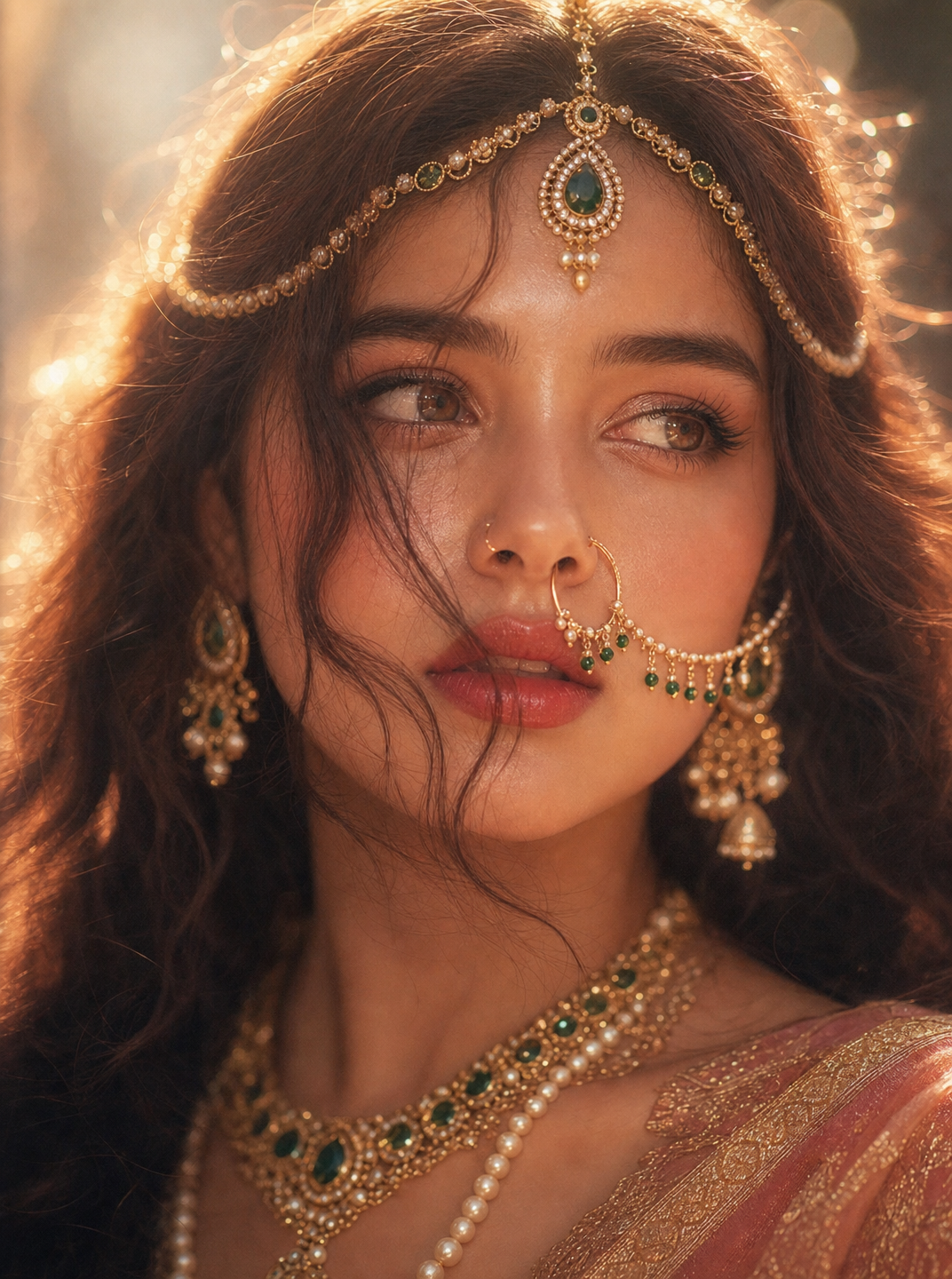
The close framing is anchored by “Close-up, photorealistic portrait,” keeping the woman’s face, jeweled headpiece, nose-ring chain, and white cheek-and-brow adornment dominant. “Warm backlight flares behind her,” “golden bokeh,” and “shallow depth of field” produce the dreamy romantic atmosphere, while the gold jewelry and “layered emerald-and-pearl necklaces” create a controlled gold, beige, pink, and green palette. “Ultra-real skin texture” and “high-end portrait photography” counterbalance the ethereal glow with tactile facial detail.
FAQ
→How do I change this prompt to make the jewelry more prominent?
Replace “Close-up portrait framing” with “tight head-and-shoulders crop with jewelry filling the lower frame,” and add “sharp focus on the ornate gold headpiece, jeweled forehead ornament, nose-ring chain, earrings, and layered emerald-and-pearl necklaces.” Keep “shallow depth of field,” but specify “face and jewelry in crisp focus, background fully blurred.”
→How do I make the portrait feel more regal and less dreamy?
Replace “romantic, ethereal atmosphere” and “dreamy cinematic glow” with “majestic, formal royal portrait atmosphere,” and change “Warm backlight flares behind her” to “controlled frontal key light with subtle gold rim light.” Replace “golden bokeh” with “dark neutral studio background” to reduce the soft, romantic haze.
→How do I build a matching series with different bridal traditions?
Keep “Close-up, photorealistic portrait,” “ultra-real skin texture,” and “high-end portrait photography” unchanged, then replace “young South Asian woman in traditional bridal attire” and the listed jewelry with a new subject block such as “young Japanese bride in layered white shiromuku with a traditional kanzashi hair ornament.” Swap “emerald-and-pearl necklaces” and “subtle white face adornment” for culture-specific accessories while retaining “warm golden backlight,” “golden bokeh,” and “shallow depth of field” for visual consistency.
Learn the technique behind this
- How should a prompt be structured, and does word order matter? — A prompt that behaves predictably names one subject first, then what it is doing, then where, then the light, then the lens or medium, then the style.
- Why can't AI spell, and how do I get readable text in an image? — Older diffusion models had no character-level representation of text, so they produced letterform-shaped texture instead of words.
- Why does AI get hands and faces wrong, and how do I fix it? — Hands fail because they're small in frame, extremely variable in pose, and self-occluding — the model has less usable signal per pixel than for any other body part.
Related prompts
Woman in Teal Light, Shadowed Fashion Portrait
Eerie Elegance Among Marble Busts
Charcoal turtleneck with red eye-beam
Dreamy Macro Portrait in Cool Water