Why this works
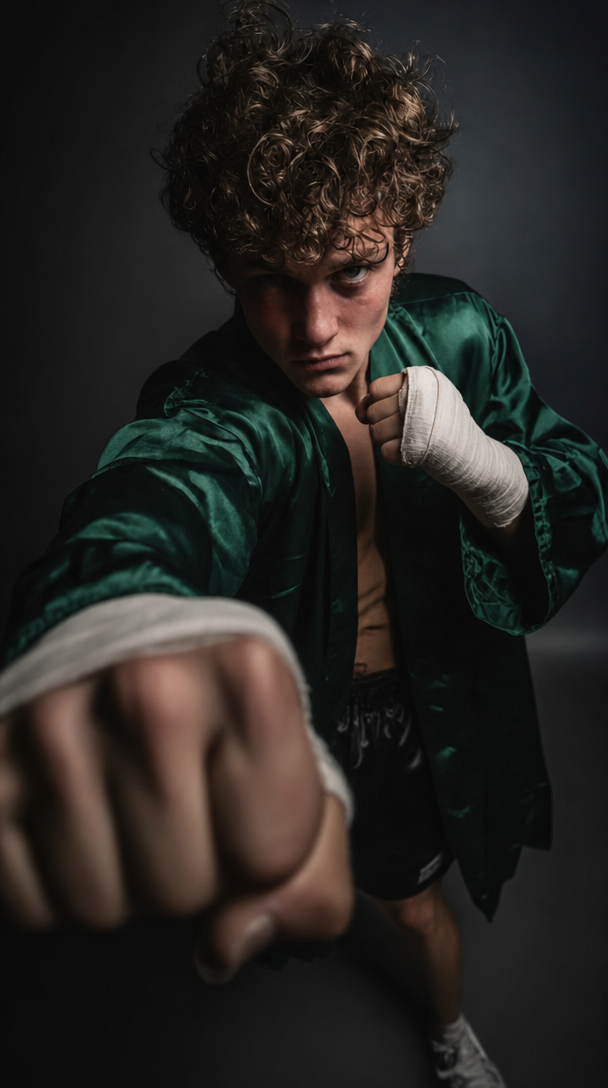
“One fist thrust toward the camera” and the “lower angle” make the boxer feel physically imposing, while the close portrait framing keeps that foreshortened fist as the immediate focal point. The “deep emerald satin robe” supplies the dominant green against the “dark moody studio background,” and “cinematic rim lighting and soft key light” separates the curly-haired silhouette while preserving the gray-black shadow structure. “Shallow depth of field” pushes the background and parts of the full-body pose out of focus, and “ultra-detailed skin and fabric texture” gives the wraps, robe, and face tactile realism.
FAQ
→How do I make the boxer’s face more central than the forward fist?
Replace “one fist thrust toward the camera” with “fist held beside the face, face as the primary focal point,” and replace “close studio portrait framing” with “tight head-and-torso portrait framing.” Keep “lower angle” for authority, but change “shallow depth of field” to “sharp focus on both eyes and facial expression” so the face remains crisp.
→How do I change the intense mood into a polished fashion-editorial portrait?
Replace “aggressive fighting stance” with “relaxed upright stance with one hand resting at the waist,” and “dark moody studio background” with “clean charcoal-gray studio backdrop.” Swap “strong contrast, dramatic shadows” for “even softbox lighting with gentle shadow falloff,” while keeping “deep emerald satin robe” to retain the green color anchor.
→How do I build a matching series with different robe colors and poses?
Keep the fixed structure “dramatic photorealistic studio portrait,” “young male boxer with curly hair,” “lower angle,” and “cinematic rim lighting and soft key light.” Create variants by replacing “deep emerald satin robe” with “cobalt blue satin robe,” “burnt orange satin robe,” or “crimson satin robe,” and replace “one fist thrust toward the camera” with “guard raised near the chin,” “both fists at the chest,” or “side-on defensive stance.”
Learn the technique behind this
- Why can't AI spell, and how do I get readable text in an image? — Older diffusion models had no character-level representation of text, so they produced letterform-shaped texture instead of words.
- How should a prompt be structured, and does word order matter? — A prompt that behaves predictably names one subject first, then what it is doing, then where, then the light, then the lens or medium, then the style.
- Which camera and lighting terms actually change an AI image? — Focal length, aperture, light direction and time of day change the image reliably because they correlate with real photographic patterns in the training data.
Related prompts
Woman in Teal Light, Shadowed Fashion Portrait
Eerie Elegance Among Marble Busts
Charcoal turtleneck with red eye-beam
Dreamy Macro Portrait in Cool Water