Why this works
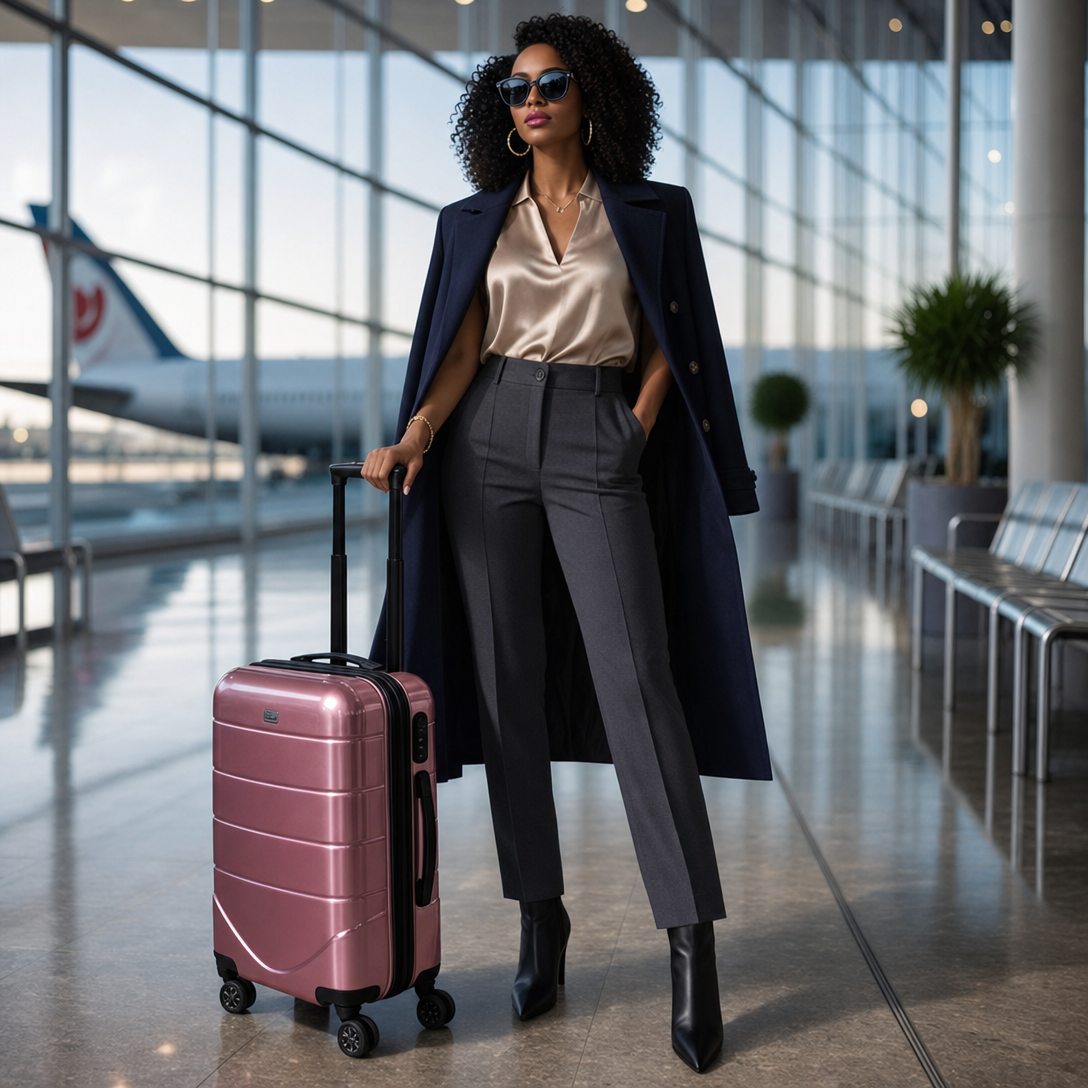
The phrase “full-body composition” gives the woman, black heeled ankle boots, tailored charcoal trousers, and pink suitcase room to read as a complete fashion silhouette, while “standing beside” establishes the suitcase as a clear secondary anchor. “Sleek glass architecture” and a “glossy reflective floor” create the polished airport geometry, reinforced by “soft natural daylight” rather than hard contrast. The navy coat, charcoal trousers, black boots, and dark sunglasses explain the image’s dominant black-and-blue balance, while “shallow depth of field” keeps that structured terminal from competing with the subject.
FAQ
→How do I make the pink suitcase more central and visually prominent?
Replace “standing beside a pink hard-shell rolling suitcase” with “standing with one hand resting on a large pink hard-shell rolling suitcase in the foreground,” and add “the suitcase occupies the lower-right third of the frame.” Keep “full-body composition” so the styling remains visible.
→How do I shift this from polished luxury to a warmer, more inviting travel mood?
Replace “soft natural daylight” with “warm golden-hour sunlight streaming through the terminal windows,” and change “confident elegant polished mood” to “relaxed, welcoming, quietly optimistic mood.” For a stronger color shift, replace the “navy long coat” with “camel wool long coat” while retaining the champagne blouse.
→How do I create a series of destination variations from this prompt?
Keep the clothing, camera, and style phrases unchanged, then replace “modern airport terminal with sleek glass architecture and glossy reflective floor” with specific settings such as “sunlit European train station with arched steel windows,” “minimalist hotel lobby with travertine walls,” or “rooftop helipad overlooking a coastal city.” Change “pink hard-shell rolling suitcase” to a setting-matched prop, such as “structured leather weekender” for the hotel lobby or “compact vintage suitcase” for the train station.
Learn the technique behind this
- Why can't AI spell, and how do I get readable text in an image? — Older diffusion models had no character-level representation of text, so they produced letterform-shaped texture instead of words.
- How should a prompt be structured, and does word order matter? — A prompt that behaves predictably names one subject first, then what it is doing, then where, then the light, then the lens or medium, then the style.
- Why does AI get hands and faces wrong, and how do I fix it? — Hands fail because they're small in frame, extremely variable in pose, and self-occluding — the model has less usable signal per pixel than for any other body part.
Related prompts
Tiny wanderer in pastel sunrise meadow

Quiet desk on a cliff terrace
Luxury yacht near chalk cliffs at dusk
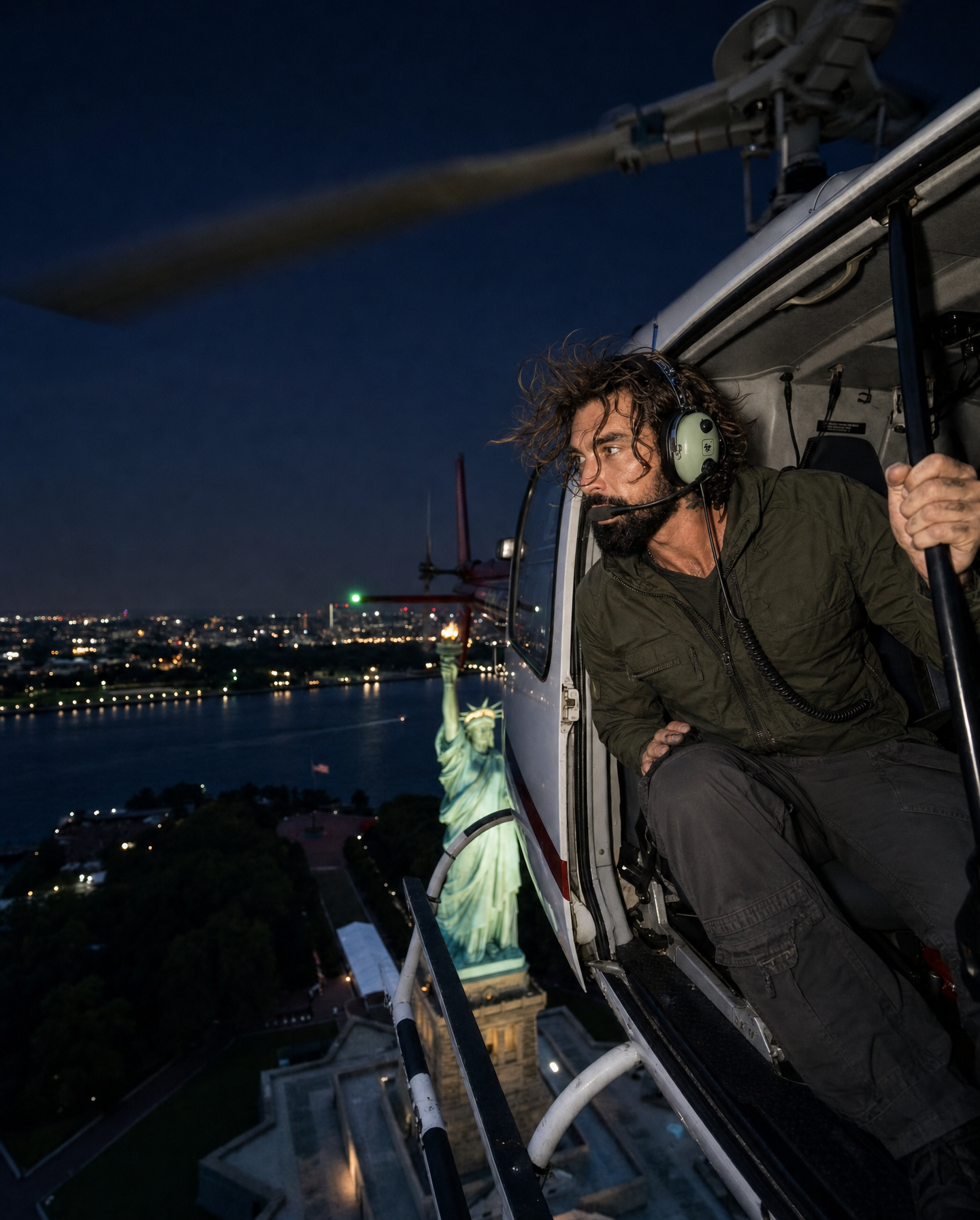
Night Helicopter Escape Over New York