Why this works
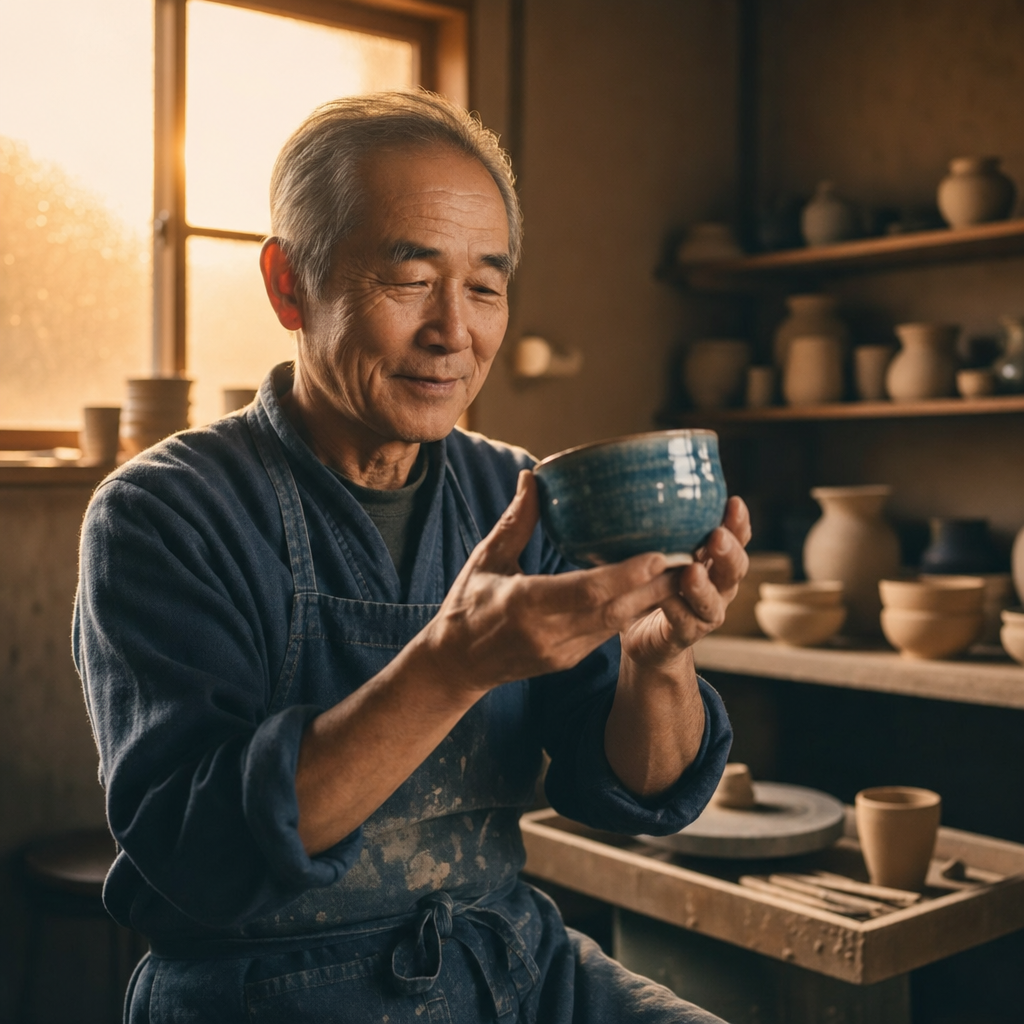
“Elderly Asian potter” and “gently holding a handcrafted blue-green glazed bowl and admiring its sheen” create the serene, contemplative narrative, while “intimate authentic atmosphere” reinforces its quiet emotional tone. “Warm late-afternoon window light” supplies the beige warmth visible across the rustic workshop, contrasting with the bowl’s blue-green glaze for a restrained color harmony. “Photorealistic portrait framing,” “shallow depth of field emphasizing hands and bowl,” and “background shelves show handmade pottery with gentle blur” keep the full-body portrait readable while directing attention to the hands and bowl; “ultra-detailed hands and realistic skin texture” makes that focal interaction tactile.
FAQ
→How do I make the blue-green bowl more prominent than the potter?
Replace “photorealistic portrait framing” with “medium close-up centered on the bowl and hands,” and change “shallow depth of field emphasizing hands and bowl” to “extreme shallow depth of field with the bowl as the sharpest focal point.” Add “bowl occupying the central foreground” after the subject description.
→How do I shift the scene from serene contemplation to a warmer, more joyful mood?
Replace “serene contemplative mood” and “intimate authentic atmosphere” with “quietly joyful, proud mood and welcoming workshop atmosphere.” Change “soft cinematic shadows” to “gentle glowing window light with subtle highlights on the potter’s face,” while retaining “warm late-afternoon window light” to preserve the existing beige warmth.
→How do I create a series of variations without losing the workshop’s visual identity?
Keep “rustic ceramic workshop,” “warm late-afternoon window light,” “natural color palette,” and “subtle filmic contrast” fixed. Vary only “handcrafted blue-green glazed ceramic bowl” into alternatives such as “amber-glazed vase,” “cream stoneware cup,” or “deep red sculptural pitcher,” and replace “admiring its sheen” with actions like “turning it toward the light” or “checking its rim.”
Learn the technique behind this
- Why can't AI spell, and how do I get readable text in an image? — Older diffusion models had no character-level representation of text, so they produced letterform-shaped texture instead of words.
- How should a prompt be structured, and does word order matter? — A prompt that behaves predictably names one subject first, then what it is doing, then where, then the light, then the lens or medium, then the style.
- Why does AI get hands and faces wrong, and how do I fix it? — Hands fail because they're small in frame, extremely variable in pose, and self-occluding — the model has less usable signal per pixel than for any other body part.
Related prompts
Woman in Teal Light, Shadowed Fashion Portrait
Eerie Elegance Among Marble Busts
Charcoal turtleneck with red eye-beam
Dreamy Macro Portrait in Cool Water