Why this works
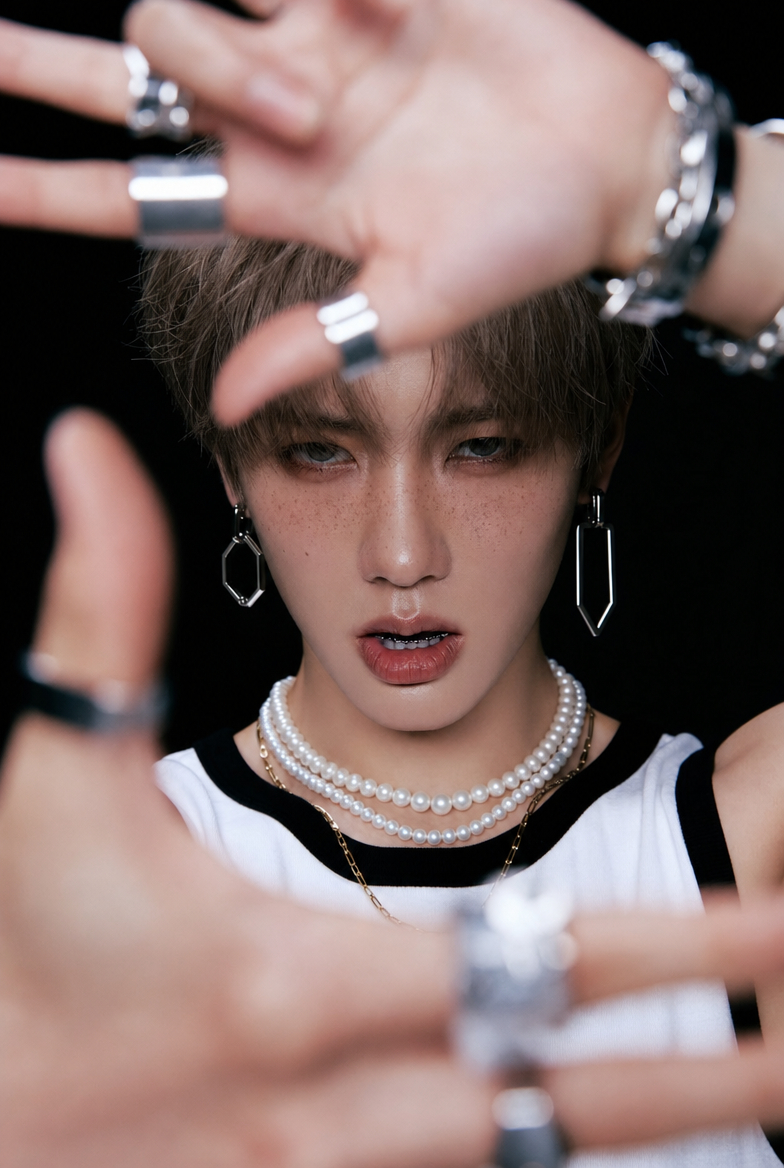
The “close-up studio portrait” and “hands raised in the foreground framing the face” create an intimate, graphic composition, while “sharp focus” keeps both the facial details and chunky silver rings visually legible. The “minimal black background” isolates the model and makes the beige, brown, gray, and white palette of the ash-brown hair, skin, pearls, and silver jewelry read with strong tonal separation. “High-contrast editorial lighting with crisp specular highlights on jewelry” supplies the dramatic, edgy mood by turning the earrings, glossy lips, rings, and thin gold chain into deliberate points of emphasis rather than relying on the black background alone.
FAQ
→How do I make the jewelry more central and prominent?
Replace “hands raised in the foreground framing the face” with “hands raised close to the lens, rings dominating the foreground while the face remains visible,” and change “crisp specular highlights on jewelry” to “hard, concentrated highlights on the earrings, layered pearls, gold chain, and silver rings.”
→How do I make the portrait softer and less aggressive while keeping the fashion-editorial look?
Replace “high-contrast editorial lighting” and “dramatic, edgy high-fashion mood” with “soft diffused studio lighting” and “quiet, refined high-fashion mood.” Change “minimal black studio background” to “warm light-gray studio background” to reduce the stark tonal contrast around the face and jewelry.
→How do I build a coordinated series of variations from this portrait?
Keep “young androgynous fashion model,” “short ash-brown hair,” “layered pearls with a thin gold chain necklace,” and “modern streetwear fashion aesthetic” fixed, then swap only the pose and background: use “one hand touching the jaw” with “textured charcoal background,” “profile view with earrings emphasized” with “cool gray background,” or “hands lowered, shoulders squared” with “off-white studio background.”
Learn the technique behind this
- Why does AI get hands and faces wrong, and how do I fix it? — Hands fail because they're small in frame, extremely variable in pose, and self-occluding — the model has less usable signal per pixel than for any other body part.
- Why can't AI spell, and how do I get readable text in an image? — Older diffusion models had no character-level representation of text, so they produced letterform-shaped texture instead of words.
- How should a prompt be structured, and does word order matter? — A prompt that behaves predictably names one subject first, then what it is doing, then where, then the light, then the lens or medium, then the style.
Related prompts
Woman in Teal Light, Shadowed Fashion Portrait
Eerie Elegance Among Marble Busts
Charcoal turtleneck with red eye-beam
Dreamy Macro Portrait in Cool Water