Why this works
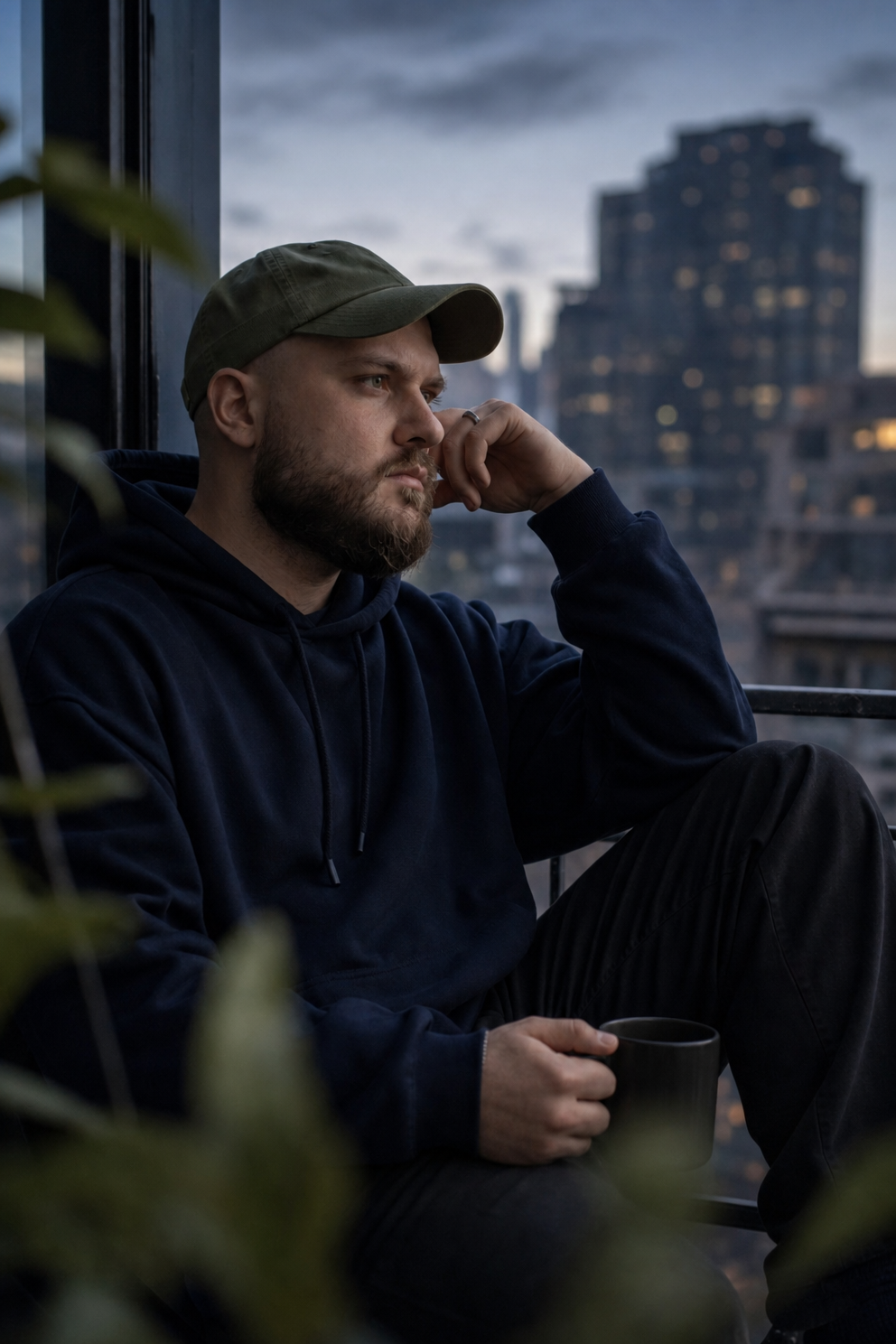
The introspective mood comes from the specific pose language, “resting his chin on his hand and looking thoughtfully to the side,” reinforced by “soft low-angle dusk ambience” and “subtle evening haze.” “Cinematic portrait framing” keeps the bearded man as the visual anchor, while “shallow depth of field with creamy bokeh” turns the skyline and foreground leaves into soft context rather than competing detail. The muted gray-and-black dominance follows “cool, muted tones,” “deep navy hoodie,” and “olive-green cap,” with “moody cinematic color grading” binding those subdued colors into a restrained editorial palette.
FAQ
→How do I change this prompt to make the portrait feel warmer and more hopeful?
Replace “cool, muted tones,” “moody cinematic color grading,” and “subtle evening haze” with “warm amber and honey-gold tones, gentle uplifting color grading, and clear sunset light.” Change “deep navy hoodie” to “soft rust or cream hoodie” and add “a faint relaxed smile” in place of “looking thoughtfully to the side.”
→How do I make the city skyline more central and prominent?
Replace “a blurred city skyline at dusk fills the background” with “a sharply detailed city skyline with illuminated windows occupies the upper two-thirds of the frame.” Change “shallow depth of field with creamy bokeh” to “moderate depth of field preserving architectural detail,” and replace “cinematic portrait framing” with “environmental portrait framing showing the man and the expansive skyline.”
→How do I build a consistent series of variations from this portrait?
Keep the fixed anchors “photorealistic editorial lifestyle photography,” “realistic skin texture,” “deep navy hoodie,” and “olive-green cap,” then vary only the scene and pose. For example, replace “seated beside a window in a modern apartment” with “standing on a rain-streaked balcony,” and replace “resting his chin on his hand” with “holding a coffee cup with both hands,” while retaining “moody cinematic color grading” and “shallow depth of field with creamy bokeh.”
Learn the technique behind this
- Why can't AI spell, and how do I get readable text in an image? — Older diffusion models had no character-level representation of text, so they produced letterform-shaped texture instead of words.
- How should a prompt be structured, and does word order matter? — A prompt that behaves predictably names one subject first, then what it is doing, then where, then the light, then the lens or medium, then the style.
- Why does AI get hands and faces wrong, and how do I fix it? — Hands fail because they're small in frame, extremely variable in pose, and self-occluding — the model has less usable signal per pixel than for any other body part.
Related prompts
Woman in Teal Light, Shadowed Fashion Portrait
Eerie Elegance Among Marble Busts
Charcoal turtleneck with red eye-beam
Dreamy Macro Portrait in Cool Water