Why this works
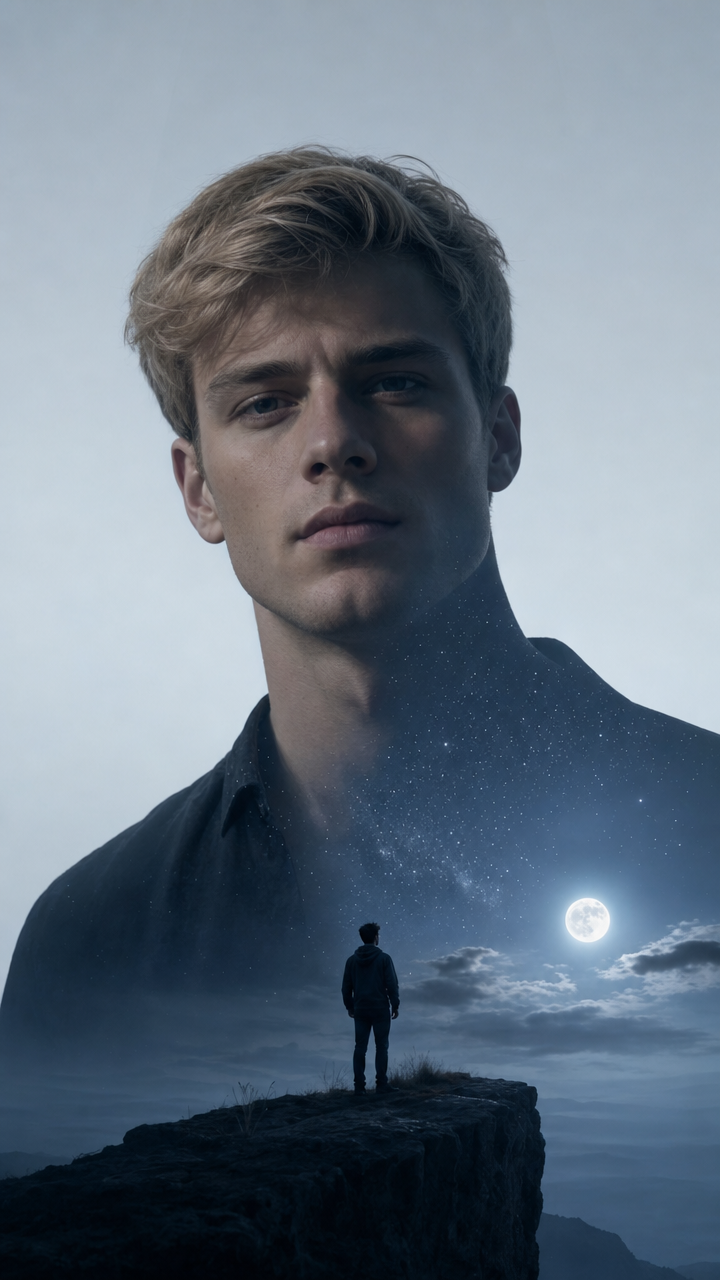
The phrase 'man's front-facing profile silhouette with short blonde hair' locks the portrait into a clean graphic shape, which is what lets the second exposure read clearly inside it rather than turning to mud. 'Solitary figure standing on a cliff edge gazing at stars' is the load-bearing line for the nostalgic, introspective mood, since it gives the silhouette an interior narrative instead of just a texture fill. 'Ethereal periwinkle sky' and 'cool blue and silver tones' are what account for the sky-blue and black dominant palette, keeping the moonlit landscape from tipping into black-and-white or warm tones. 'Luminous crescent moon' anchors the single bright focal point that pulls the eye through the portrait-closeup composition, which would otherwise feel flat without one strong light source.
FAQ
→How do I make the mood warmer and less melancholic?
Swap 'cool blue and silver tones' for 'warm amber and rose tones' and change 'ethereal periwinkle sky' to 'golden dusk sky.' You could also change 'luminous crescent moon' to 'low setting sun' so the light source itself shifts from night to golden hour.
→How do I make the cliff figure the main subject instead of the silhouette?
Move 'solitary figure standing on a cliff edge gazing at stars' to the front of the prompt and describe it with more detail, like 'a woman in a flowing coat standing at the cliff edge, gazing up at the stars, sharply lit against the horizon.' Then demote the portrait by shortening it to something like 'faintly overlaid with a man's silhouette' so it reads as the secondary texture rather than the primary shape.
→How do I build a series of variations from this same prompt?
Keep the double exposure structure and the phrase 'cool blue and silver tones' constant, then rotate the landscape half: swap 'cliff edge gazing at stars' for 'forest clearing beneath a full moon,' 'ocean shoreline under a starry sky,' or 'mountain ridge wrapped in fog.' Changing just that one setting phrase each time gives you a matched set with the same silhouette treatment and palette but a different scene inside it.
Learn the technique behind this
- Why can't AI spell, and how do I get readable text in an image? — Older diffusion models had no character-level representation of text, so they produced letterform-shaped texture instead of words.
- How should a prompt be structured, and does word order matter? — A prompt that behaves predictably names one subject first, then what it is doing, then where, then the light, then the lens or medium, then the style.
- Do negative prompts work, and what should go in one? — Negative prompts work on models that support a separate negative conditioning channel — mainly Stable Diffusion and FLUX-family models.
Related prompts
Young girl with dog in tornado
Headless sitter atop a giant head
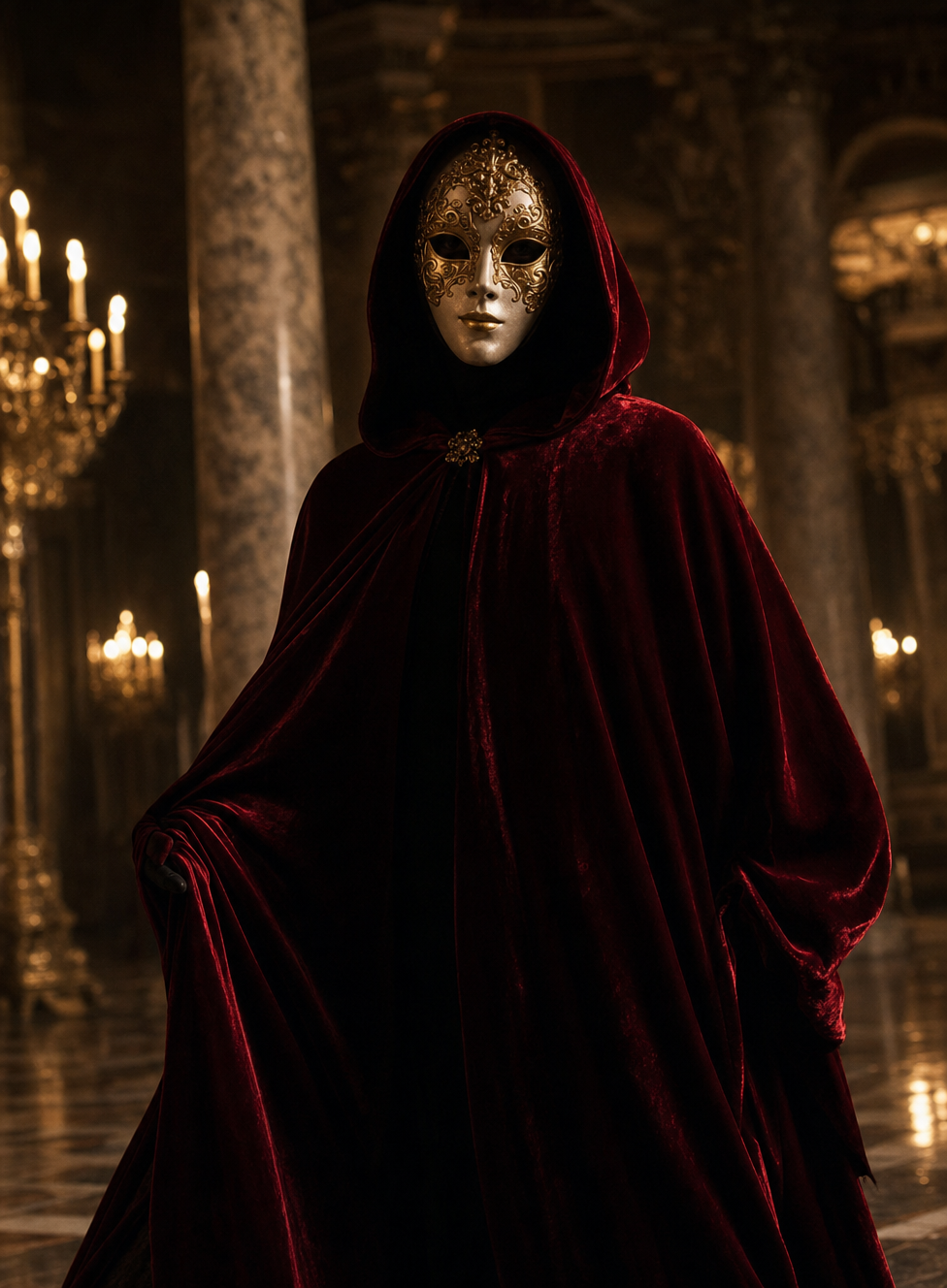
Crimson-Cloaked Specter in Candlelit Ballroom

Violet Holographic Hands Almost Touching