Why this works
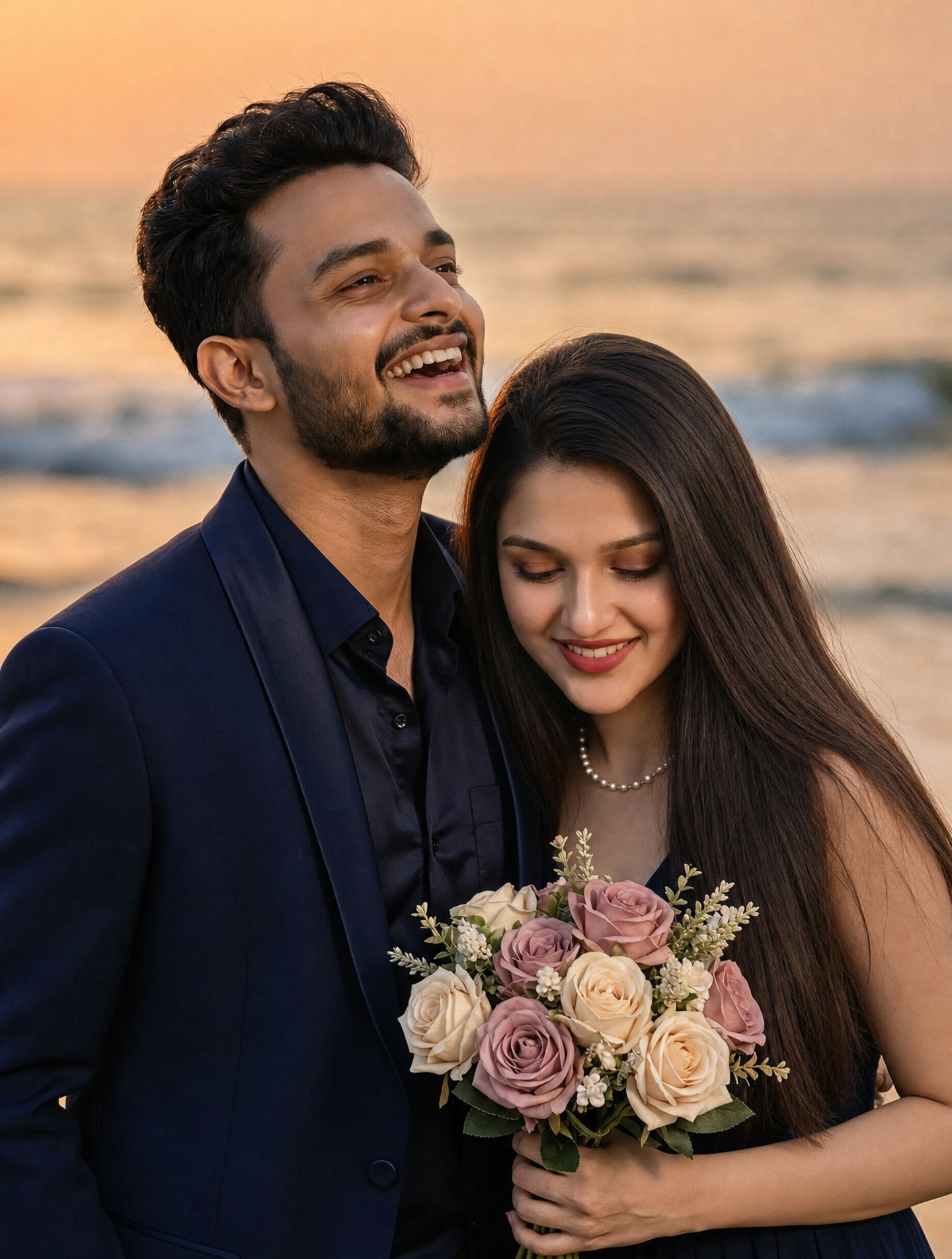
The romantic mood is anchored by the literal phrases “romantic couple,” “leaning into him,” and “warm dreamy atmosphere,” while “golden hour,” “soft amber rim light,” and “cinematic bokeh highlights” supply the glowing, nostalgic finish. “Portrait framing,” “elegant balanced framing,” and the close-up composition keep attention on the couple and bouquet rather than the beach, with “shallow depth of field” reducing the ocean horizon to a soft contextual blur. The deep navy suit, dark brown hair, dusty pink and cream roses, and natural skin tones create a restrained navy-brown-pink-white palette that reads clearly against the sandy setting.
FAQ
→How do I make the portrait feel more intimate and emotionally intense?
Replace “smiles while looking slightly upward” with “the couple gazes directly into each other’s eyes, foreheads touching, tender restrained expressions,” and change “elegant balanced framing” to “tight intimate close-up with their faces and hands filling the frame.” Keep “leaning into him” and “shallow depth of field” to preserve physical closeness and background separation.
→How do I make the bouquet more prominent?
Replace “holding a bouquet of dusty pink and cream roses” with “holding a large foreground bouquet of dusty pink and cream roses, sharply detailed and centered between their faces,” and change “portrait-closeup” to “medium close-up including both hands and the full bouquet.” Reduce “cinematic background blur” only slightly if you want the flower texture to remain crisp without losing the soft ocean backdrop.
→How do I build a different variation while keeping the same romantic style?
Swap “sandy beach with a soft blurred ocean horizon” for a specific setting such as “quiet Italian garden at sunset with flowering arches,” and replace “deep navy suit” with an outfit suited to that location, such as “cream linen suit.” Retain “warm dreamy atmosphere,” “soft amber rim light,” “natural skin tones,” and “cinematic bokeh highlights” so the new scene remains part of the same visual series.
Learn the technique behind this
- Why can't AI spell, and how do I get readable text in an image? — Older diffusion models had no character-level representation of text, so they produced letterform-shaped texture instead of words.
- How should a prompt be structured, and does word order matter? — A prompt that behaves predictably names one subject first, then what it is doing, then where, then the light, then the lens or medium, then the style.
- Which aspect ratio should I use, and how does it change the image? — Aspect ratio determines what the model composes, not how it's cropped afterwards.
Related prompts
Woman in pale blue dress in lily boat
Woman and Man in Intimate Studio Portrait
Older Couple in Tender Watercolor Embrace
Evening Garden Romance in Jewel Tones