Why this works
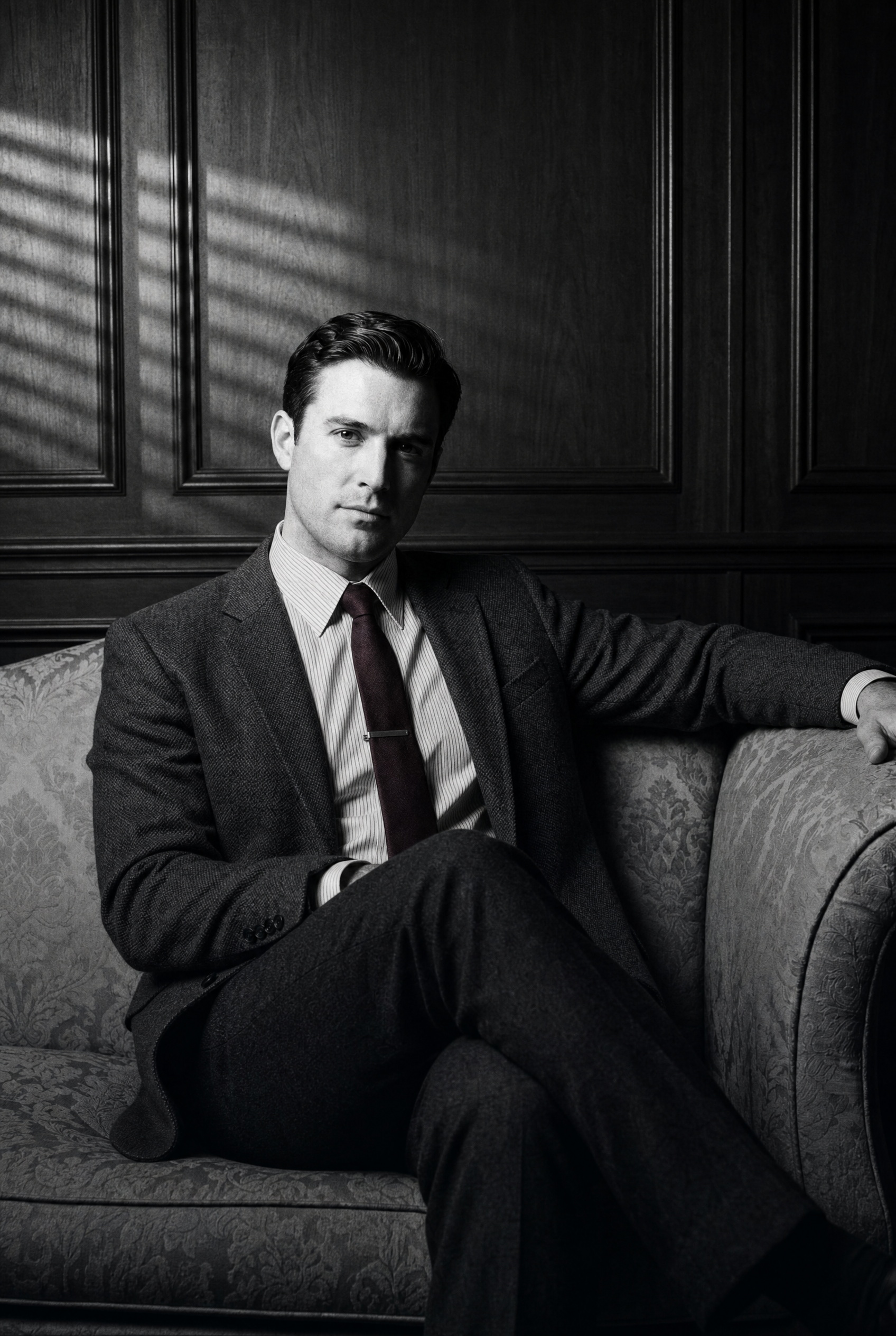
“Medium-shot” and “classic studio portrait composition” keep the seated figure dominant while “legs crossed and one arm draped casually over the backrest” gives the full-body pose a relaxed, controlled geometry. The sophisticated mood comes from “dapper,” “confident, composed expression,” “dark wood-paneled wall,” and “timeless elegant styling,” while “high-contrast black-and-white” reduces the palette to graphic blacks and whites, with the brown sofa and paneling preserved as warm visual anchors. “Stronger side light for deeper contrast” sculpts the face, and “subtle venetian-blind shadows across part of the background” adds a precise linear pattern without competing with the eyes. “Classic 50mm film photography aesthetic,” “sharp focus,” and “fine grain” balance crisp facial detail with an analog finish.
FAQ
→How do I change this prompt for a warmer, more approachable portrait?
Replace “high-contrast black-and-white” with “warm muted color photography,” change “stronger side light for deeper contrast” to “soft, even frontal light with gentle fill,” and replace “confident, composed expression” with “a relaxed, friendly smile.” Keep “dark wood-paneled wall” and the vintage sofa to retain the tailored lounge atmosphere.
→How do I make the man more visually prominent than the sofa and wall?
Replace “medium-shot” with “tight waist-up portrait,” change “vintage patterned sofa” to “minimal upholstered chair with subdued texture,” and replace “subtle venetian-blind shadows across part of the background” with “clean, shadow-free dark background.” Retain “looking directly at the camera,” “sharp focus,” and “stronger side light for deeper contrast” so attention stays on the face and clothing.
→How do I turn this into a consistent series with different subjects?
Keep the fixed framework “high-contrast black-and-white,” “classic 50mm film photography aesthetic,” “fine grain,” “soft cinematic studio lighting,” and “dark wood-paneled wall,” then swap only “a dapper man” for subjects such as “an elegant woman in a satin evening dress” or “an older jazz musician in a dark suit.” Preserve “medium-shot,” “looking directly at the camera,” and “subtle venetian-blind shadows” across each prompt so framing, eye contact, and background pattern remain consistent.
Learn the technique behind this
- Why can't AI spell, and how do I get readable text in an image? — Older diffusion models had no character-level representation of text, so they produced letterform-shaped texture instead of words.
- How should a prompt be structured, and does word order matter? — A prompt that behaves predictably names one subject first, then what it is doing, then where, then the light, then the lens or medium, then the style.
- Why does AI get hands and faces wrong, and how do I fix it? — Hands fail because they're small in frame, extremely variable in pose, and self-occluding — the model has less usable signal per pixel than for any other body part.
Related prompts
Woman in Teal Light, Shadowed Fashion Portrait
Eerie Elegance Among Marble Busts
Charcoal turtleneck with red eye-beam
Dreamy Macro Portrait in Cool Water