Why this works
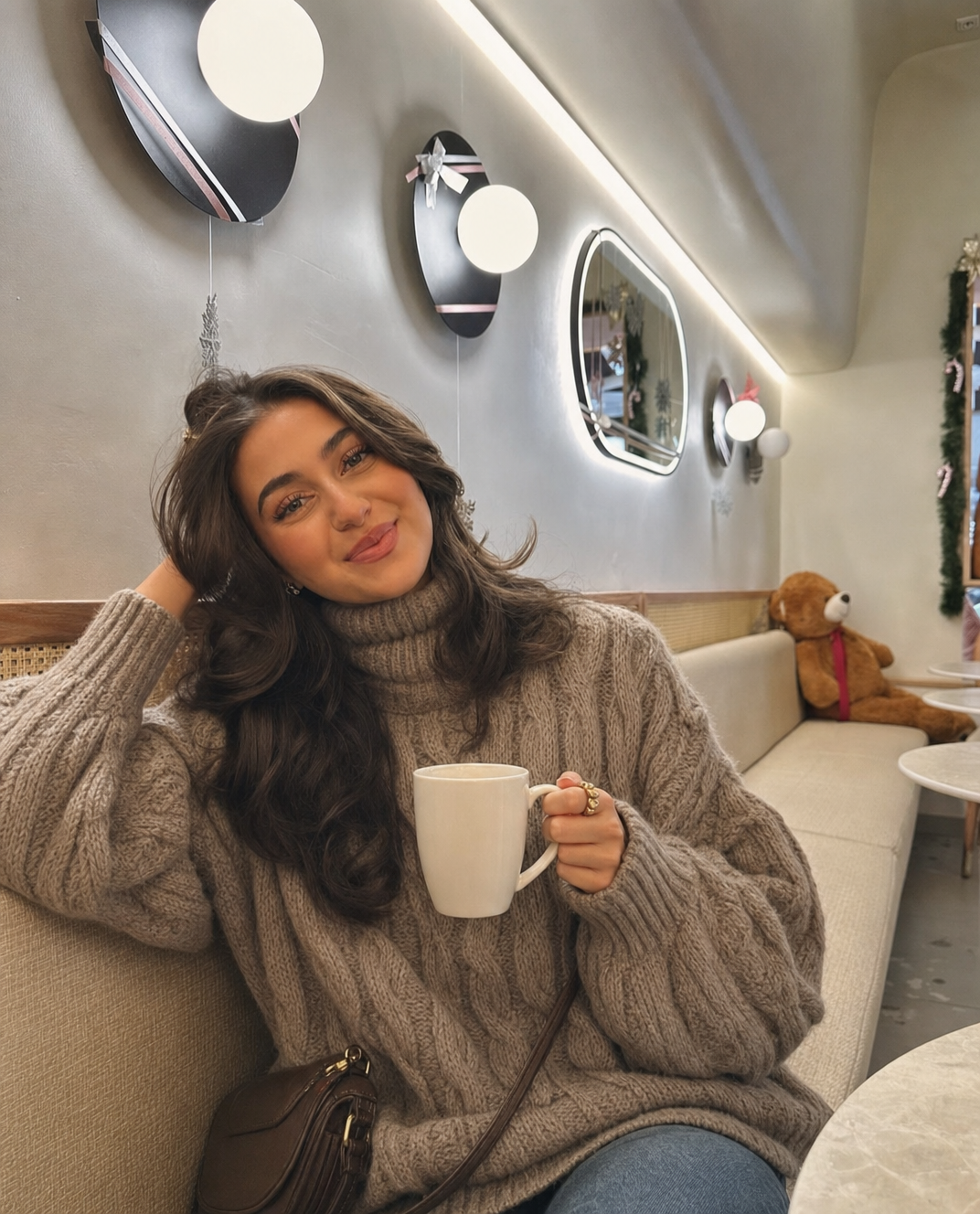
The intimate portrait-closeup comes directly from “intimate candid framing” and the seated booth arrangement, keeping the woman, mug, and sweater as the visual anchors. “Shallow depth of field” separates her from the “modern wall mirrors in the background,” while “soft ambient lighting with warm neutral tones” supports the relaxed brown, gray, and white palette without overpowering the natural skin texture. The phrases “chunky cable-knit turtleneck sweater,” “ceramic mug,” and “realistic fabric detail” supply tactile focal points that make the cozy cafe setting feel specific rather than generic.
FAQ
→How do I change this prompt to make the portrait feel brighter and more energetic?
Replace “soft ambient lighting with warm neutral tones” with “bright morning window light with crisp highlights and gentle bounce fill,” and change “warm, relaxed, cozy mood” to “fresh, lively, optimistic mood.” Keep “natural skin texture” so the stronger light does not make the portrait look overly retouched.
→How do I make the ceramic mug and the woman’s expression more prominent?
Replace “portrait-closeup” and “intimate candid framing” with “tight chest-up close-up with the ceramic mug held prominently in the foreground,” and change “shallow depth of field” to “focused eyes and mug with a softly blurred cafe background.” Add “gentle eye contact and a clearly visible subtle smile” after “smiling gently at the camera.”
→How do I build a matching series with different cafe moments?
Keep “photorealistic lifestyle portrait,” “warm neutral tones,” “natural skin texture,” and “realistic fabric detail” unchanged, then replace “seated in a cozy cafe booth holding a ceramic mug” with variations such as “standing at the cafe counter pouring coffee,” “reading a paperback beside the window,” or “walking past the cafe mirrors with a takeaway cup.” Preserve “chunky cable-knit turtleneck sweater” and the brown, gray, and white palette to keep the series visually consistent.
Learn the technique behind this
- Why can't AI spell, and how do I get readable text in an image? — Older diffusion models had no character-level representation of text, so they produced letterform-shaped texture instead of words.
- Why does the model ignore parts of my prompt? — Ignored instructions are almost always conflicts, counts, or spatial relationships — three things current models handle badly — rather than the model failing to read you.
- Which aspect ratio should I use, and how does it change the image? — Aspect ratio determines what the model composes, not how it's cropped afterwards.
Related prompts
Woman in Teal Light, Shadowed Fashion Portrait
Eerie Elegance Among Marble Busts
Charcoal turtleneck with red eye-beam
Dreamy Macro Portrait in Cool Water