Why this works
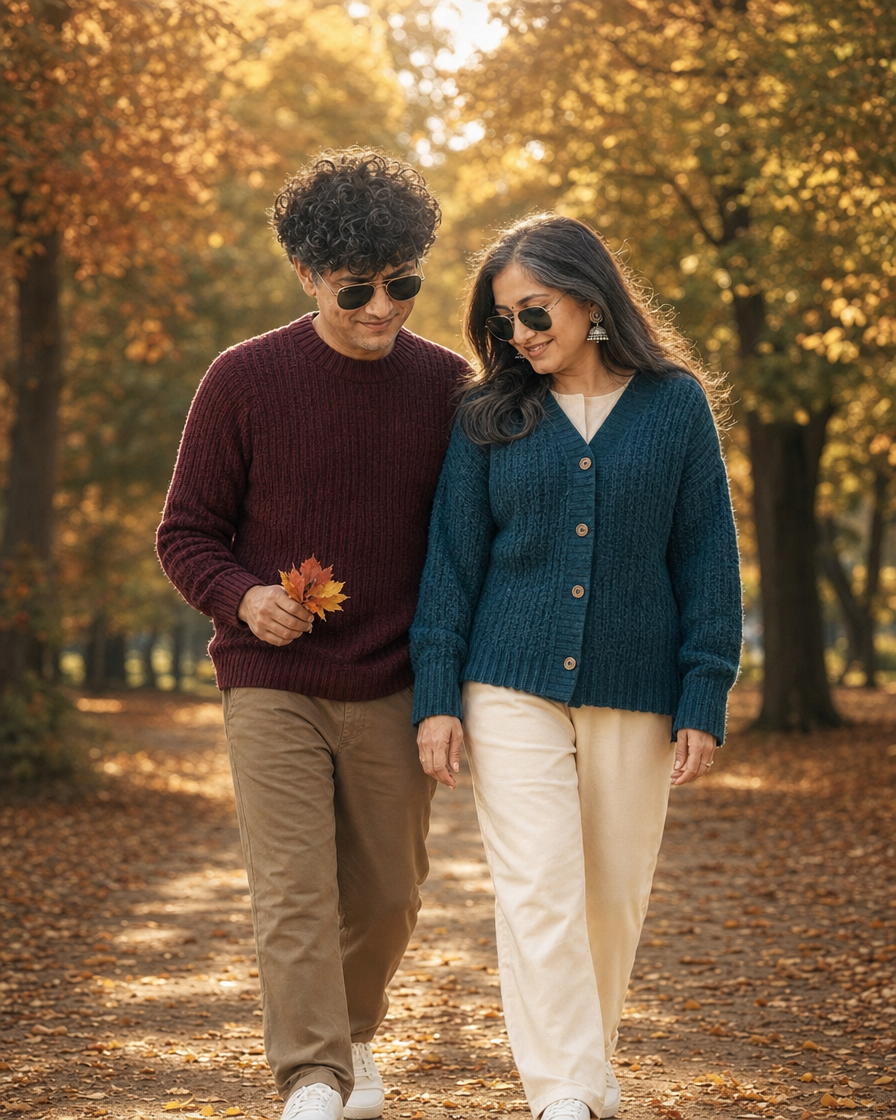
The phrase 'torn paper effect dividing a close-up portrait...above from the full-body walking shot below' is what actually builds the dual-exposure structure, not just the words 'dual exposure' alone, since it tells the generator exactly where the seam falls and what sits on each side. 'Warm golden-hour lighting filtering through leaves' is doing the color work you see in the amber and tan dominant tones, while 'teal knitted cardigan' is the one specific garment call-out that survives as the lone cool accent against all that gold. The 'peaceful expressions' and 'holding hands' phrases are what keep the candid-action composition feeling tender rather than posed, since without an emotional cue like that a walking shot defaults to neutral or generic. 'Intimate nostalgic mood' as a closing tag reinforces everything else, but it's riding on the specific wardrobe and lighting language, not replacing it.
FAQ
→How do I make the torn paper divide feel more dramatic or rougher-edged?
Change 'torn paper effect' to 'jagged, ripped paper edge effect with visible fibrous tears' and add 'rough torn seam with light bleeding through the gap' right after it. That gives the generator more to work with than the current clean, subtle division.
→How do I shift this from nostalgic-romantic to more melancholic or bittersweet?
Swap 'intimate nostalgic mood' for 'wistful, bittersweet mood, muted undertones' and change 'warm golden-hour lighting filtering through leaves' to 'fading late-afternoon light with long shadows and cooling color temperature.' Also drop 'peaceful expressions' to something like 'faces showing quiet longing' so the couple's expressions carry the shift too.
→How do I make the woman's teal cardigan the visual focal point instead of the couple as a whole?
Move 'teal knitted cardigan' earlier in the sentence right after 'woman in a' and add 'vivid teal knitted cardigan, contrasting sharply against the amber trees' before mentioning the man's outfit. You could also add 'camera slightly favoring her figure in the full-body shot below' to the camera component so the composition itself leans toward her.
Learn the technique behind this
- Why does AI get hands and faces wrong, and how do I fix it? — Hands fail because they're small in frame, extremely variable in pose, and self-occluding — the model has less usable signal per pixel than for any other body part.
- Why can't AI spell, and how do I get readable text in an image? — Older diffusion models had no character-level representation of text, so they produced letterform-shaped texture instead of words.
- How do I keep the same character across multiple images? — Text prompts alone won't hold a face across images — a description defines a type, not a person.
Related prompts

Woman in pale blue dress in lily boat

Woman and Man in Intimate Studio Portrait
Older Couple in Tender Watercolor Embrace
Elderly Couple Embracing in Golden Afternoon Light