Why this works
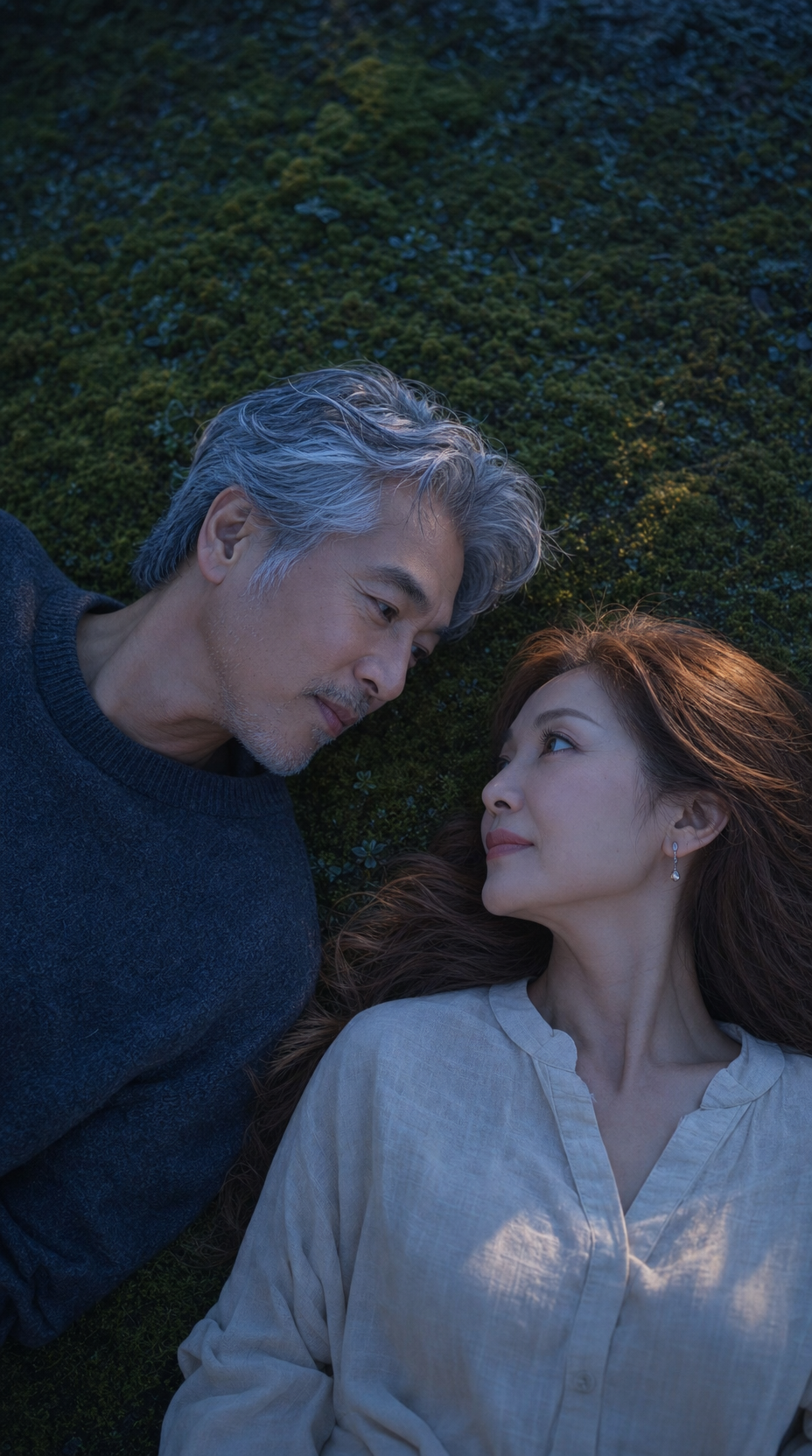
'Overhead close-up shot' is what flattens the couple into a single intimate frame, forcing their tilted heads together into the center of composition rather than showing two separate bodies. 'Cool blue hour twilight' is the direct source of the teal-green cast you see across the moss and skin, while 'soft ethereal highlights on their skin and silver tones' explains why the man's silver-streaked hair and the woman's earrings catch light instead of going flat in the low twilight. The warmth in the mood comes from the beige of the 'cream linen blouse' cutting against all that cool color grading, and 'shallow depth of field' is what blurs the moss into a soft green wash so nothing behind their faces competes for attention.
FAQ
→How do I make this feel more melancholic instead of tender and warm?
Swap 'gazing tenderly into each other's eyes' for something like 'eyes closed, foreheads touching in quiet stillness' and change 'creating a serene, timeless atmosphere' to 'creating a hushed, wistful atmosphere.' Keep the blue hour lighting since cool tones already lean melancholic, just strip out the tenderness cues in the subject description.
→How do I shift focus onto the setting instead of the couple?
Change 'Overhead close-up shot' to 'Overhead wide shot' so the moss-covered ground fills more of the frame, and expand 'Soft moss-covered ground outdoors' into something like 'a mossy forest clearing scattered with fallen leaves and dappled light.' Drop or loosen 'shallow depth of field' too, since that blur is currently what erases the background detail you'd want visible.
→How do I build a series of variations from this same prompt?
Keep the camera angle and lighting language fixed ('Overhead close-up shot,' 'Cool blue hour twilight,' 'shallow depth of field') since those three phrases are doing most of the visual work, and just cycle the subject line: try 'a mother and young daughter' or 'two old friends' in place of 'an older couple,' adjusting hair and clothing details to match. That keeps the mood and color palette consistent across the set while varying who's actually in frame.
Learn the technique behind this
- Why can't AI spell, and how do I get readable text in an image? — Older diffusion models had no character-level representation of text, so they produced letterform-shaped texture instead of words.
- How should a prompt be structured, and does word order matter? — A prompt that behaves predictably names one subject first, then what it is doing, then where, then the light, then the lens or medium, then the style.
- Do negative prompts work, and what should go in one? — Negative prompts work on models that support a separate negative conditioning channel — mainly Stable Diffusion and FLUX-family models.
Related prompts
Woman in pale blue dress in lily boat

Woman and Man in Intimate Studio Portrait
Older Couple in Tender Watercolor Embrace

Elderly Couple Embracing in Golden Afternoon Light