Why this works
The heart-shaped hands 'held up in front of the camera in the foreground' is what forces the composition into that portrait-closeup framing, since the hands have to stay sharp while everything behind them dissolves. That sharpness contrast comes directly from 'shallow depth of field with soft glowing bokeh lights,' which is also the phrase responsible for the amber-and-black palette the render actually produced, since bokeh at sunset naturally clumps into warm blobs against dark negative space. 'Soft directional lighting highlighting their faces and hands' is the load-bearing lighting cue, it's the reason the faces read clearly instead of silhouetting against the bright background, which is a real risk with backlit golden hour shots. Drop 'smiling warmly' and the romantic mood collapses into a neutral or ambiguous portrait even with identical lighting and framing.
FAQ
→How do I make the bokeh lights more prominent instead of just background texture?
Move the bokeh language earlier and add specificity: change 'soft glowing bokeh lights in the warm sunset background' to 'large glowing string-light bokeh orbs scattered across the frame, some overlapping the couple's silhouette.' Also loosen 'shallow depth of field' to 'very shallow depth of field, f/1.4 look' so the blur circles grow bigger and more painterly.
→How do I shift this from romantic to more of a nostalgic, faded memory feel?
Swap 'rich warm skin tones' and 'cinematic portrait photography' for 'faded film grain, muted sepia tones, slightly desaturated highlights.' Keep the heart-hands and golden hour setting intact, but change 'smiling warmly' to 'smiling softly with eyes closed' to push it toward reminiscence rather than active joy.
→How do I build a series of variations without losing the core composition?
Keep 'hands held up in front of the camera in the foreground' and 'shallow depth of field with soft glowing bokeh' fixed as your anchor phrases, then rotate the subject and setting pair: try 'young couple' with 'string lights on a rooftop at dusk,' or 'father and daughter' with 'wheat field at sunset.' Changing only those two slots while keeping the lighting and camera language identical will hold the mood and framing constant across the set.
Learn the technique behind this
- Why can't AI spell, and how do I get readable text in an image? — Older diffusion models had no character-level representation of text, so they produced letterform-shaped texture instead of words.
- Why does AI get hands and faces wrong, and how do I fix it? — Hands fail because they're small in frame, extremely variable in pose, and self-occluding — the model has less usable signal per pixel than for any other body part.
- How should a prompt be structured, and does word order matter? — A prompt that behaves predictably names one subject first, then what it is doing, then where, then the light, then the lens or medium, then the style.
Related prompts

Woman in pale blue dress in lily boat

Woman and Man in Intimate Studio Portrait
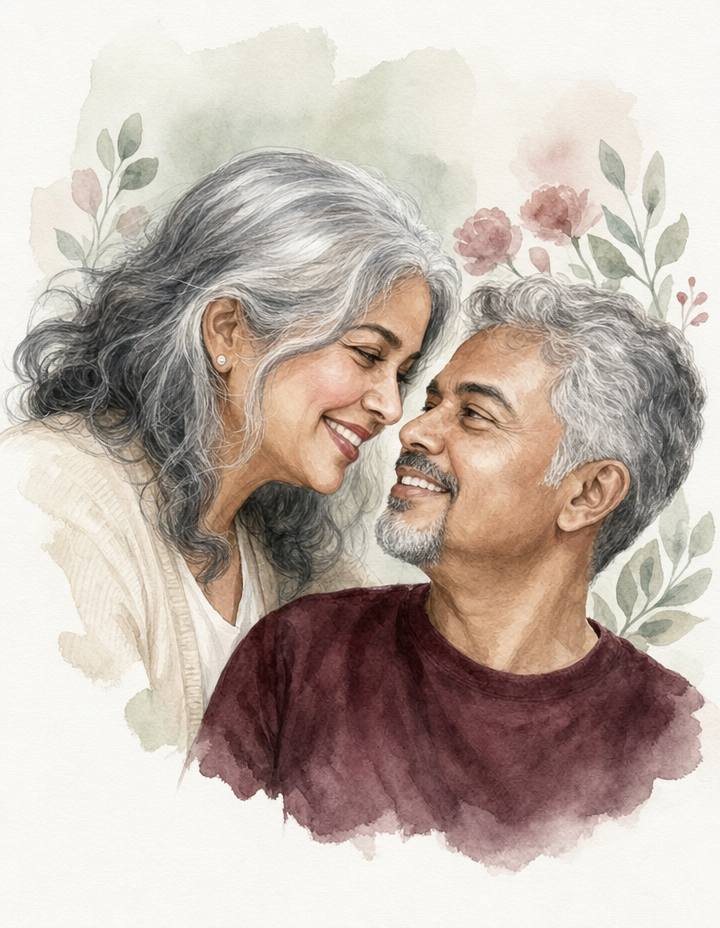
Older Couple in Tender Watercolor Embrace
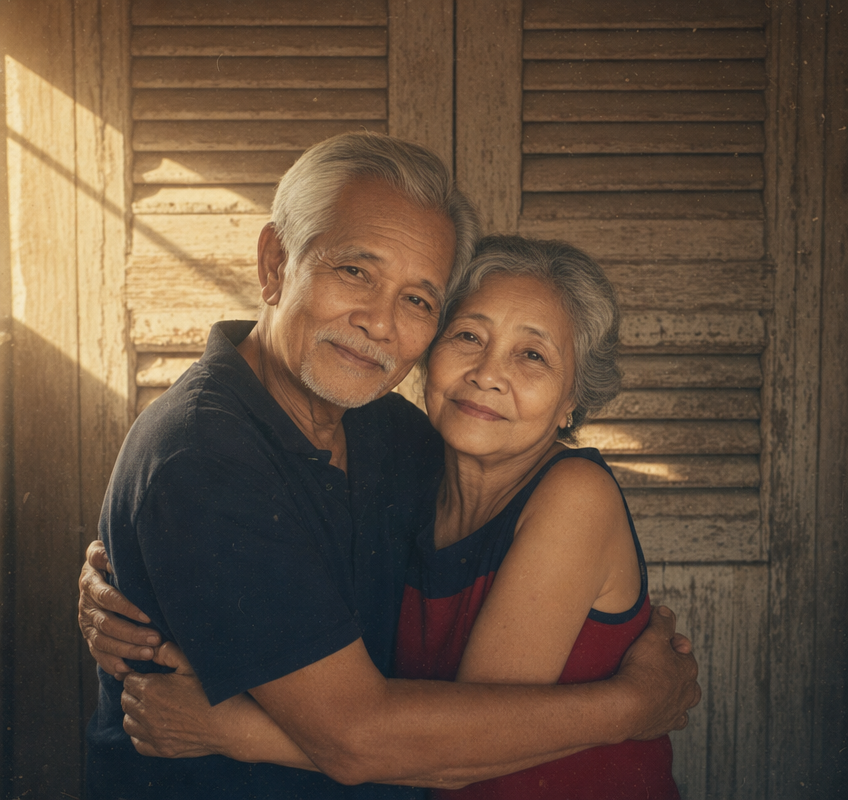
Elderly Couple Embracing in Golden Afternoon Light