Why this works
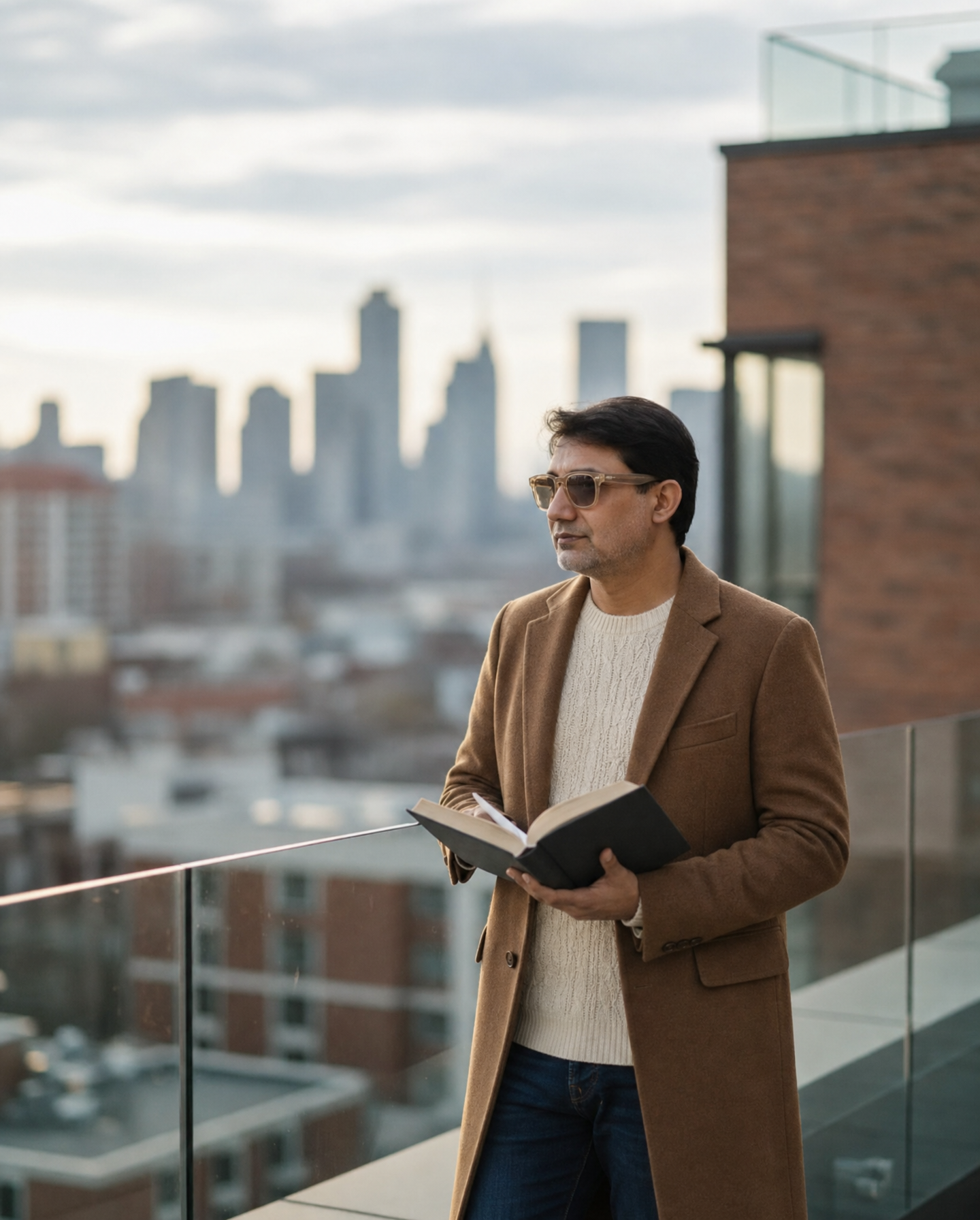
The calm, contemplative mood comes from the specific combination of “natural contemplative pose,” “holding an open book,” and “cool late-afternoon sky light,” which keeps the beige sweater and brown overcoat restrained against the gray skyline rather than turning the scene golden or dramatic. “Portrait framing with natural pose” and the full-body rooftop composition give the man clear presence while “shallow depth of field” and the “softly blurred city skyline” separate him from the background. The beige-and-gray harmony is anchored by the “cream knit sweater,” “brown overcoat,” and cool sky light, while “realistic fabric and skin texture” preserves tactile detail in the clothing and face.
FAQ
→How do I make the man’s expression and reading feel more central?
Replace “holding an open book” with “reading an open book close to his chest, eyes focused on the page,” and change “portrait framing with natural pose” to “medium close-up portrait framing.” Keep “shallow depth of field” and “softly blurred city skyline” so the face, sunglasses, and book receive priority over the balcony.
→How do I turn this into a warmer, more nostalgic rooftop portrait?
Replace “cool late-afternoon sky light (instead of warm golden hour)” and “cool late-afternoon sky light with cinematic color balance” with “warm golden-hour sunlight with amber rim light and soft long shadows.” Shift the palette by replacing “cream knit sweater” and “brown overcoat” with “ivory knit sweater and rust-colored wool overcoat,” while retaining “realistic fabric and skin texture.”
→How do I create a consistent series using different city settings?
Keep the fixed subject phrases “stylish middle-aged man,” “light-tinted sunglasses,” “cream knit sweater,” “brown overcoat,” and “holding an open book,” then replace “modern balcony with a softly blurred city skyline” with specific locations such as “glass high-rise terrace overlooking Tokyo” or “stone rooftop overlooking Paris.” Preserve “cool late-afternoon sky light,” “shallow depth of field,” and “portrait framing with natural pose” across every variation so the lighting, focus, and composition remain consistent.
Learn the technique behind this
- Why can't AI spell, and how do I get readable text in an image? — Older diffusion models had no character-level representation of text, so they produced letterform-shaped texture instead of words.
- How should a prompt be structured, and does word order matter? — A prompt that behaves predictably names one subject first, then what it is doing, then where, then the light, then the lens or medium, then the style.
- Why does the model ignore parts of my prompt? — Ignored instructions are almost always conflicts, counts, or spatial relationships — three things current models handle badly — rather than the model failing to read you.
Related prompts
Woman in Teal Light, Shadowed Fashion Portrait
Eerie Elegance Among Marble Busts
Charcoal turtleneck with red eye-beam
Dreamy Macro Portrait in Cool Water