Why this works
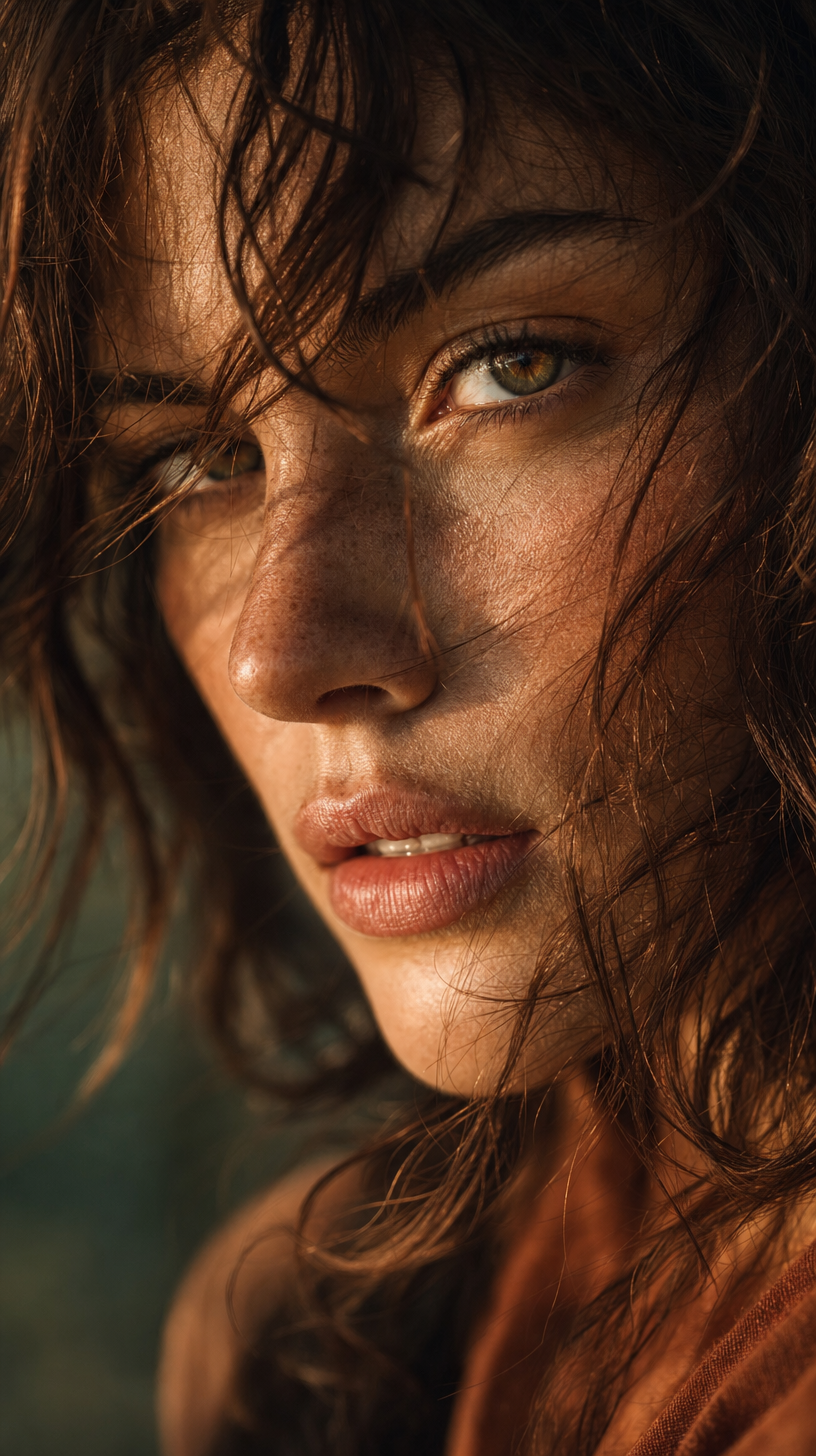
The intimate, contemplative mood comes directly from “intimate and contemplative expression,” reinforced by the “intimate framing” and softly wind-tousled loose waves. “85mm lens look at f/2.2” keeps the portrait close while creating “slightly deeper separation,” and “background softly blurred for creamy bokeh” prevents the setting from competing with her face. The warm orange presence in the generated image is grounded in “late-afternoon golden overcast light” and the “warm muted greens and terracotta” palette, while the black and gray areas gain photographic weight from “gentle cinematic grain” and the high-contrast detail of “hyper-realistic skin texture.”
FAQ
→How do I make her expression and face feel more prominent in the composition?
Replace “intimate framing” with “tight extreme close-up framing focused on the eyes and mouth,” and change “85mm lens look at f/2.2” to “105mm lens look at f/1.8.” Keep “hyper-realistic skin texture,” but add “eyes in razor-sharp focus” so attention stays on her face rather than the hair or clothing.
→How do I shift this from warm, contemplative portraiture to a cooler, more dramatic mood?
Replace “soft late-afternoon golden overcast light” with “cool blue-hour side-lighting with restrained shadow,” and swap “warm muted greens and terracotta” for “slate blue, charcoal gray, and desaturated teal.” Change “intimate and contemplative expression” to “quietly guarded, melancholic expression” while retaining “gentle cinematic grain” for the filmic finish.
→How do I build a matching series with different subjects or locations?
Keep the fixed visual structure, including “ultra-realistic cinematic close-up portrait,” “85mm lens look at f/2.2,” “creamy bokeh,” and “warm muted greens and terracotta.” Replace only “a woman” and “hair ... darker chestnut-brown with loose waves” with each subject’s defining details, then swap the implied portrait setting for phrases such as “rain-streaked apartment window,” “quiet coastal overlook,” or “shadowed greenhouse,” while preserving “soft late-afternoon golden overcast light” across the series.
Learn the technique behind this
- How should a prompt be structured, and does word order matter? — A prompt that behaves predictably names one subject first, then what it is doing, then where, then the light, then the lens or medium, then the style.
- Why can't AI spell, and how do I get readable text in an image? — Older diffusion models had no character-level representation of text, so they produced letterform-shaped texture instead of words.
- Which camera and lighting terms actually change an AI image? — Focal length, aperture, light direction and time of day change the image reliably because they correlate with real photographic patterns in the training data.
Related prompts
Woman in Teal Light, Shadowed Fashion Portrait
Eerie Elegance Among Marble Busts
Charcoal turtleneck with red eye-beam
Dreamy Macro Portrait in Cool Water