Why this works
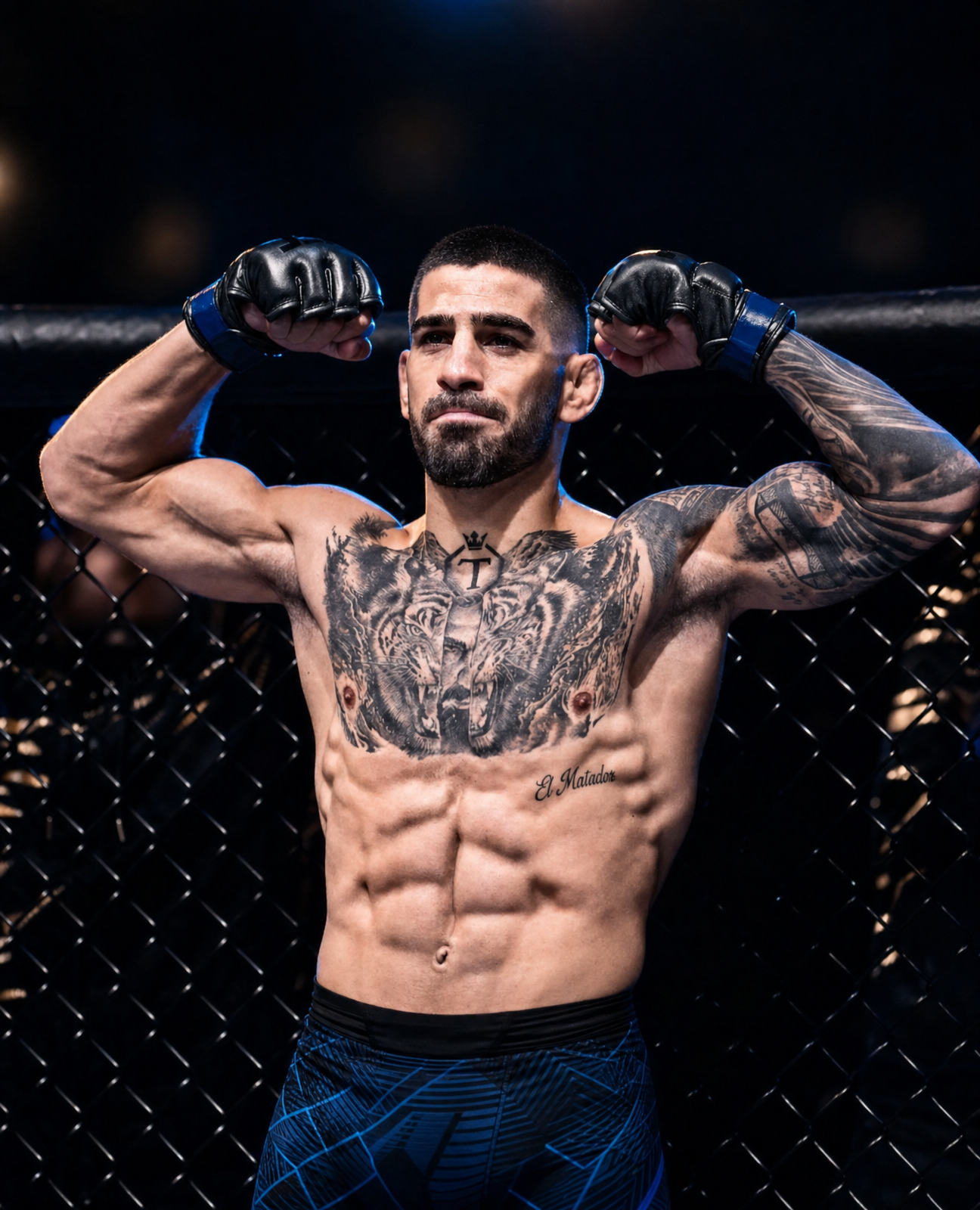
The phrase “photorealistic sports photography portrait” establishes a documentary fight-night look, while “portrait-full-body framing” keeps the flexing stance, black gloves, blue patterned shorts, tattoos, and octagon context readable together. “Cool blue rim light and warm spotlights” supplies the blue-and-tan color contrast visible against the gray-black smoky arena, and “high contrast” gives the fighter’s musculature and tattoos crisp separation. “Flexing both arms in a confident pose” is the main compositional anchor, with the cage and “dark smoky background” adding scale and a dramatic sense of isolation.
FAQ
→How do I change this prompt to make the fighter’s face and upper-body expression more prominent?
Replace “portrait-full-body framing” with “tight chest-up portrait” and change “flexing both arms in a confident pose” to “intense direct-to-camera stare, fists raised near the face.” Keep “sharp detail” and “tattooed chest and arms” so the expression and ink remain highly resolved.
→How do I change this prompt for a colder, more intimidating mood?
Replace “warm spotlights” with “hard icy-blue overhead lights” and change “cool blue rim light” to “deep cobalt backlight.” You can also replace “confident pose” with “threatening fight stance” and “dark smoky background” with “dense black smoke and faint cage silhouettes.”
→How do I build a series of variations while keeping the same fighter and visual identity?
Keep “muscular mixed martial arts fighter,” “tattooed chest and arms,” “black fight gloves,” and “blue fight shorts with subtle geometric patterns” unchanged. Create variations by swapping “flexing both arms in a confident pose” for “wrapping hands before a bout,” “crouched defensive stance,” or “raising one glove after victory,” while retaining “inside an octagon cage” and “sports photo realism” for continuity.
Learn the technique behind this
- Why can't AI spell, and how do I get readable text in an image? — Older diffusion models had no character-level representation of text, so they produced letterform-shaped texture instead of words.
- How should a prompt be structured, and does word order matter? — A prompt that behaves predictably names one subject first, then what it is doing, then where, then the light, then the lens or medium, then the style.
- Why does the model ignore parts of my prompt? — Ignored instructions are almost always conflicts, counts, or spatial relationships — three things current models handle badly — rather than the model failing to read you.
Related prompts
Woman in Teal Light, Shadowed Fashion Portrait
Eerie Elegance Among Marble Busts
Charcoal turtleneck with red eye-beam
Dreamy Macro Portrait in Cool Water