Why this works
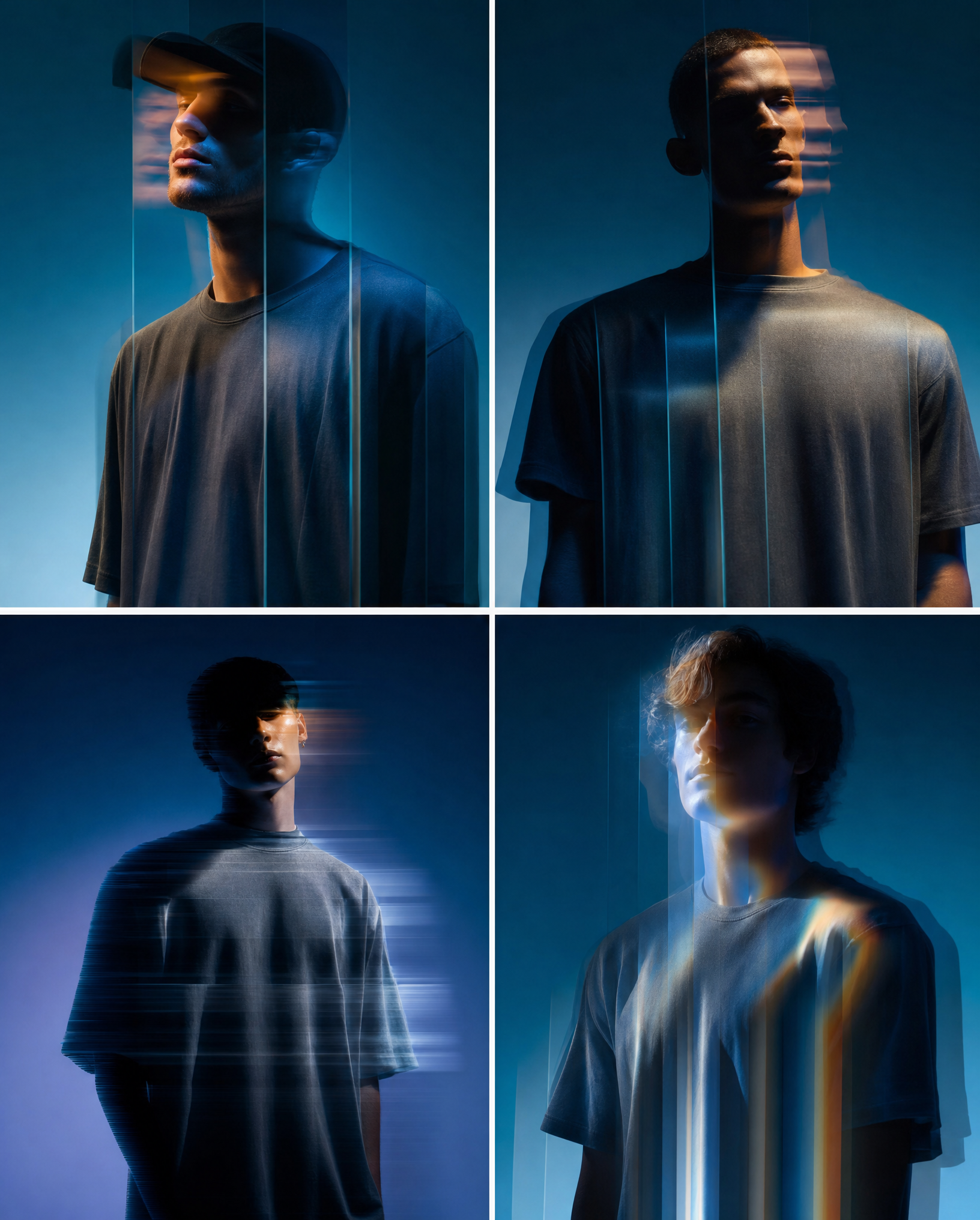
The phrase “transparent vertical glass filter that refracts and slices the scene into layered, fragmented distortions across his torso and shoulders” supplies the image’s main structure, breaking the full-body portrait into readable vertical fragments while keeping the silhouette recognizable. “Charcoal-dark casual minimal T-shirt” and the “teal-to-indigo gradient background” establish a restrained dark palette, with the generated image’s gray and black dominance reinforcing the subdued futuristic tone. “High-contrast lighting,” “sharper refracted highlights,” and “crisp editorial detail on the glass edges” direct attention to the filter’s boundaries, while “subtle motion blur” makes only the refracted areas feel unstable rather than softening the entire subject.
FAQ
→How do I make the humanoid’s face and upper torso more prominent?
Replace “portrait-full-body” and “vertical framing” with “tight chest-up portrait, face and shoulders filling the frame.” Change “across his torso and shoulders” to “concentrated across the face and upper chest,” and add “eyes and facial silhouette remain sharply visible behind the glass.”
→How do I shift this from moody futuristic to a brighter, cleaner editorial look?
Replace “experimental moody futuristic mood” with “bright contemporary fashion editorial mood,” and change “high-contrast lighting” to “soft even studio lighting with controlled highlights.” Replace the “minimal teal-to-indigo gradient background” with “clean white-to-pale-cyan gradient background,” while retaining “crisp glass-edge detail” so the refraction remains legible.
→How do I create a series of wardrobe variations without changing the composition?
Keep “same person identity” and the full existing glass and studio description, then replace “charcoal-dark casual minimal T-shirt” with specific alternatives such as “off-white oversized linen shirt,” “deep cobalt technical jacket,” or “muted burgundy knit sweater.” Preserve “vertical composition,” “transparent vertical glass filter,” and “layered, fragmented sliced distortions” in every version so wardrobe is the main variable.
Learn the technique behind this
- Why can't AI spell, and how do I get readable text in an image? — Older diffusion models had no character-level representation of text, so they produced letterform-shaped texture instead of words.
- How should a prompt be structured, and does word order matter? — A prompt that behaves predictably names one subject first, then what it is doing, then where, then the light, then the lens or medium, then the style.
- Which aspect ratio should I use, and how does it change the image? — Aspect ratio determines what the model composes, not how it's cropped afterwards.
Related prompts
Woman in Teal Light, Shadowed Fashion Portrait
Eerie Elegance Among Marble Busts
Charcoal turtleneck with red eye-beam
Dreamy Macro Portrait in Cool Water