Why this works
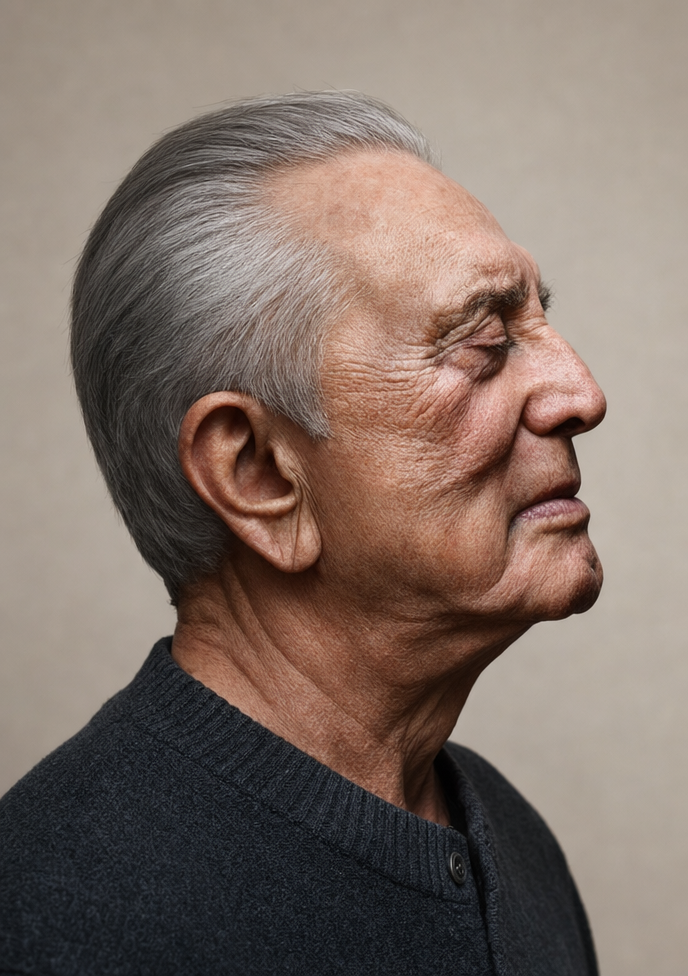
The phrase “close-up side-profile portrait” makes the face and jawline the compositional anchor, while “sharp focus on the face and jawline” preserves detail in the realistic pores and fine wrinkles. “Soft, even illumination” and the “neutral warm beige studio background” create a calm, restrained mood, with the beige, charcoal cardigan, and silver-gray hair producing the image’s brown-black-beige tonal harmony. “Shallow depth of field for subtle background falloff” separates the profile without turning the studio setting into a distracting visual element.
FAQ
→How do I make the portrait feel more dramatic and emotionally intense?
Replace “soft, even illumination” with “dramatic Rembrandt side-lighting with deep shadow on the far side of the face,” and replace “calm and dignified in a contemplative mood” with “somber, emotionally charged, introspective mood.” Keep “sharp focus on the face and jawline” so the stronger contrast still serves the expression.
→How do I make the eyes and expression more central than the jawline?
Change “sharp focus on the face and jawline” to “sharp focus on the visible eye and subtle facial expression,” and replace “side-profile portrait” with “three-quarter portrait angled toward the camera.” You can also replace “shallow depth of field for subtle background falloff” with “very shallow depth of field with the eye as the single focal point.”
→How do I build a consistent series with different subjects or backgrounds?
Keep the fixed structure “photorealistic editorial close-up portrait,” “soft, even studio lighting,” and “sharp focus” while swapping “elderly person” for subjects such as “middle-aged ceramicist” or “young classical musician.” Replace “neutral warm beige studio background” with controlled alternatives such as “muted sage green studio background” or “cool gray studio background,” and retain “close-up side-profile” to keep the framing consistent across the series.
Learn the technique behind this
- Why can't AI spell, and how do I get readable text in an image? — Older diffusion models had no character-level representation of text, so they produced letterform-shaped texture instead of words.
- How should a prompt be structured, and does word order matter? — A prompt that behaves predictably names one subject first, then what it is doing, then where, then the light, then the lens or medium, then the style.
- Why does AI get hands and faces wrong, and how do I fix it? — Hands fail because they're small in frame, extremely variable in pose, and self-occluding — the model has less usable signal per pixel than for any other body part.
Related prompts
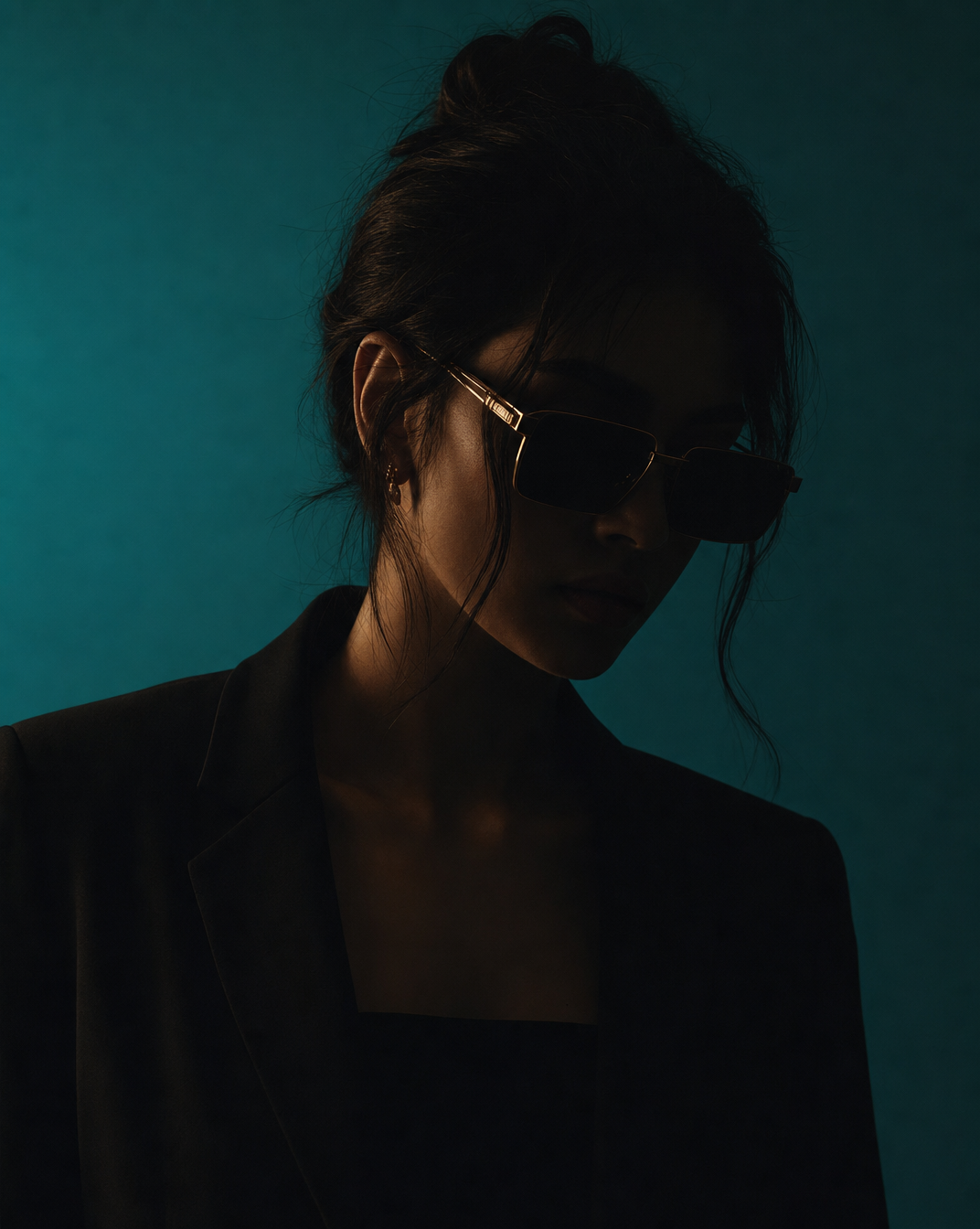
Woman in Teal Light, Shadowed Fashion Portrait
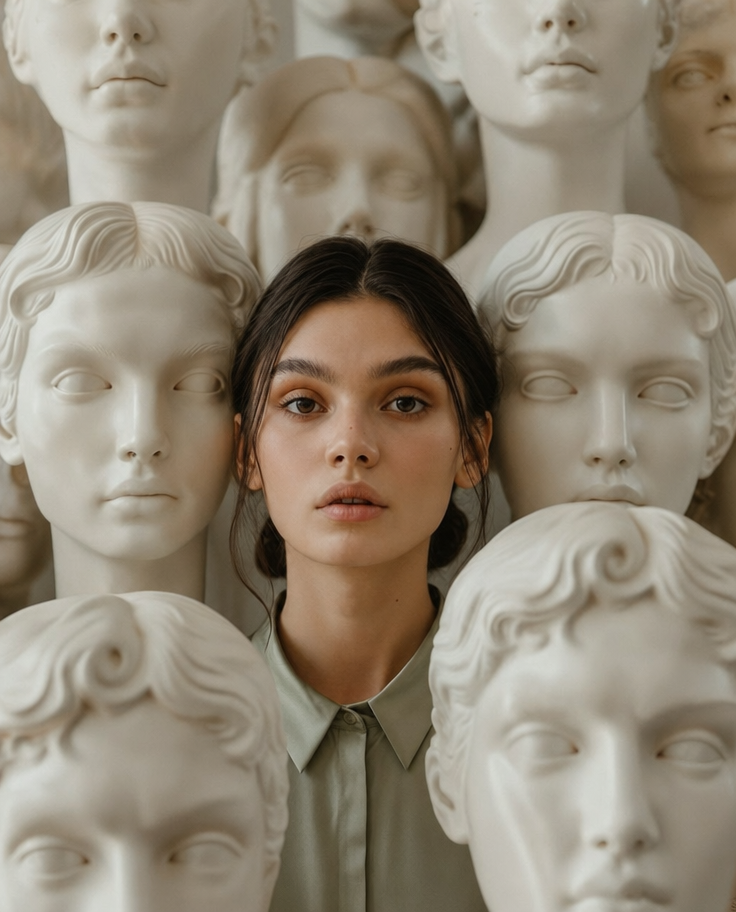
Eerie Elegance Among Marble Busts
Charcoal turtleneck with red eye-beam
Dreamy Macro Portrait in Cool Water