Why this works
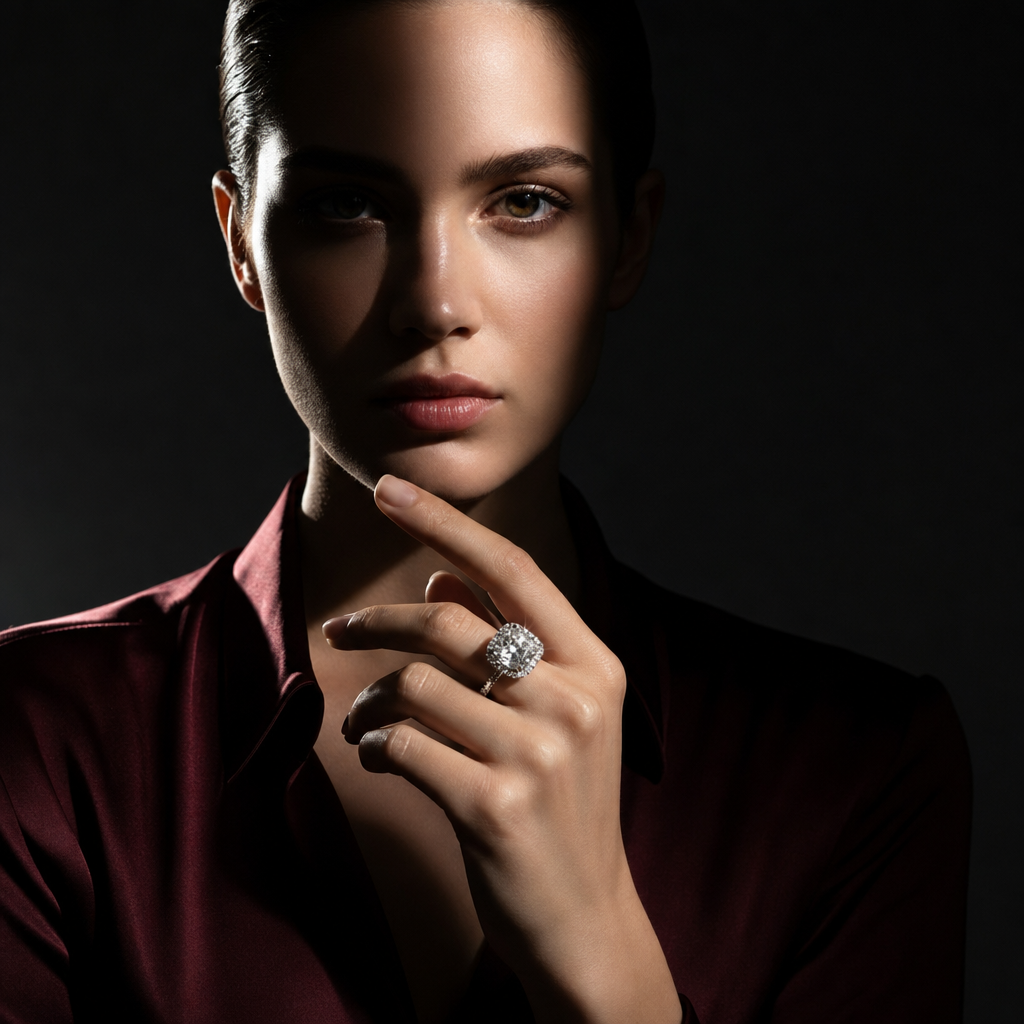
“Portrait framing with shallow depth of field” keeps the woman’s face and hand near her chin dominant, while the “dark minimal studio background” removes competing shapes around the close-up. The mood comes from the explicit “dramatic low-key” treatment, with “face is lit from the left with a crisp rim light” defining the contour and “right side falls into shadow” supplying the cinematic split. Deep burgundy satin and the dominant brown-crimson palette create a warm, luxurious color harmony, while “emphasizing the sparkle and soft reflections of the diamond ring” gives the small jewelry detail a clear visual role.
FAQ
→How do I make the diamond ring more prominent in the image?
Replace “portrait framing with shallow depth of field” with “tight beauty close-up including the hand and ring in the foreground,” and change “one hand near her chin” to “ring hand resting beside her lips, diamond facing camera.” Add “sharp focus on the diamond facets and ring, face slightly softer” so the jewelry becomes the focal point rather than a secondary detail.
→How do I make the portrait feel brighter and less severe while keeping the burgundy blouse?
Replace “dramatic low-key studio lighting” and “right side falls into shadow” with “soft, balanced studio lighting with a broad left key and gentle fill on the right.” Keep “crisp rim light” but change it to “subtle warm rim light,” and replace “cinematic contrast” with “soft luminous editorial contrast” to preserve the luxury fashion finish without the hard split-shadow effect.
→How do I create a series of variations from this portrait without losing its identity?
Keep the fixed anchors “same woman,” “deep burgundy satin blouse,” “one hand near her chin,” and “luxury fashion editorial style,” then vary one phrase per version. Swap “dark minimal studio background” for “charcoal velvet backdrop,” “deep brown architectural shadows,” or “muted crimson gradient,” and alternate “left-side key” with “high frontal beauty light” or “backlit halo with soft frontal fill” for controlled lighting studies.
Learn the technique behind this
- Why does AI get hands and faces wrong, and how do I fix it? — Hands fail because they're small in frame, extremely variable in pose, and self-occluding — the model has less usable signal per pixel than for any other body part.
- Why can't AI spell, and how do I get readable text in an image? — Older diffusion models had no character-level representation of text, so they produced letterform-shaped texture instead of words.
- How do I keep the same character across multiple images? — Text prompts alone won't hold a face across images — a description defines a type, not a person.
Related prompts
Woman in Teal Light, Shadowed Fashion Portrait
Eerie Elegance Among Marble Busts
Charcoal turtleneck with red eye-beam
Dreamy Macro Portrait in Cool Water