Why this works
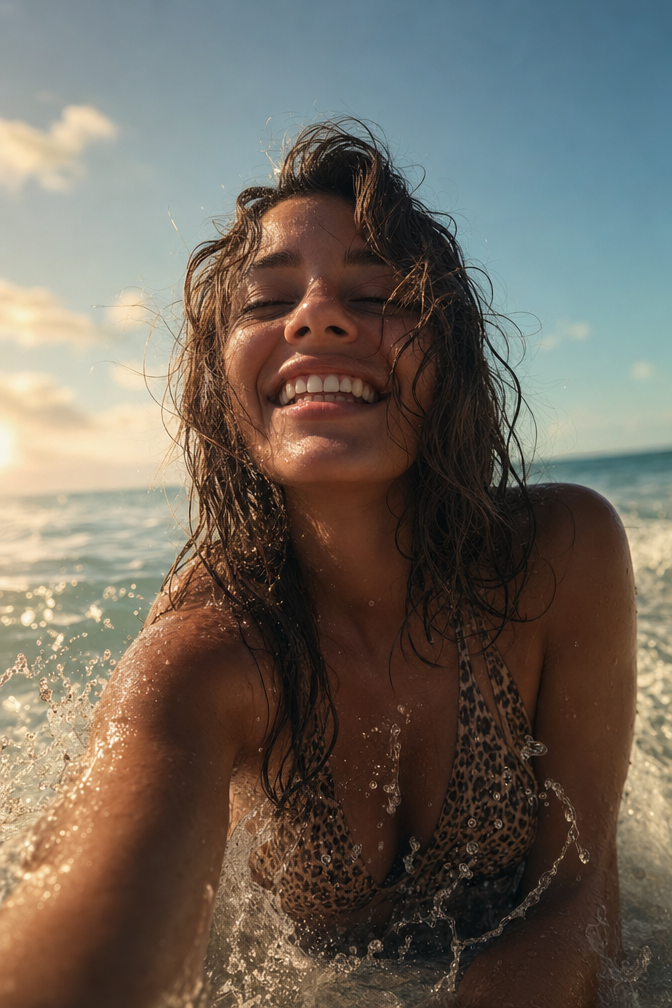
The “cinematic low-angle” and “close-up candid composition” keep the smiling brunette woman dominant, while “ocean water splashes across her collarbone and upper arms” adds a specific, energetic foreground action. “Warm late-afternoon sunlight” balances the “deep ocean blues” and sandy tan tones, producing the bright summer mood without flattening the subject into a generic beach scene. “Wind-swept slightly damp hair,” “natural skin texture,” and “shallow depth of field” combine tactile realism with a soft background separation that keeps attention on her face and the water droplets.
FAQ
→How do I make the ocean splash more central and dramatic?
Replace “ocean water splashes across her collarbone and upper arms” with “a large crystalline wave breaking across the foreground and partially covering her shoulders,” and change “close-up candid composition” to “tight action portrait with the splash dominating the lower half of the frame.” Keep “shallow depth of field” if you want her face sharp while the nearest droplets blur.
→How do I shift this from a bright summer portrait to a moodier coastal image?
Replace “warm late-afternoon sunlight” and “vibrant summer atmosphere” with “overcast blue-hour light” and “quiet, windswept coastal mood.” Change “rich saturated greens and deep ocean blues” to “muted slate blue, gray-green, and weathered tan,” while retaining “natural skin texture” for a grounded photographic result.
→How do I create a series of variations without losing this portrait’s identity?
Keep “cinematic low-angle,” “close-up candid composition,” “smiling brunette woman,” and “natural skin texture” unchanged, then swap the action phrase for variations such as “holding a translucent shell near her cheek,” “turning toward a passing seabird,” or “letting foam curl around her forearms.” Replace “sandy beach” with “rocky tide pool,” “pale dune shoreline,” or “sunlit coastal boardwalk” to vary the setting while preserving the same subject and camera treatment.
Learn the technique behind this
- Why can't AI spell, and how do I get readable text in an image? — Older diffusion models had no character-level representation of text, so they produced letterform-shaped texture instead of words.
- How should a prompt be structured, and does word order matter? — A prompt that behaves predictably names one subject first, then what it is doing, then where, then the light, then the lens or medium, then the style.
- Which aspect ratio should I use, and how does it change the image? — Aspect ratio determines what the model composes, not how it's cropped afterwards.
Related prompts
Woman in Teal Light, Shadowed Fashion Portrait
Eerie Elegance Among Marble Busts
Charcoal turtleneck with red eye-beam
Dreamy Macro Portrait in Cool Water