Why this works
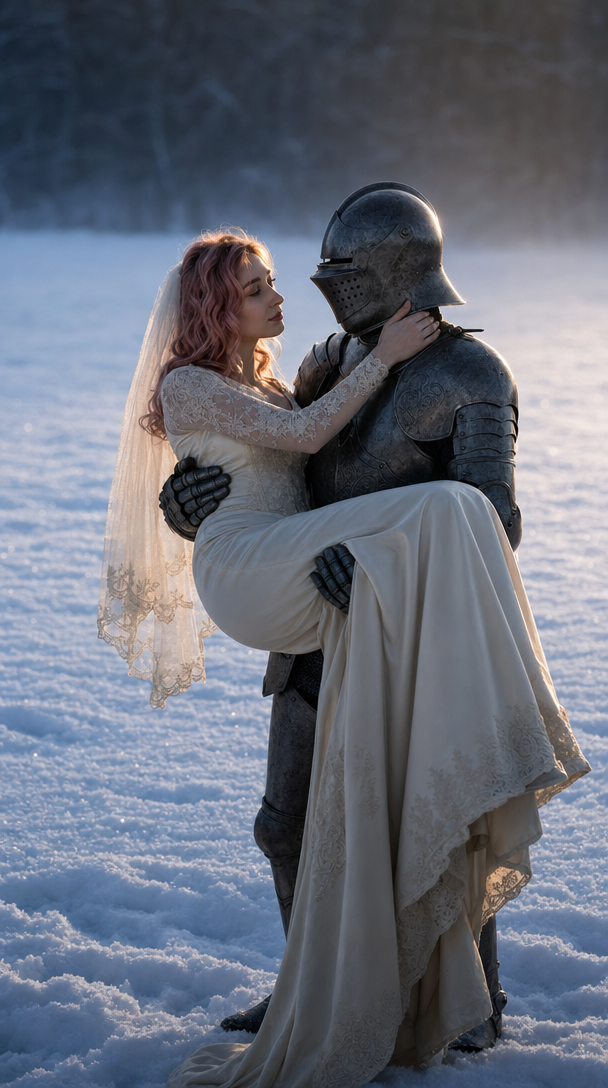
The intimate pose is immediately legible because “a bride ... is carried in the arms of a medieval knight” and “they share an intimate embrace” make the relationship the central action, while the portrait-full-body format preserves the full gown, armor, and shoreline context. The cool, restrained palette comes from “early morning blue hour” and “cool dawn rim light instead of warm sunrise glow,” producing the dominant gray and black tones rather than golden bridal imagery. “Cinematic low-angle composition” gives the pair a heightened, storybook presence, and “shallow depth of field” with “light atmospheric haze” separates their textured satin, lace, and weathered steel from the misty rocks.
FAQ
→How do I make the bride more visually prominent than the knight?
Replace “a bride ... carried in the arms of a medieval knight” with “the bride is the dominant foreground subject, filling most of the frame, while the knight supports her behind her,” and add “ivory gown catching the primary rim light.” Keep “portrait-full-body,” but change “cinematic low-angle composition” to “slightly low-angle medium-full-body framing centered on the bride.”
→How do I shift this from dreamy romance to a darker, stormier fantasy scene?
Replace “early morning blue hour” with “pre-storm twilight” and “cool dawn rim light instead of warm sunrise glow” with “cold intermittent lightning and hard side light.” Change “dreamy fairytale mood” to “ominous gothic fantasy mood,” and replace “light atmospheric haze” with “windblown sea spray, heavy storm mist, and dark rain clouds.”
→How do I create a series of variations while keeping the same couple and visual style?
Keep “photorealistic fantasy editorial photography,” “realistic fabric texture,” “realistic, slightly worn metal reflections,” and “shallow depth of field” unchanged, then swap only the setting phrase “misty rocky shoreline” for locations such as “ruined chapel at dusk,” “snow-covered castle courtyard,” or “foggy forest bridge.” Preserve “a bride ... carried in the arms of a medieval knight” and vary the action with replacements such as “walking through shallow surf,” “standing beneath a stone arch,” or “kneeling beside a lantern.”
Learn the technique behind this
- Why can't AI spell, and how do I get readable text in an image? — Older diffusion models had no character-level representation of text, so they produced letterform-shaped texture instead of words.
- How should a prompt be structured, and does word order matter? — A prompt that behaves predictably names one subject first, then what it is doing, then where, then the light, then the lens or medium, then the style.
- Do negative prompts work, and what should go in one? — Negative prompts work on models that support a separate negative conditioning channel — mainly Stable Diffusion and FLUX-family models.
Related prompts
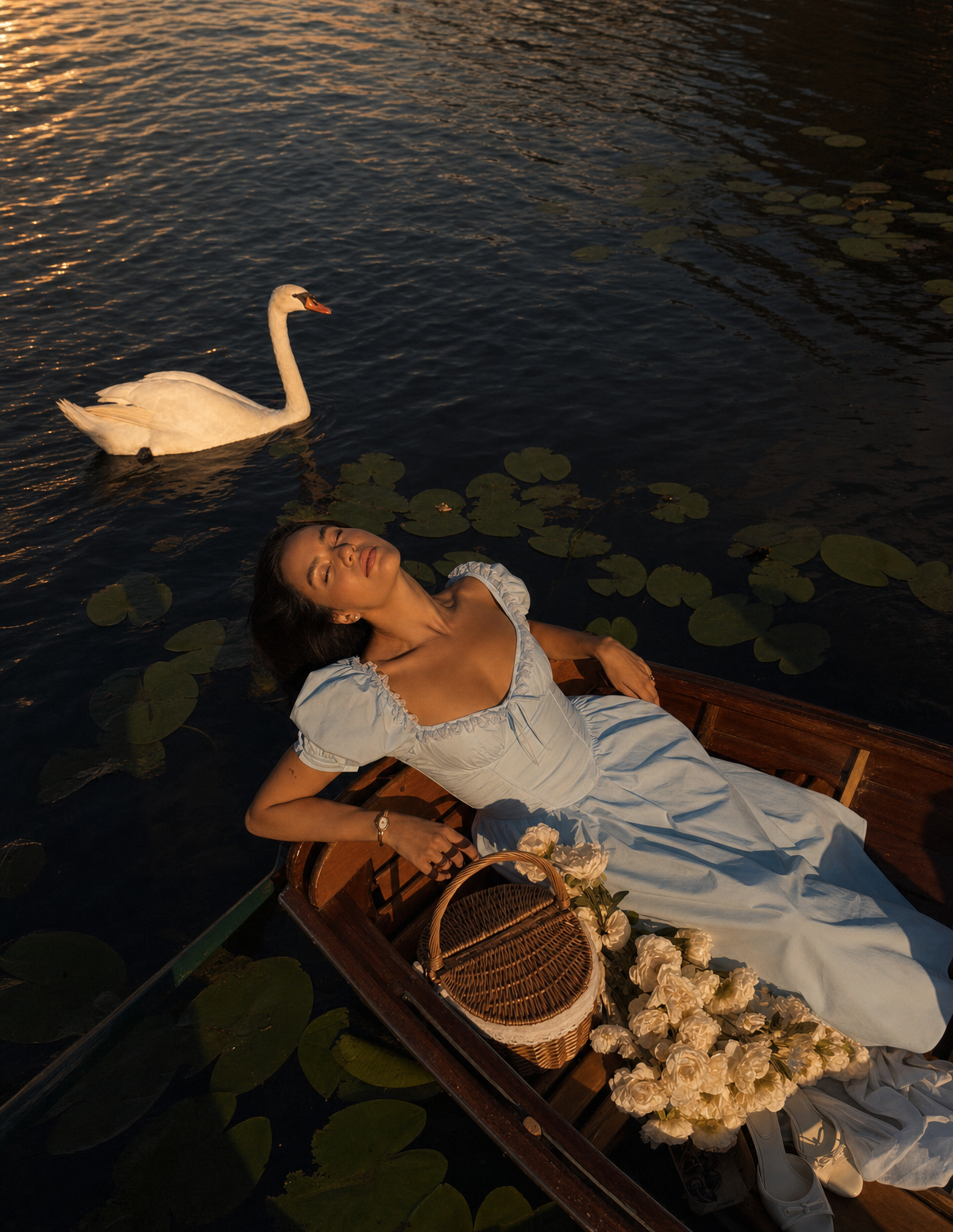
Woman in pale blue dress in lily boat

Woman and Man in Intimate Studio Portrait
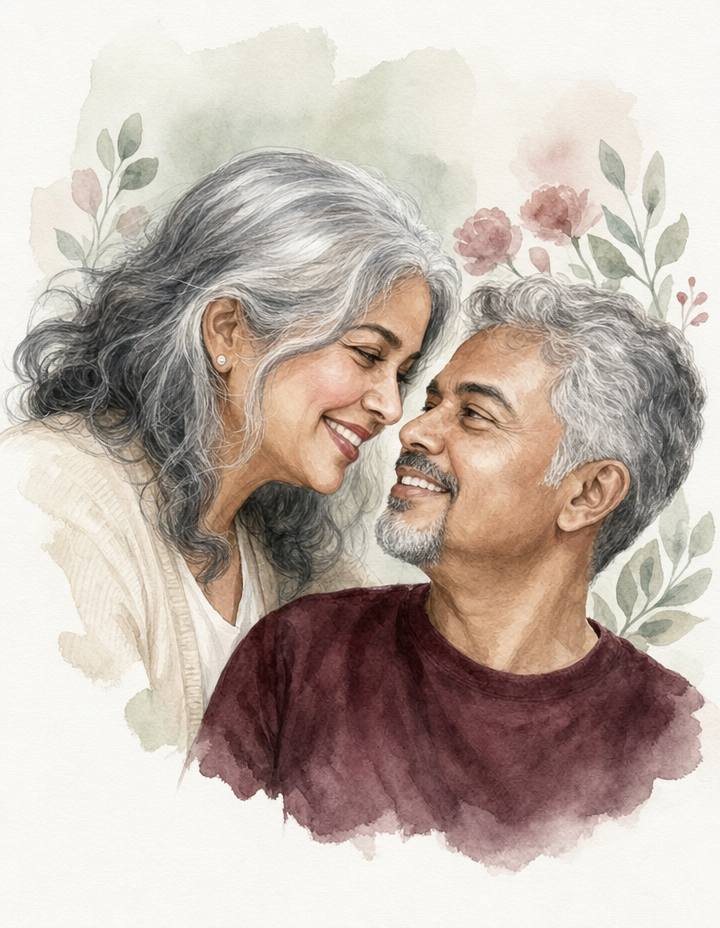
Older Couple in Tender Watercolor Embrace
Couple's Warm Burgundy Turtleneck Mirror Selfie