Why this works
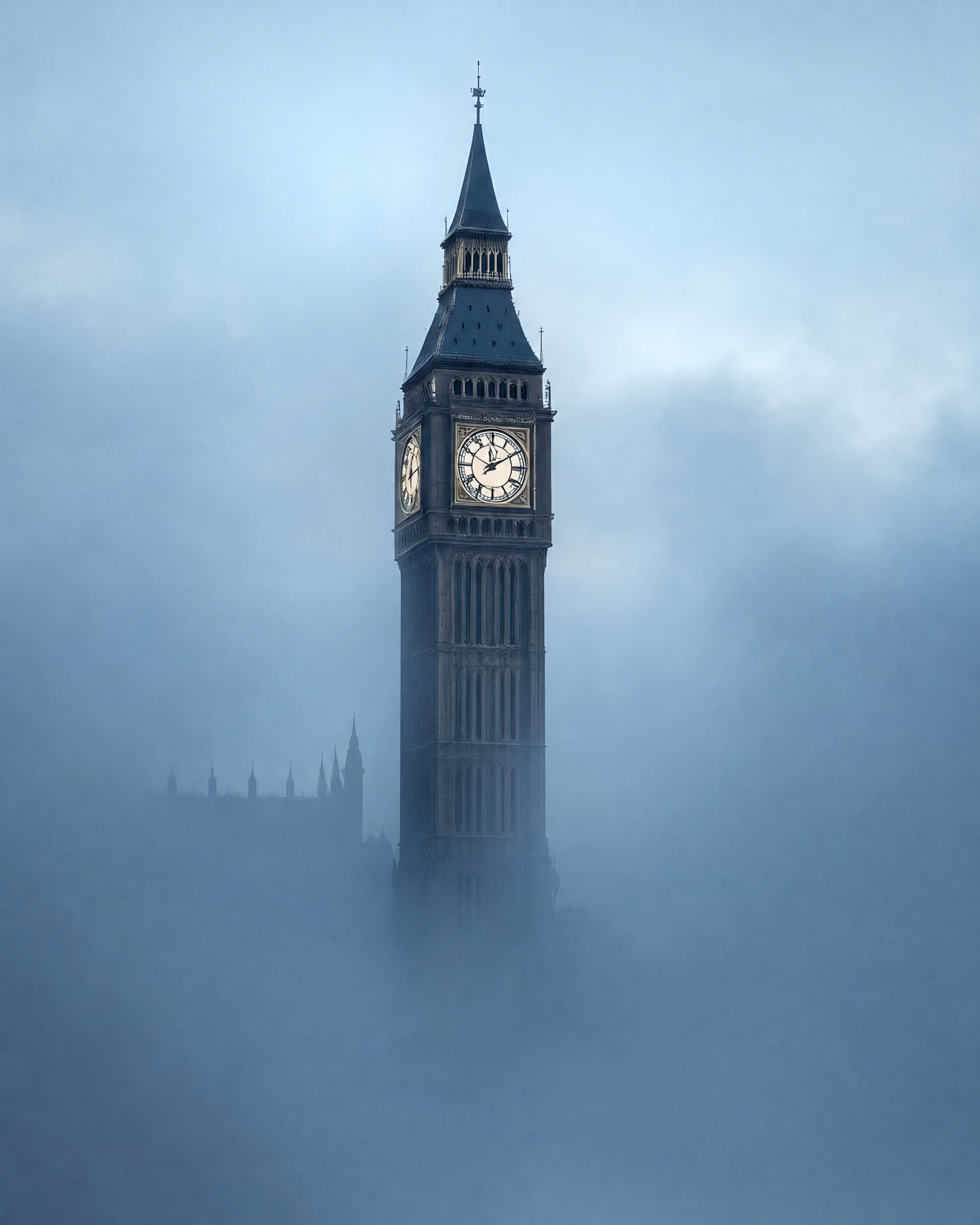
The phrase “tower centered in a dramatic vertical composition” gives Elizabeth Tower a rigid central axis and makes the wide shot read as monumental, while “rising above dense morning fog” supplies the scale contrast between the small visible landmark and the empty haze. “Cool blue dawn backlight,” together with the “pale cyan to deep slate” gradient, limits the scene to a restrained blue-gray range that matches the generated image’s dominant gray and white colors. The words “lower portion ... partially obscured by thicker haze” and “realistic atmospheric scattering” create the soft disappearance at the base, while “highly detailed stonework and architectural edges” preserves crisp focus on the exposed upper structure.
FAQ
→How do I make the tower feel more ominous and dramatic?
Replace “serene yet cinematic mood” with “ominous, storm-laden cinematic mood,” change “cool blue dawn backlight” to “cold lightning-lit backlight,” and replace “pale cyan to deep slate” with “smoky charcoal to near-black.” Keep “dense morning fog” and “thicker haze” to preserve the obscured lower structure.
→How do I make the clock face the main focal point?
Replace “tower centered in a dramatic vertical composition” with “tight vertical crop centered on the illuminated clock face,” and add “clock face dominant in frame, sharply focused, upper third emphasis.” Replace “lower portion ... partially obscured by thicker haze” with “lower tower fading softly into fog” so the base recedes while the dial remains prominent.
→How do I build a matching series of London landmark variations?
Replace “Elizabeth Tower (Big Ben)” with another landmark such as “Tower Bridge” or “St Paul’s Cathedral,” and change “highly detailed stonework and architectural edges” to a material-specific phrase such as “intricate suspension cables and steelwork” or “detailed limestone dome and masonry.” Keep “dense morning fog,” “cool blue dawn backlight,” and “pale cyan to deep slate” unchanged to maintain the same gray-white, blue-dawn visual identity.
Learn the technique behind this
- Why can't AI spell, and how do I get readable text in an image? — Older diffusion models had no character-level representation of text, so they produced letterform-shaped texture instead of words.
- Which aspect ratio should I use, and how does it change the image? — Aspect ratio determines what the model composes, not how it's cropped afterwards.
- How should a prompt be structured, and does word order matter? — A prompt that behaves predictably names one subject first, then what it is doing, then where, then the light, then the lens or medium, then the style.
Related prompts
Beige Modern Villa with Rectangular Pool Garden
Luxury modern villa with dark concrete facade and vertical windows
Golden-hour eco boulevard with tram
Blue-Hour Wedding Tent Reception Scene