Why this works
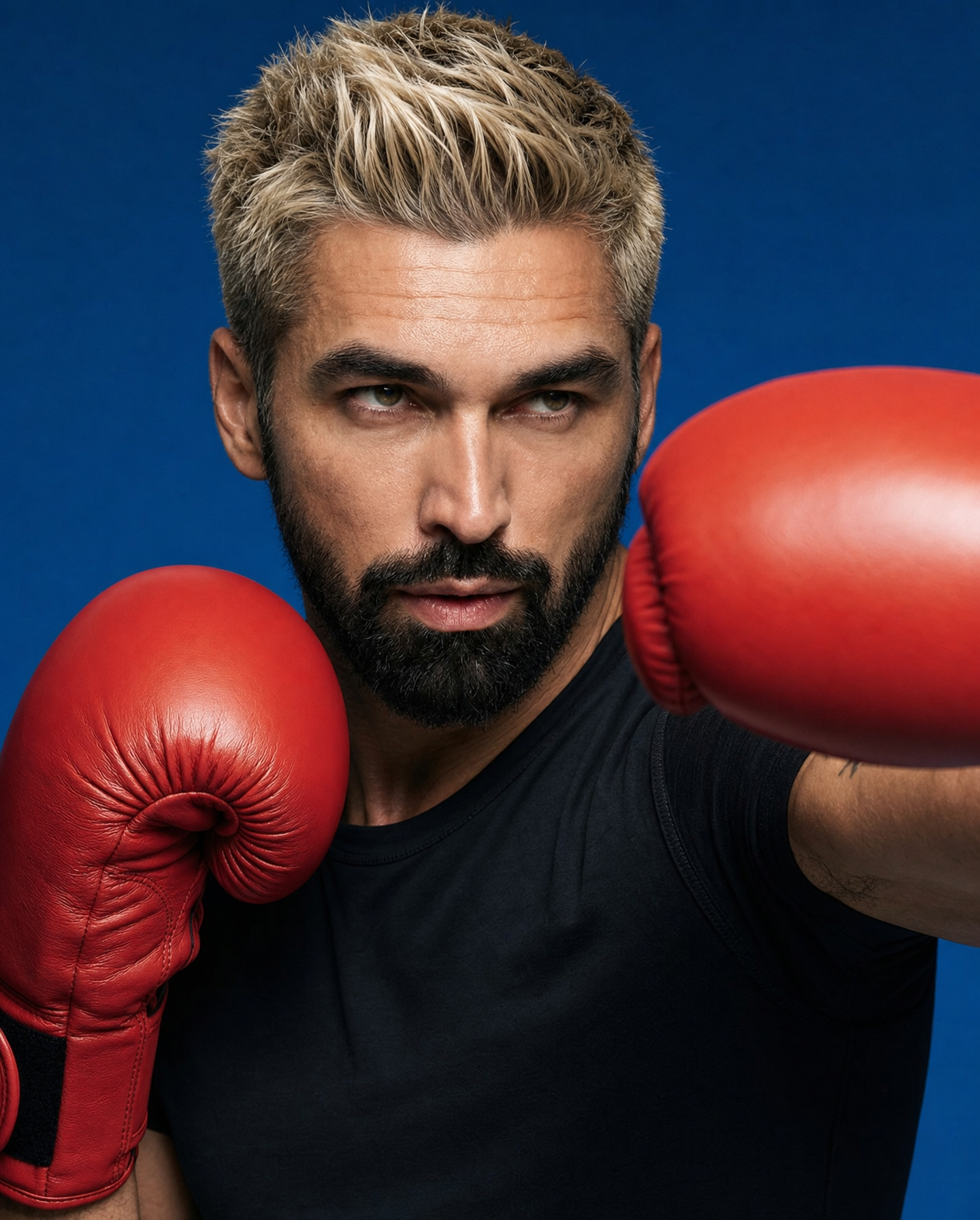
The phrases “confident bearded man in boxing gloves in an intense boxing stance” and “close-up framing, sharp detail on face and gloves” make the face and raised gloves the visual anchors, giving the portrait its confrontational focus. “Short styled blond hair,” “red boxing gloves,” and a “black crew-neck athletic shirt” create the dominant red-and-black contrast against the “solid deep blue studio background.” “Editorial lighting emphasizing realistic skin texture and facial contours” supplies the controlled, serious mood by preserving beard detail, skin texture, and facial structure rather than flattening them into a graphic silhouette.
FAQ
→How do I make the boxing gloves more prominent in the portrait?
Replace “close-up framing, sharp detail on face and gloves” with “tight crop centered on the raised red boxing gloves, gloves occupying the foreground, face slightly behind them.” Keep “red boxing gloves,” and add “shallow depth of field with the front glove in crisp focus” to make the gloves the primary subject.
→How do I shift the image from intense editorial portraiture to a darker, more dramatic tone?
Replace “editorial lighting emphasizing realistic skin texture and facial contours” with “hard single-source side lighting, deep shadows across one half of the face, controlled rim light on the gloves.” Change “solid deep blue studio background” to “near-black navy studio background with subtle falloff” while retaining “bold color contrast.”
→How do I create a consistent series with different fighters or colorways?
Keep the fixed structure, especially “photorealistic studio portrait,” “close-up framing,” and “solid deep blue studio background,” then replace “a confident bearded man” with a defined subject such as “a focused female kickboxer with braided hair.” Swap “red boxing gloves” and “black crew-neck athletic shirt” for a repeatable palette pair such as “yellow boxing gloves and a white athletic shirt,” while preserving “sharp facial detail” and the same editorial lighting phrase.
Learn the technique behind this
- Why can't AI spell, and how do I get readable text in an image? — Older diffusion models had no character-level representation of text, so they produced letterform-shaped texture instead of words.
- How should a prompt be structured, and does word order matter? — A prompt that behaves predictably names one subject first, then what it is doing, then where, then the light, then the lens or medium, then the style.
- Which aspect ratio should I use, and how does it change the image? — Aspect ratio determines what the model composes, not how it's cropped afterwards.
Related prompts
Woman in Teal Light, Shadowed Fashion Portrait
Eerie Elegance Among Marble Busts
Charcoal turtleneck with red eye-beam
Dreamy Macro Portrait in Cool Water