Why this works
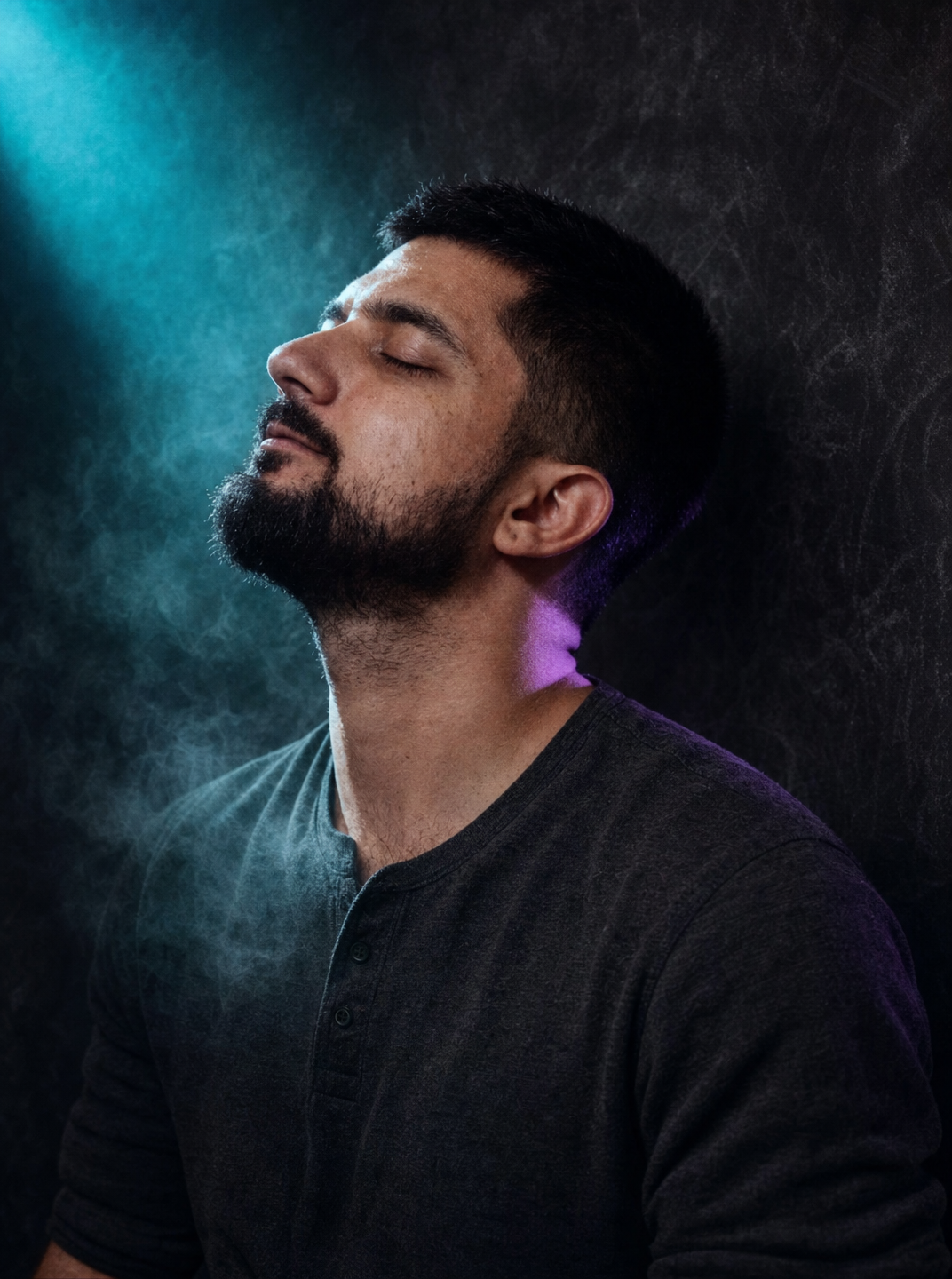
The close framing is anchored by “cinematic close-up portrait photography,” while “eyes closed and head tilted slightly upward” gives the bearded subject an introspective, upward-reaching pose. “Cool teal side light from the left” and “subtle violet rim light from behind” supply the dominant blue-violet harmony and separate his silhouette from the “dark, nearly blank chalkboard-like surface.” “Shallow depth of field” keeps attention on the “realistic skin texture,” while “soft drifting mist/smoke near the bottom foreground” adds depth without competing with the face.
FAQ
→How do I change this prompt to make the portrait feel warmer and less somber?
Replace “cool teal side light from the left” with “soft golden-amber key light from the left,” and replace “subtle violet rim light from behind” with “warm rose-gold rim light.” You can also change “dramatic moody lighting” to “gentle cinematic evening light” while keeping the dark chalkboard background for contrast.
→How do I make the eyes and facial expression more prominent?
Replace “cinematic close-up” with “extreme close-up focused on the eyes and upper face,” and change “eyes closed” to “eyes slightly open, gazing directly toward the camera.” Reduce the mist phrase from “soft drifting mist/smoke near the bottom foreground” to “a barely visible haze below the shoulders” so it does not pull attention away from the expression.
→How do I build a matching series with different subjects while preserving this visual identity?
Keep “cool teal side light from the left,” “subtle violet rim light from behind,” “dark, nearly blank chalkboard-like surface,” “shallow depth of field,” and “soft foreground mist/smoke.” Replace “a contemplative bearded man” with parallel subjects such as “an elderly woman with silver hair,” “a young violinist holding a worn instrument,” or “a tired astronaut in a charcoal-grey collar,” while retaining the closed-eye, slightly upward-tilted pose for continuity.
Learn the technique behind this
- How should a prompt be structured, and does word order matter? — A prompt that behaves predictably names one subject first, then what it is doing, then where, then the light, then the lens or medium, then the style.
- Why can't AI spell, and how do I get readable text in an image? — Older diffusion models had no character-level representation of text, so they produced letterform-shaped texture instead of words.
- Why does AI get hands and faces wrong, and how do I fix it? — Hands fail because they're small in frame, extremely variable in pose, and self-occluding — the model has less usable signal per pixel than for any other body part.
Related prompts
Woman in Teal Light, Shadowed Fashion Portrait
Eerie Elegance Among Marble Busts
Charcoal turtleneck with red eye-beam
Dreamy Macro Portrait in Cool Water