Why this works
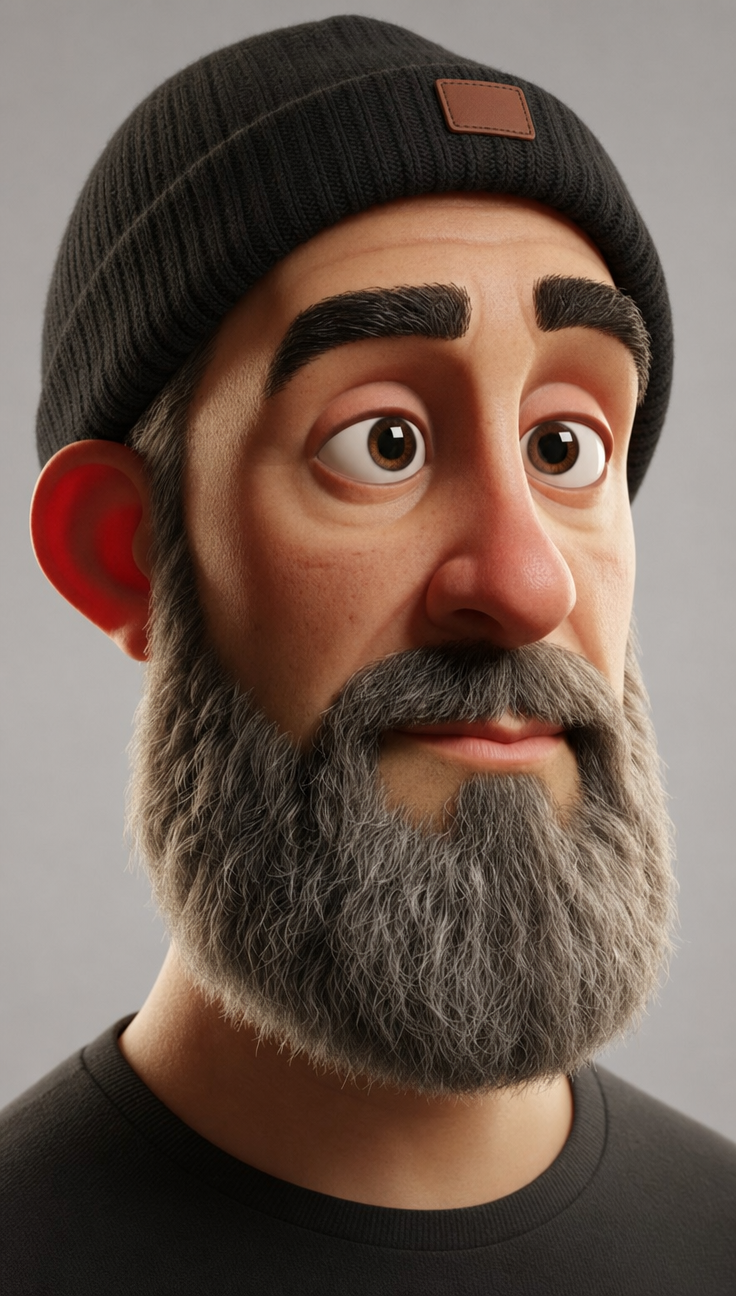
“Close-up portrait” and “slightly off-center face with a sideways glance” create an intimate, character-focused composition while preserving a little visual tension. “Black knit beanie instead of the thick green cap” gives the gray-and-beige palette a controlled dark anchor, and “smooth light-gray background” keeps attention on the face. “Warm, calm, polished studio lighting with soft rim highlights” supplies the restrained mood, while “realistic skin texture with visible pores and subtle wrinkles” balances the “exaggerated facial proportions” with convincing material detail.
FAQ
→How do I make the eyes and sideways glance more prominent?
Replace “slight sideways glance” with “strong, deliberate sideways gaze toward the camera edge, eyes sharply in focus” and add “eyebrows raised asymmetrically to emphasize expression.” Keep “close-up framing,” but replace “slightly off-center face” with “eyes positioned near the upper-third focal point” so the gaze becomes the primary compositional cue.
→How do I turn this calm studio portrait into a moodier, more dramatic version?
Replace “warm, calm, polished studio lighting with soft rim highlights” with “low-key cinematic lighting, deep cheek shadows, and a narrow warm rim light.” Change “smooth light-gray background” to “dark charcoal studio background with a subtle vignette,” while retaining “realistic skin texture” so the face remains detailed instead of disappearing into the shadows.
→How do I create a series of consistent variations with different headwear or expressions?
Keep the fixed structure “stylized 3D close-up portrait,” “smooth light-gray background,” “warm soft studio lighting,” and “realistic skin texture with visible pores and subtle wrinkles.” Make one controlled substitution at a time, such as replacing “black knit beanie with a small leather patch” with “navy wool cap with a brass badge” or “olive bucket hat with stitched trim,” then replace “slight sideways glance” with expressions like “direct neutral gaze,” “thoughtful downward glance,” or “subtle amused squint.”
Learn the technique behind this
- Why can't AI spell, and how do I get readable text in an image? — Older diffusion models had no character-level representation of text, so they produced letterform-shaped texture instead of words.
- How should a prompt be structured, and does word order matter? — A prompt that behaves predictably names one subject first, then what it is doing, then where, then the light, then the lens or medium, then the style.
- Do negative prompts work, and what should go in one? — Negative prompts work on models that support a separate negative conditioning channel — mainly Stable Diffusion and FLUX-family models.
Related prompts
Woman in Teal Light, Shadowed Fashion Portrait
Eerie Elegance Among Marble Busts
Charcoal turtleneck with red eye-beam
Dreamy Macro Portrait in Cool Water