Why this works
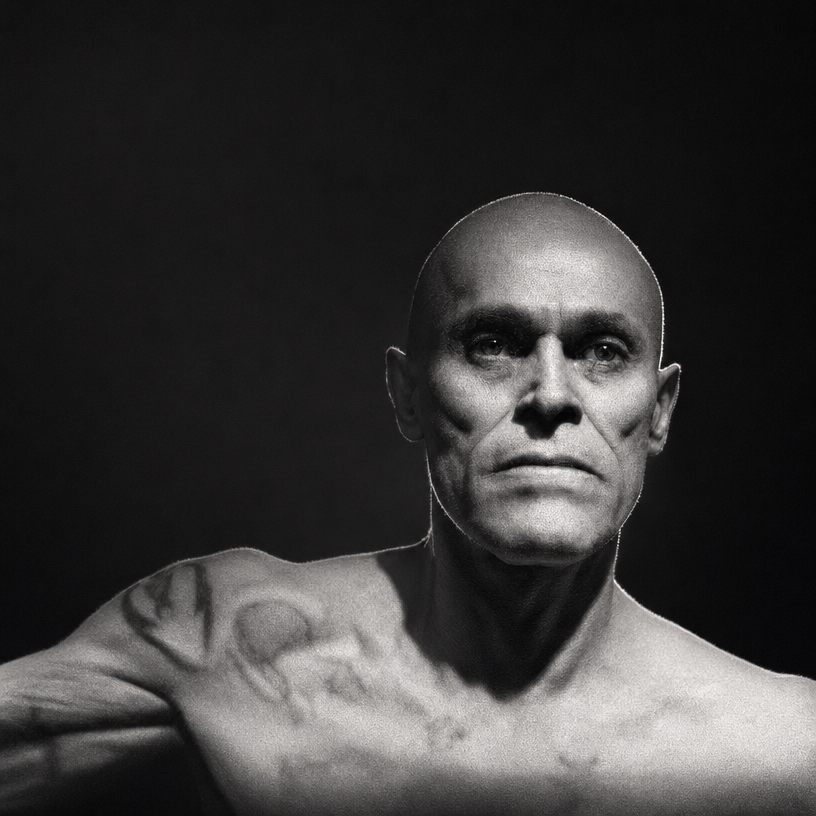
“Close-up portrait” and “framed from the upper chest up” make the face and jawline dominate the portrait composition, while “very sharp facial detail” and “sharper micro-contrast” give the gray image its tactile skin texture. The mood comes from the specific combination of “deep shadows in the eye sockets,” “minimalist dark background,” and “moody stark atmosphere,” while “softer, more directional rim lighting” places controlled highlights along the jawline and scalp instead of flattening the face. “Black-and-white gritty cinematic photography” and “slightly reduced overall contrast” keep the tonal range restrained, producing a raw filmic look rather than a glossy high-contrast portrait.
FAQ
→How do I make the eyes and expression more central and psychologically intense?
Replace “framed from the upper chest up” with “tight head-and-shoulders crop centered on the eyes,” and change “deep shadows in the eye sockets” to “eyes clearly visible with a narrow catchlight and hard shadow beneath the brow.” Keep “intense expression,” but add “direct eye contact with the camera” to make the gaze the primary focal point.
→How do I turn this into a softer, more human portrait while keeping the black-and-white style?
Replace “moody stark atmosphere” and “deep shadows in the eye sockets” with “quiet intimate atmosphere” and “soft open shadows around the eyes.” Change “softer, more directional rim lighting” to “large diffused key light with gentle fill,” and reduce “sharper micro-contrast” to “subtle natural skin texture” for less abrasive detail.
→How do I build a varied series from this prompt without losing its visual identity?
Keep “black-and-white gritty cinematic photography,” “minimalist dark background,” and “raw studio look” unchanged, then swap “bald man” for specific subjects such as “older woman with cropped silver hair,” “boxer with a broken nose,” or “young musician with shoulder-length curls.” Vary “directional rim lighting” with replacements such as “top-down side light,” “low frontal light,” or “split lighting,” while retaining “close-up portrait” and “very sharp facial detail” so the series remains visually consistent.
Learn the technique behind this
- Why can't AI spell, and how do I get readable text in an image? — Older diffusion models had no character-level representation of text, so they produced letterform-shaped texture instead of words.
- How should a prompt be structured, and does word order matter? — A prompt that behaves predictably names one subject first, then what it is doing, then where, then the light, then the lens or medium, then the style.
- Do negative prompts work, and what should go in one? — Negative prompts work on models that support a separate negative conditioning channel — mainly Stable Diffusion and FLUX-family models.
Related prompts
Woman in Teal Light, Shadowed Fashion Portrait
Eerie Elegance Among Marble Busts
Charcoal turtleneck with red eye-beam
Dreamy Macro Portrait in Cool Water