Why this works
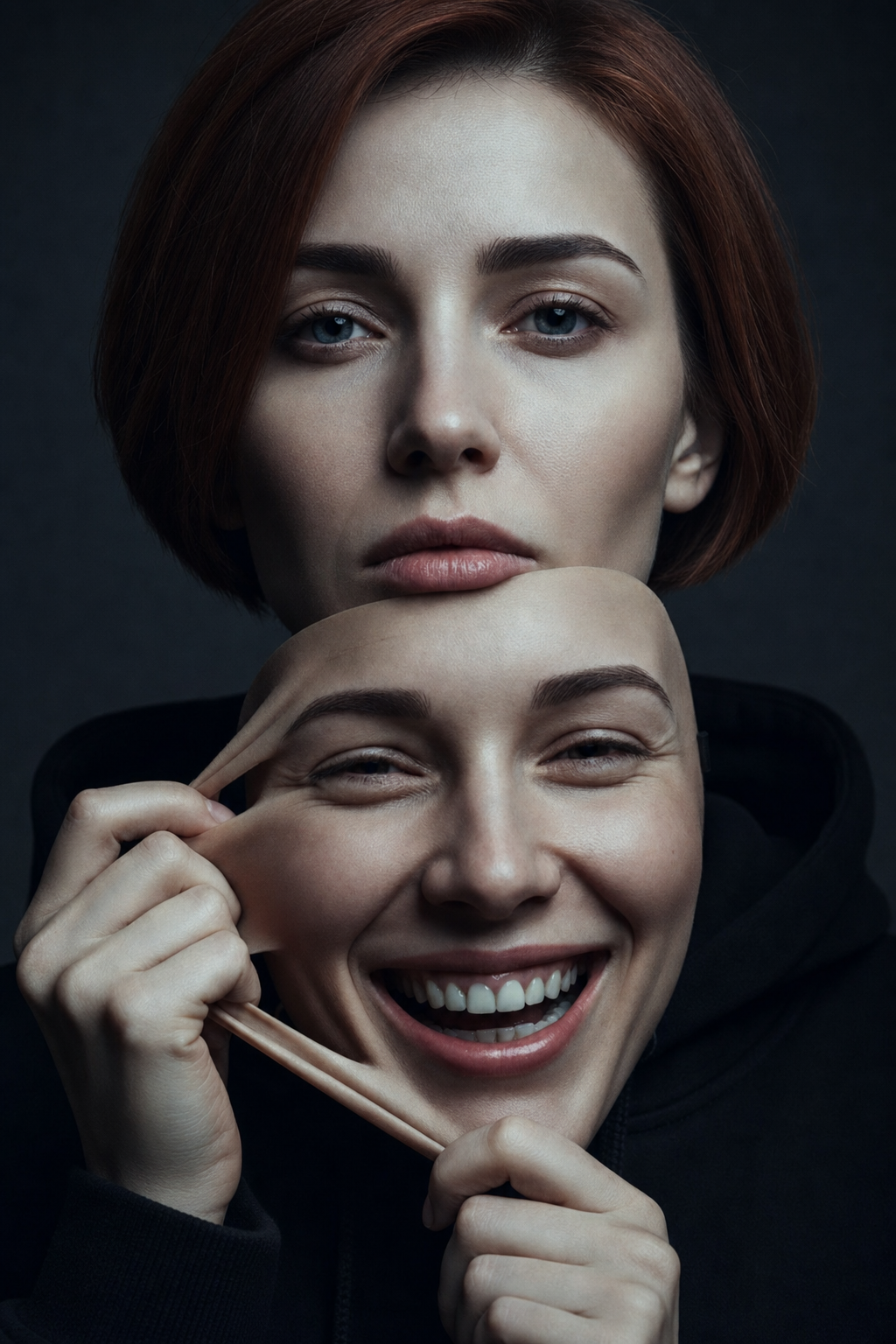
The surreal premise is carried by “a realistic peeled face mask of her own smiling face” held “in front of her lower face,” creating the dual-expression effect while keeping the eyes as the emotional anchor. “Deep charcoal studio background” and “minimal composition” isolate the subject, while “cool-toned soft dramatic lighting” and “moody contrast” produce the contemplative, slightly eerie tone. “Sharp focus on eyes and hands,” “natural skin texture,” and “realistic fingers” make the impossible prop feel physically credible, reinforced by the restrained black, brown, and beige palette.
FAQ
→How do I make the woman’s eyes and hidden expression feel more central?
Replace “sharp focus on eyes and hands” with “extreme sharp focus on the woman’s eyes, with the mask and hands slightly softened,” and change “holding ... in front of her lower face” to “holding the peeled mask lower, revealing her mouth and tense jaw.” This shifts attention from the prop’s realism toward her living expression.
→How do I make the image more frightening rather than contemplative?
Replace “cool-toned soft dramatic lighting” with “cold, harsh overhead lighting with deep eye sockets and sharp shadows,” and change “own smiling face” to “own distorted, mismatched smiling face with cracked lips.” Keep “deep charcoal studio background,” but replace “moody contrast” with “severe chiaroscuro contrast” for a more threatening result.
→How do I build a consistent series of variations from this portrait?
Keep “photorealistic close-up portrait,” “deep charcoal studio background,” “natural skin texture,” and “sharp focus on eyes and hands” unchanged, then vary only the mask phrase: use “a peeled laughing face,” “a calm older version of her face,” or “a tearful face with closed eyes.” Preserve “cool-toned soft dramatic lighting” and the portrait-closeup framing so the mask expressions become the controlled series variable.
Learn the technique behind this
- Why does AI get hands and faces wrong, and how do I fix it? — Hands fail because they're small in frame, extremely variable in pose, and self-occluding — the model has less usable signal per pixel than for any other body part.
- Why can't AI spell, and how do I get readable text in an image? — Older diffusion models had no character-level representation of text, so they produced letterform-shaped texture instead of words.
- How should a prompt be structured, and does word order matter? — A prompt that behaves predictably names one subject first, then what it is doing, then where, then the light, then the lens or medium, then the style.
Related prompts
Young girl with dog in tornado
Headless sitter atop a giant head
Crimson-Cloaked Specter in Candlelit Ballroom
Violet Holographic Hands Almost Touching