Why this works
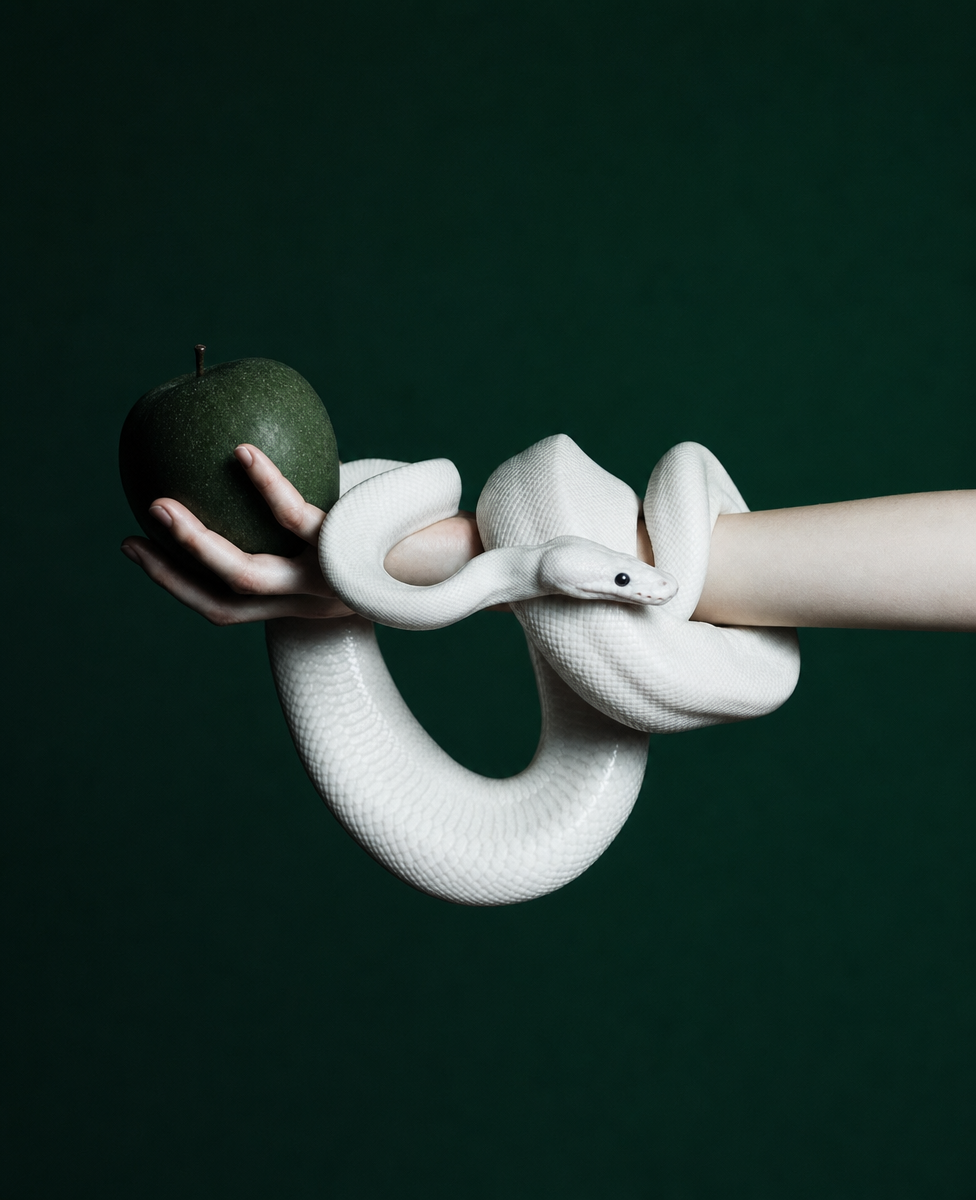
The centered framing comes directly from “centered subject framing” and “Centered subject,” keeping the coiled white snake, pale hand, and matte dark-green apple visually concentrated rather than letting the studio recede. “Cooler, side-lit contrast” gives the highly detailed scales a hard, tactile edge, while “deep emerald seamless background” supplies controlled color separation; the generated image’s dominant white and black tones make that contrast read more starkly. “Photorealistic surreal studio,” “minimalist,” and “surreal but coherent anatomy” balance the unnatural snake-and-hand arrangement with a clean fashion-editorial finish.
FAQ
→How do I make the apple more central and visually dominant?
Replace “the hand gripping a matte dark-green apple” with “the hand presenting a large matte dark-green apple in the exact center foreground, partially overlapping the snake’s coils.” Keep “centered subject framing,” but add “apple as the primary focal point” and “snake receding behind the apple” to shift hierarchy without losing the original composition.
→How do I make the image feel darker and more ominous?
Replace “clean, crisp illumination” with “low-key, high-contrast lighting with deep black shadows,” and change “cooler, side-lit contrast” to “single narrow side light from camera left.” Replace “deep emerald seamless background” with “near-black emerald seamless background” to preserve the green identity while pushing the white snake and pale hand into a more severe silhouette.
→How do I build a matching series with different objects instead of the apple?
Keep “white snake,” “pale human forearm and hand,” “deep emerald seamless background,” “cooler, side-lit contrast,” and “centered subject framing” unchanged, then replace “gripping a matte dark-green apple” with a controlled object list such as “gripping a polished black pear,” “gripping a translucent glass orb,” or “gripping a folded ivory flower.” Repeating the same “photorealistic surreal studio fashion editorial” and “minimalist, dramatic composition” language will keep the variations visually consistent.
Learn the technique behind this
- Why can't AI spell, and how do I get readable text in an image? — Older diffusion models had no character-level representation of text, so they produced letterform-shaped texture instead of words.
- How should a prompt be structured, and does word order matter? — A prompt that behaves predictably names one subject first, then what it is doing, then where, then the light, then the lens or medium, then the style.
- Which aspect ratio should I use, and how does it change the image? — Aspect ratio determines what the model composes, not how it's cropped afterwards.
Related prompts
Playful brunette beauty ad portrait
Red Lip Balm with Lychee Freshness
Premium wellness pouch with golden spices
Teal-Accented Bunny Toy Studio Portrait