Why this works
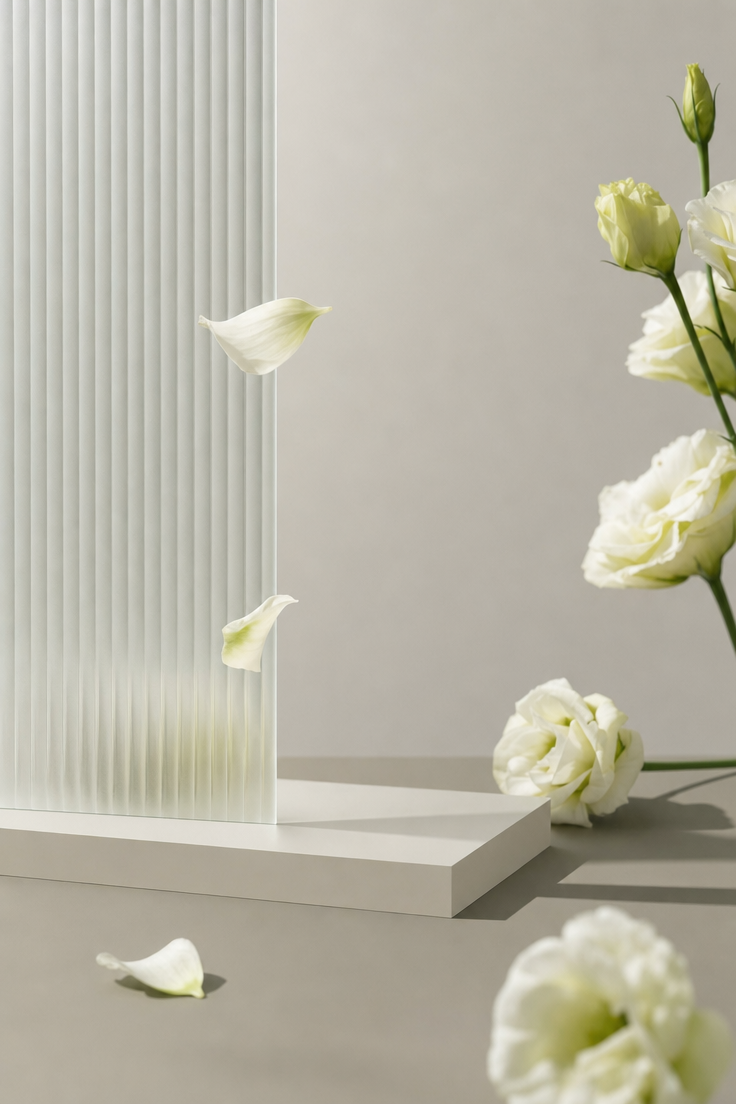
The centered arrangement and “elegant commercial framing, close minimalist still-life perspective” keep the white flowers, loose petals, and geometric platform controlled and immediately legible. “Warm light gray gradient background” supplies the beige-gray field, while “softer, slightly cooler daylight with gentle falloff” prevents the whites from feeling harsh; “clean, understated shadows” preserves the airy mood without flattening the platform and petals. Replacing translucent acrylic slats with “matte frosted glass dividers” adds quiet vertical structure while staying consistent with “minimalist,” “photorealistic,” and “calm airy mood.”
FAQ
→How do I make the flowers more prominent than the platform and petals?
Replace “white flowers and loose petals arranged around a simple geometric platform” with “a dense central bouquet of white flowers, with only a few loose petals at its base, resting on a partially obscured geometric platform.” Keep “centered” and “close minimalist still-life perspective” so the bouquet gains visual weight without changing the overall composition.
→How do I shift this from calm commercial minimalism to a moodier editorial still life?
Replace “softer, slightly cooler daylight with gentle falloff and clean, understated shadows” with “directional cool window light, deeper side shadows, and restrained dramatic contrast.” Change “calm airy mood” to “quiet, contemplative mood,” and replace “warm light gray gradient background” with “deep charcoal gray gradient background” to move the beige-gray palette toward slate and silver.
→How do I create coordinated variations of this image as a series?
Keep “elegant commercial framing,” “centered,” “photorealistic,” and “simple geometric platform” unchanged, then swap only the subject and divider material in each version. For example, replace “white flowers” with “pale pink tulips,” “yellow ranunculus,” or “deep red anemones,” and replace “matte frosted glass dividers” with “brushed aluminum panels” or “opaque porcelain fins,” while retaining “soft, slightly cooler daylight” for consistent lighting across the series.
Learn the technique behind this
- Why can't AI spell, and how do I get readable text in an image? — Older diffusion models had no character-level representation of text, so they produced letterform-shaped texture instead of words.
- Why does the model ignore parts of my prompt? — Ignored instructions are almost always conflicts, counts, or spatial relationships — three things current models handle badly — rather than the model failing to read you.
- Do negative prompts work, and what should go in one? — Negative prompts work on models that support a separate negative conditioning channel — mainly Stable Diffusion and FLUX-family models.
Related prompts

Playful brunette beauty ad portrait

Red Lip Balm with Lychee Freshness

Premium wellness pouch with golden spices

Teal-Accented Bunny Toy Studio Portrait