Why this works
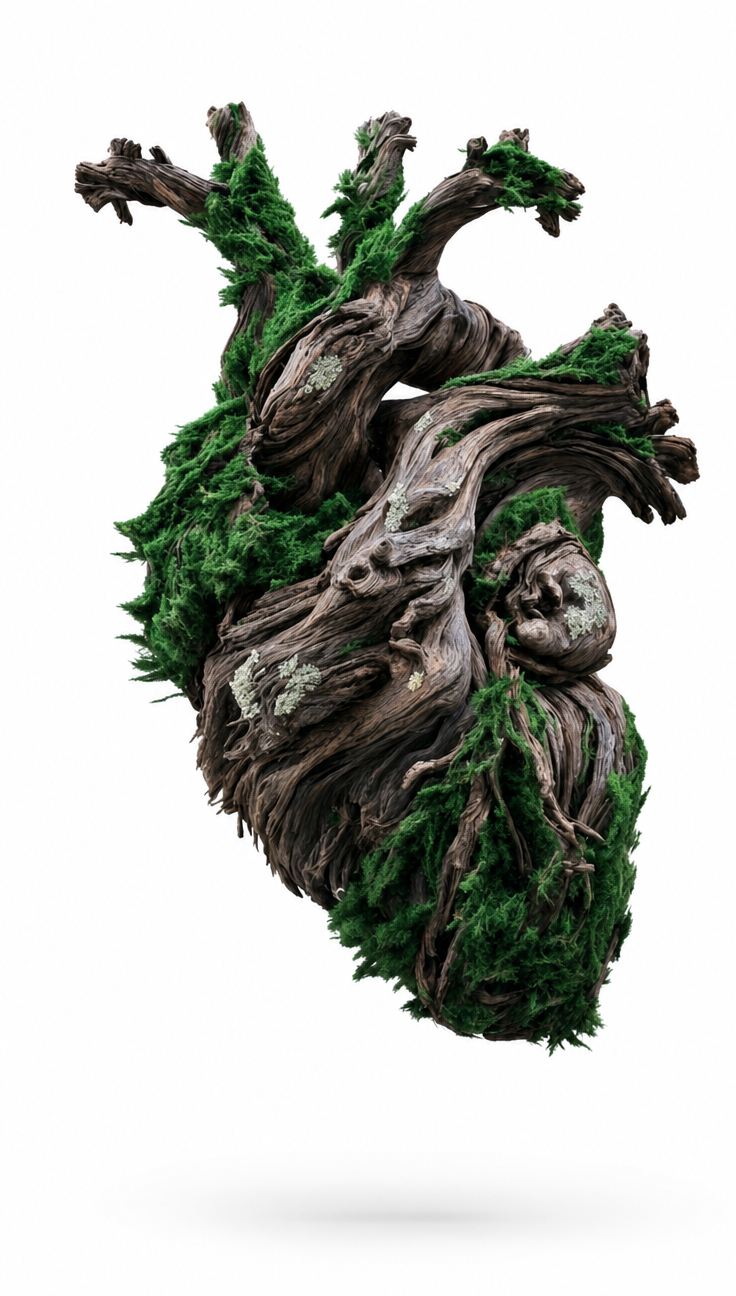
The centered product-style framing and “no visible environment beyond the white backdrop” isolate the anatomical heart as the sole subject, while the “pure white studio background” and “crisp realistic shadow beneath” give it clean separation and a grounded floating-object effect. “Weathered walnut-colored wood roots and branching veins” supplies the warm organic structure, and “vivid emerald moss” against white creates the dominant green-and-white contrast. “Soft controlled studio lighting highlighting wood grain and moss fibers,” combined with “ultra-detailed, 8K” and “sharp focus,” makes the texture-driven surrealism read as a premium photographic object rather than a vague fantasy image.
FAQ
→How do I change this prompt to make the heart feel darker and more gothic?
Replace “pure white studio background” with “deep charcoal-black studio background,” change “soft controlled studio lighting” to “dramatic low-key side lighting with deep shadows,” and replace “vivid emerald moss and small patches of pale lichen” with “dark crimson moss, black lichen, and faint wet highlights.” Keep “crisp realistic shadow beneath” if you still want a product-style presentation.
→How do I make the moss and lichen more prominent than the wooden structure?
Change “partially wrapped with vivid emerald moss and small patches of pale lichen” to “densely engulfed in vivid emerald moss, thick moss cushions covering most surfaces, and abundant pale lichen,” and replace “lighting highlighting wood grain and moss fibers” with “lighting prioritizing moss fibers, lichen growth, and dewy surface detail.” Add “wood grain visible only through small exposed gaps” to shift visual priority without losing the heart’s root-like construction.
→How do I turn this into a consistent series of natural-history specimens?
Keep the fixed phrases “product-style studio framing,” “pure white studio background,” “crisp realistic shadow beneath,” “soft controlled studio lighting,” and “ultra-detailed 8K” unchanged. Replace “anatomical heart” with a repeatable specimen subject such as “anatomical human lung,” “human brain,” or “rib cage,” while retaining “sculpted from weathered walnut-colored wood roots and branching veins” and varying only the plant treatment, such as “wrapped with vivid emerald moss and pale lichen” or “threaded with small fern fronds.”
Learn the technique behind this
- Why can't AI spell, and how do I get readable text in an image? — Older diffusion models had no character-level representation of text, so they produced letterform-shaped texture instead of words.
- How should a prompt be structured, and does word order matter? — A prompt that behaves predictably names one subject first, then what it is doing, then where, then the light, then the lens or medium, then the style.
- Do negative prompts work, and what should go in one? — Negative prompts work on models that support a separate negative conditioning channel — mainly Stable Diffusion and FLUX-family models.
Related prompts

Playful brunette beauty ad portrait
Red Lip Balm with Lychee Freshness
Premium wellness pouch with golden spices

Teal-Accented Bunny Toy Studio Portrait