Why this works
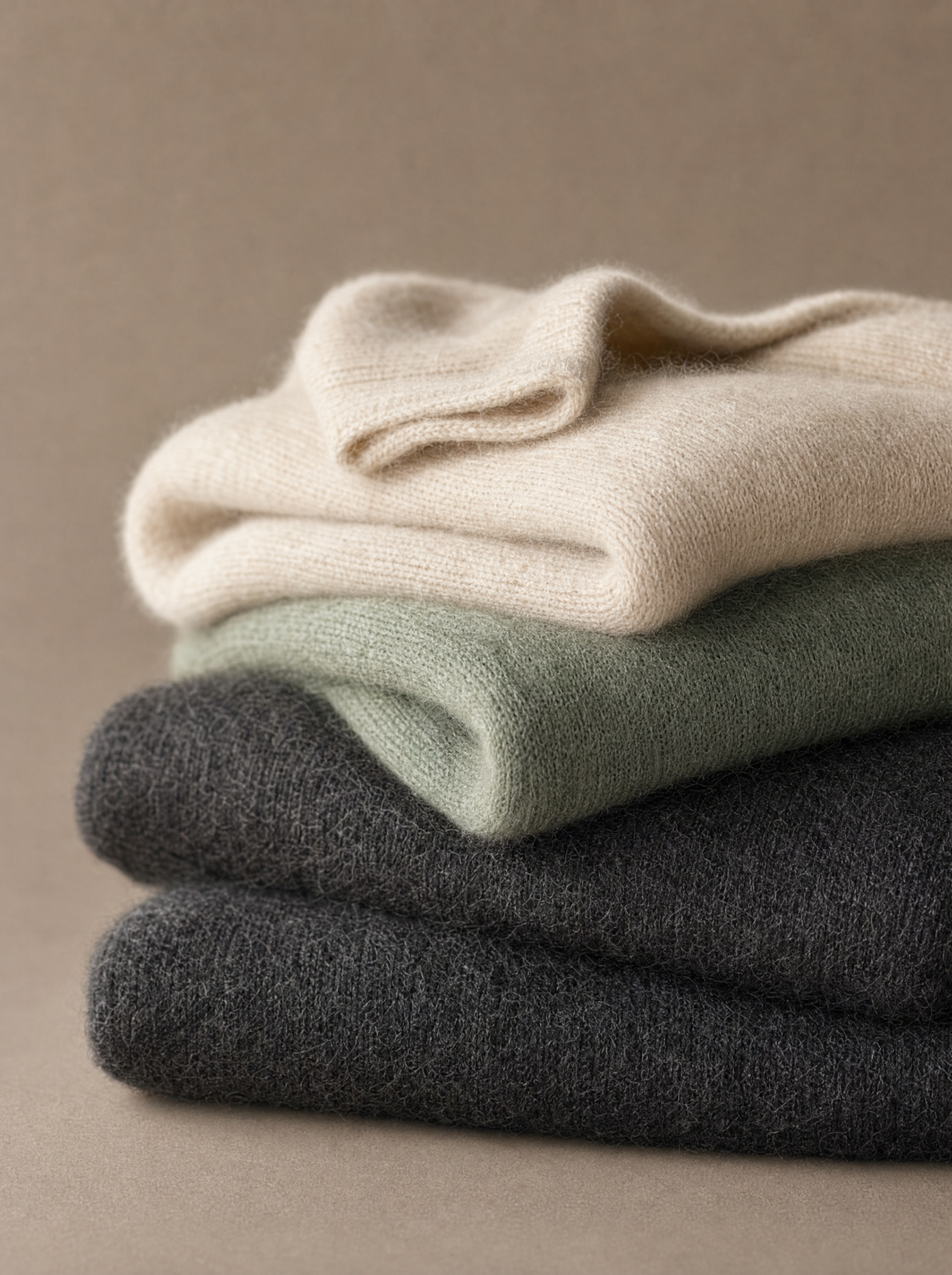
The centered editorial product-still-life framing gives the three-sweater stack a controlled, catalog-like presence, while “clean minimal composition” keeps the taupe background visually quiet. “Cream, sage green, and charcoal gray” establishes the muted palette, reflected in the image’s dominant gray, black, and olive tones, and “soft, even studio lighting with gentle shadows” preserves the calm refined mood without flattening the folds. “High detail on the wool fibers,” “smooth cashmere drape,” and “shallow depth of field” direct attention to the tactile knit surface and the slightly unfolded top edge.
FAQ
→How do I make the top sweater more prominent and tactile?
Replace “the top sweater slightly unfolded at one edge” with “the top cream sweater prominently unfolded across the stack, with its cuff and plush knit surface fully visible,” and change “centered” framing to “slightly elevated three-quarter close-up.” Keep “high detail on the wool fibers” to preserve the fiber-level focus.
→How do I shift this from a calm luxury mood to a warmer, cozier mood?
Replace “soft, even studio lighting with gentle shadows” with “warm window light from the upper left with soft amber shadows,” and replace “softly blurred taupe background” with “warm oatmeal linen background.” Change “calm refined mood” to “inviting, cozy winter mood” while retaining the cashmere drape and plush knit texture.
→How do I build a coordinated series with different sweater palettes?
Keep “editorial product still life,” “clean minimal composition,” “centered,” and “softly blurred taupe studio background” unchanged for consistency. Replace “cream, sage green, and charcoal gray” with a fixed three-color set for each variation, such as “ivory, dusty rose, and espresso brown,” “pale blue, moss green, and stone gray,” or “butter yellow, rust, and deep navy.”
Learn the technique behind this
- Why can't AI spell, and how do I get readable text in an image? — Older diffusion models had no character-level representation of text, so they produced letterform-shaped texture instead of words.
- How should a prompt be structured, and does word order matter? — A prompt that behaves predictably names one subject first, then what it is doing, then where, then the light, then the lens or medium, then the style.
- Why does the model ignore parts of my prompt? — Ignored instructions are almost always conflicts, counts, or spatial relationships — three things current models handle badly — rather than the model failing to read you.
Related prompts
Playful brunette beauty ad portrait
Red Lip Balm with Lychee Freshness
Premium wellness pouch with golden spices
Teal-Accented Bunny Toy Studio Portrait