Why this works
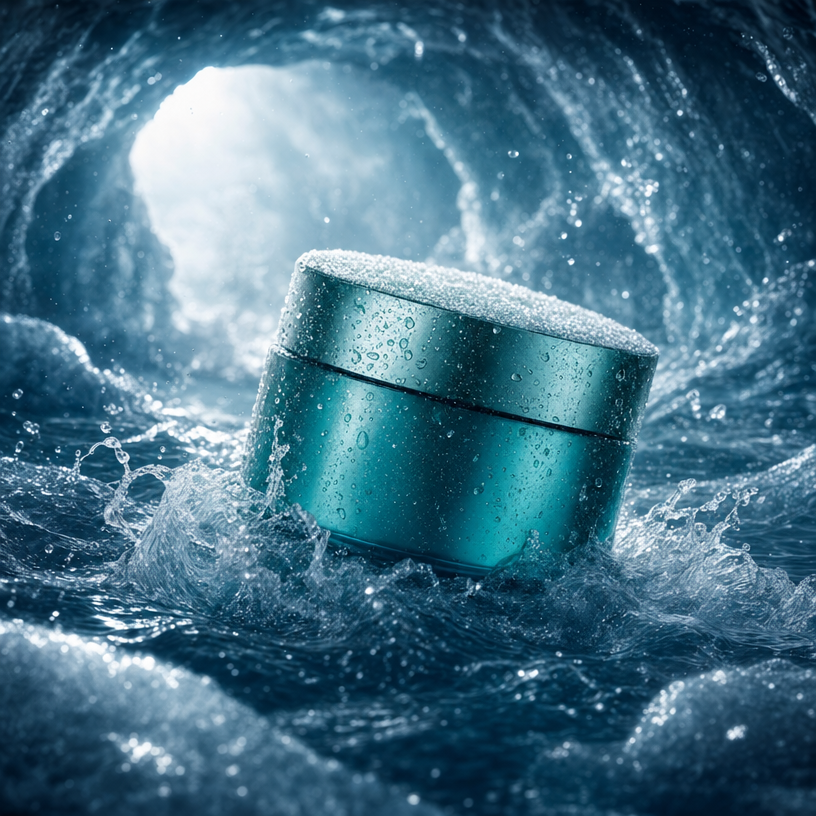
The phrase “teal cosmetic cream jar, diagonally placed and partially embedded” makes the product the centered focal point while adding directional energy to the close-up framing. “Dramatic ocean cave tunnel” supplies scale and enclosure, while “stronger wave spray and faster swirling currents” creates motion around the otherwise controlled luxury-ad image. The cool palette is anchored by “cool teal-and-cyan lighting” and the dominant teal, gray, and white colors; “crisp specular highlights” and “realistic water refraction” provide the glossy, photorealistic finish.
FAQ
→How do I make the cream jar more prominent and easier to read?
Replace “partially embedded in fresh icy water” with “standing prominently above the waterline on a wet rock ledge,” and add “front-facing label fully visible, unobstructed.” Keep “cinematic high-end product framing, diagonal composition close-up,” but change it to “centered hero product framing, tight close-up” if the label should dominate the image.
→How do I make the scene calmer and more luxurious instead of energetic?
Replace “stronger wave spray and faster swirling currents” with “slow glassy ripples and minimal suspended droplets.” Change “dramatic ocean cave tunnel” to “quiet sculpted ocean grotto with still reflective water,” while retaining “cool teal-and-cyan lighting” and “crisp specular highlights” for the polished luxury look.
→How do I build a variation series without losing the product identity?
Keep “teal cosmetic cream jar,” “photorealistic commercial product photography,” and “high-end luxury advertising look” unchanged, then swap “dramatic ocean cave tunnel” for settings such as “misty glacier cavern,” “dark volcanic tide pool,” or “sunlit turquoise reef grotto.” Match each version with a lighting replacement such as “cool silver-blue lighting,” “deep emerald lighting,” or “bright aqua daylight,” while preserving “realistic water refraction.”
Learn the technique behind this
- Why can't AI spell, and how do I get readable text in an image? — Older diffusion models had no character-level representation of text, so they produced letterform-shaped texture instead of words.
- How should a prompt be structured, and does word order matter? — A prompt that behaves predictably names one subject first, then what it is doing, then where, then the light, then the lens or medium, then the style.
- Do negative prompts work, and what should go in one? — Negative prompts work on models that support a separate negative conditioning channel — mainly Stable Diffusion and FLUX-family models.
Related prompts
Playful brunette beauty ad portrait
Red Lip Balm with Lychee Freshness
Premium wellness pouch with golden spices
Teal-Accented Bunny Toy Studio Portrait