Why this works
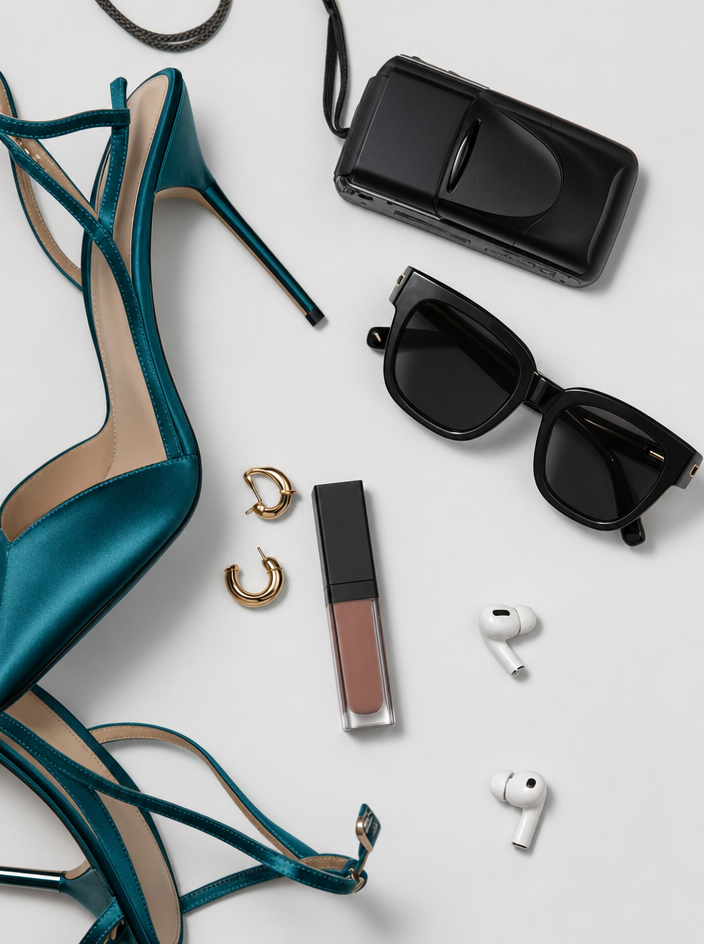
“Overhead flat lay” and “clean pale background” establish the graphic top-down composition, giving each accessory room to read as a separate object. The polished luxury mood comes from the combination of “teal satin pointed-toe heels,” “subtle gold accents,” and “small gold hoop earrings,” while “soft diffuse studio lighting” with “crisp subtle shadows” preserves satin, matte, metal, and plastic textures without harsh contrast. The dominant black, teal, and gray balance is anchored by the “black thick-frame sunglasses” and “matte black camera,” with teal acting as the focal accent and the pale ground maintaining the minimalist editorial feel.
FAQ
→How do I make the teal heels more central and visually dominant?
Replace “luxury fashion accessories” with “teal satin pointed-toe heels as the hero subject,” and add “heels centered, larger than every other accessory, with accessories arranged around them.” Keep “overhead flat lay,” but change “minimalist editorial styling” to “hero-product editorial styling” for stronger hierarchy.
→How do I shift this from a polished luxury mood to a darker, more dramatic campaign image?
Replace “clean pale background” with “charcoal gray background,” and change “soft diffuse studio lighting, crisp subtle shadows” to “directional side lighting, deep controlled shadows, and a narrow highlight on the teal satin.” Retain “subtle gold accents,” but replace “neutral nude lipstick” with “deep burgundy lipstick” to reinforce the richer palette.
→How do I create a coordinated series with different accessory color stories?
Keep the structure “Overhead flat lay,” “minimalist editorial styling,” and “photorealistic,” then replace “teal satin pointed-toe heels” and “subtle gold accents” with a repeated color pair such as “cobalt blue leather heels and silver accents” or “cherry red patent heels and polished brass accents.” Swap “clean pale background” for a background matched to each palette, such as “cool light gray” for cobalt and “warm ivory” for red.
Learn the technique behind this
- Why can't AI spell, and how do I get readable text in an image? — Older diffusion models had no character-level representation of text, so they produced letterform-shaped texture instead of words.
- How should a prompt be structured, and does word order matter? — A prompt that behaves predictably names one subject first, then what it is doing, then where, then the light, then the lens or medium, then the style.
- Do negative prompts work, and what should go in one? — Negative prompts work on models that support a separate negative conditioning channel — mainly Stable Diffusion and FLUX-family models.
Related prompts
Playful brunette beauty ad portrait
Red Lip Balm with Lychee Freshness
Premium wellness pouch with golden spices
Teal-Accented Bunny Toy Studio Portrait