Why this works
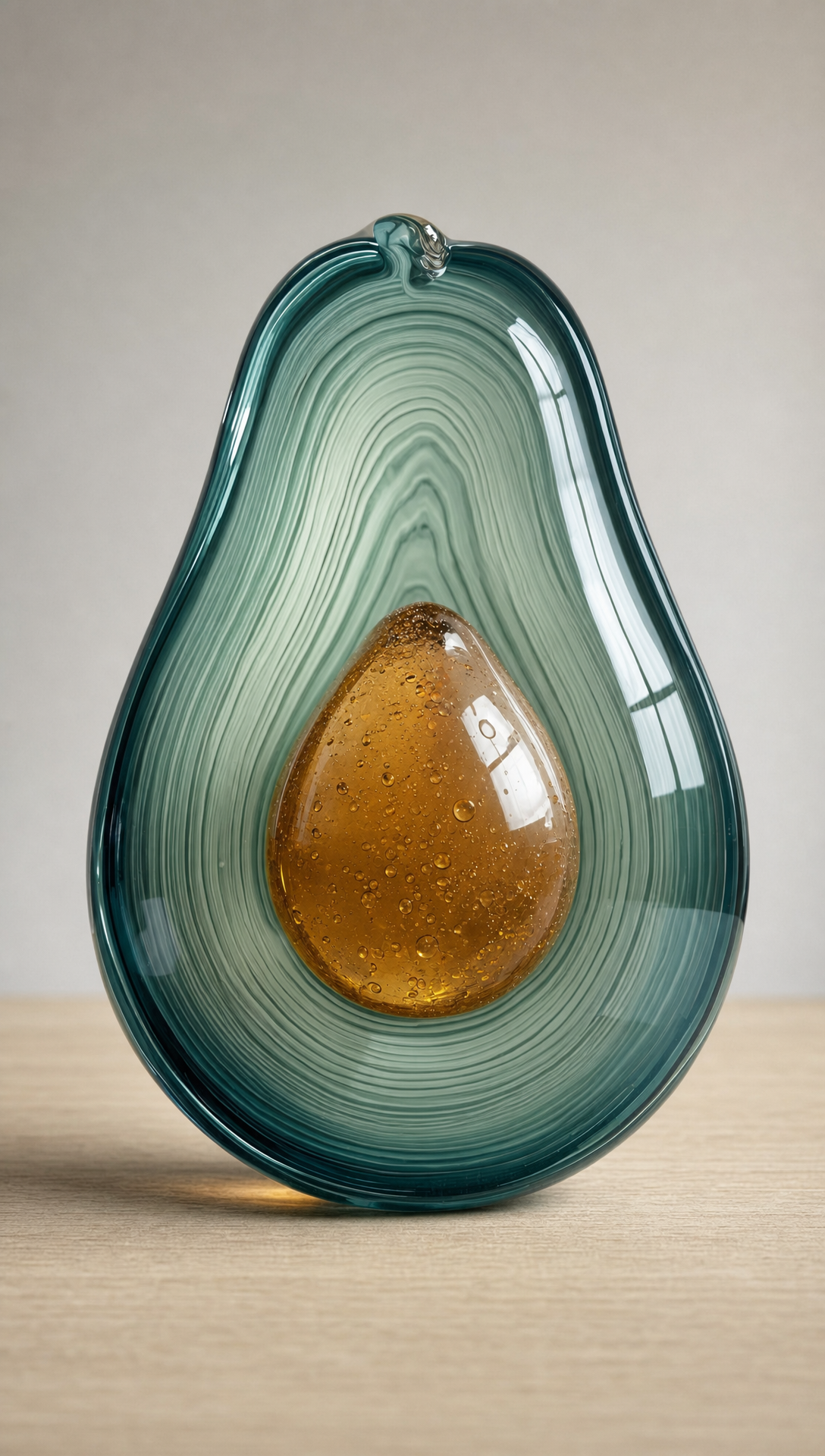
The centered “sculptural glass avocado” and “studio product framing” give the image a stable, object-first composition, while “sharp focus on glass texture and edges” preserves the shell layers and pit bubbles as readable details. “Soft diffused window light” paired with “crisp controlled reflections” makes the glass luminous without introducing harsh glare, supporting the stated “clean, refined, calm minimalist aesthetic.” The pale oak tabletop, warm-gray background, and honey-amber pit create the dominant beige-and-gold harmony, while the “layered translucent teal-green outer shell” supplies a restrained cool contrast.
FAQ
→How do I make the amber glass pit the main visual focus?
Replace “sculptural glass avocado” with “sculptural glass avocado with an oversized honey-amber glass pit,” and change “centered” to “three-quarter close-up framing emphasizing the pit.” Keep “sharp focus on glass texture and edges,” but add “selective focus and brightest controlled reflections concentrated on the pit” to direct attention inward.
→How do I shift this from calm product photography to a darker, more dramatic mood?
Replace “soft diffused window light” with “low-key directional side light,” and replace “minimal neutral warm-gray background” with “deep charcoal background.” Change “clean refined calm minimalist aesthetic” to “moody luxury editorial aesthetic,” while retaining “crisp controlled reflections” so the glass remains legible rather than becoming flat or muddy.
→How do I create a coordinated series using different glass fruit?
Replace “sculptural glass avocado” with a variable subject phrase such as “sculptural glass pear” or “sculptural glass citrus slice,” and adapt “honey-amber glass pit featuring subtle bubble inclusions” to a fruit-specific internal feature such as “ruby-red glass core with subtle bubble inclusions.” Keep “pale oak tabletop,” “neutral warm-gray background,” “soft diffused window light,” “studio product framing,” and the centered composition unchanged for visual consistency across the series.
Learn the technique behind this
- Why can't AI spell, and how do I get readable text in an image? — Older diffusion models had no character-level representation of text, so they produced letterform-shaped texture instead of words.
- How should a prompt be structured, and does word order matter? — A prompt that behaves predictably names one subject first, then what it is doing, then where, then the light, then the lens or medium, then the style.
- Do negative prompts work, and what should go in one? — Negative prompts work on models that support a separate negative conditioning channel — mainly Stable Diffusion and FLUX-family models.
Related prompts
Playful brunette beauty ad portrait
Red Lip Balm with Lychee Freshness
Premium wellness pouch with golden spices

Teal-Accented Bunny Toy Studio Portrait