Why this works
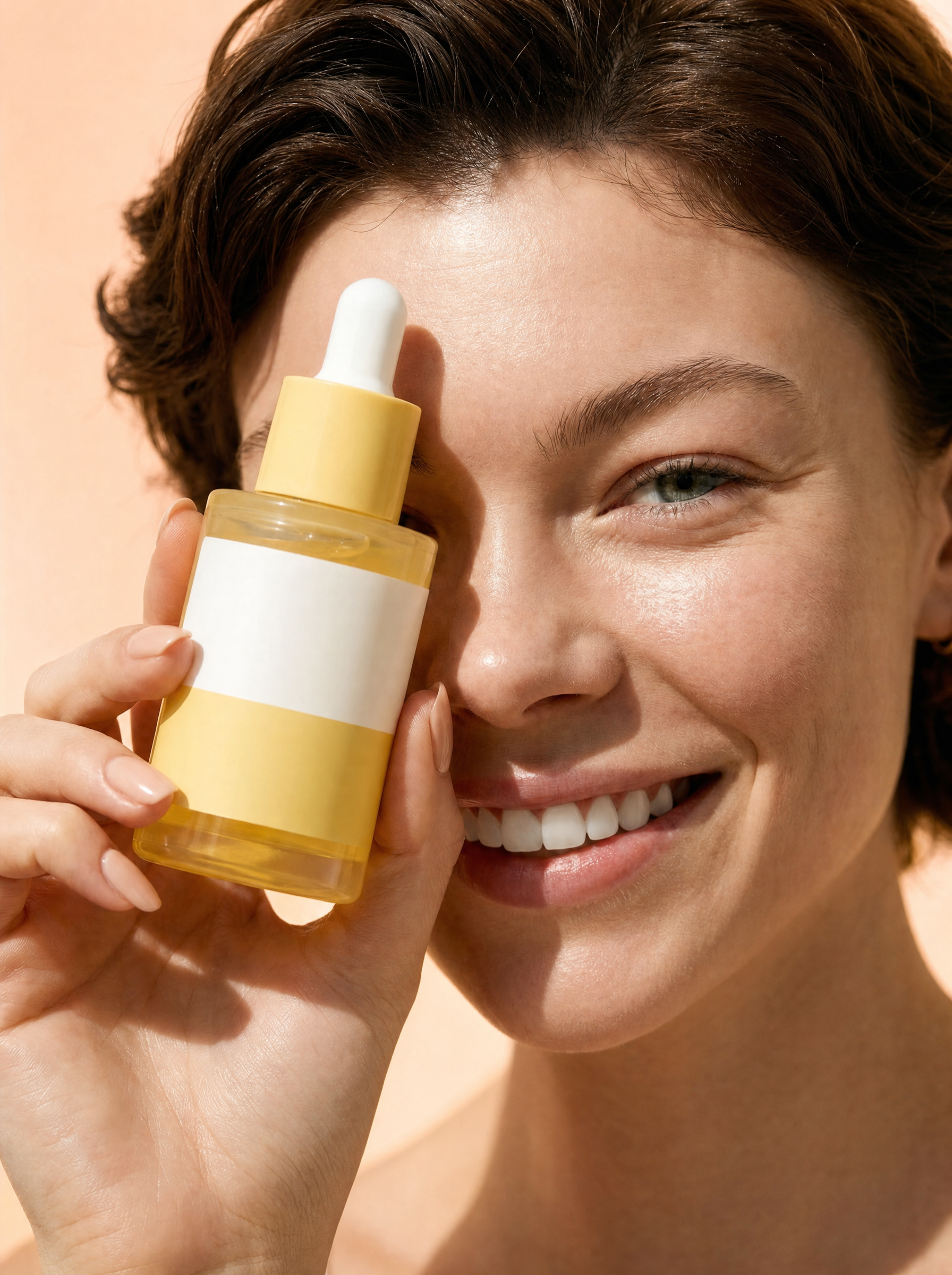
The portrait-close-up framing comes directly from “beauty campaign close-up” and “holding a small amber skincare serum dropper bottle near her cheek,” keeping the face and product as the paired focal points. “Soft peach-to-cream gradient background” supplies the pale white and warm yellow field seen behind the subject, while the amber bottle contributes the dominant brown accent. “Gentle diffused studio lighting” preserves detailed natural skin texture, and “subtle warm rim light for a premium glow” separates the woman from the backdrop without losing the clean advertising finish; “slightly cooler highlights than the background” adds the fresh contrast.
FAQ
→How do I make the serum bottle more central and prominent?
Replace “holding a small amber skincare serum dropper bottle near her cheek” with “holding a larger amber serum dropper bottle centered beside her lips, occupying the foreground,” and change “portrait-closeup” to “tight product-and-face close-up.” Keep “crisp product label area with no readable text” to retain a clean label.
→How do I shift this from cheerful premium to a moodier luxury campaign?
Replace “bright cheerful color palette” with “muted deep caramel, cream, and charcoal palette,” change “soft peach-to-cream gradient background” to “dark warm taupe-to-black gradient background,” and replace “subtle warm rim light for a premium glow” with “controlled golden rim light against deep shadow.”
→How do I create a series with different skincare products while preserving this look?
Keep “photorealistic beauty campaign close-up,” “gentle diffused studio lighting,” “shallow depth of field,” and “detailed natural skin texture” unchanged. Swap “small amber skincare serum dropper bottle” for consistent variants such as “frosted glass vitamin C bottle,” “white cream jar,” or “cobalt blue facial oil bottle,” and replace “peach-to-cream gradient” with coordinated backdrops such as “lemon-to-ivory,” “lavender-to-white,” or “pale blue-to-cream.”
Learn the technique behind this
- Why can't AI spell, and how do I get readable text in an image? — Older diffusion models had no character-level representation of text, so they produced letterform-shaped texture instead of words.
- How should a prompt be structured, and does word order matter? — A prompt that behaves predictably names one subject first, then what it is doing, then where, then the light, then the lens or medium, then the style.
- Why does the model ignore parts of my prompt? — Ignored instructions are almost always conflicts, counts, or spatial relationships — three things current models handle badly — rather than the model failing to read you.
Related prompts
Playful brunette beauty ad portrait
Red Lip Balm with Lychee Freshness
Premium wellness pouch with golden spices
Teal-Accented Bunny Toy Studio Portrait