Why this works
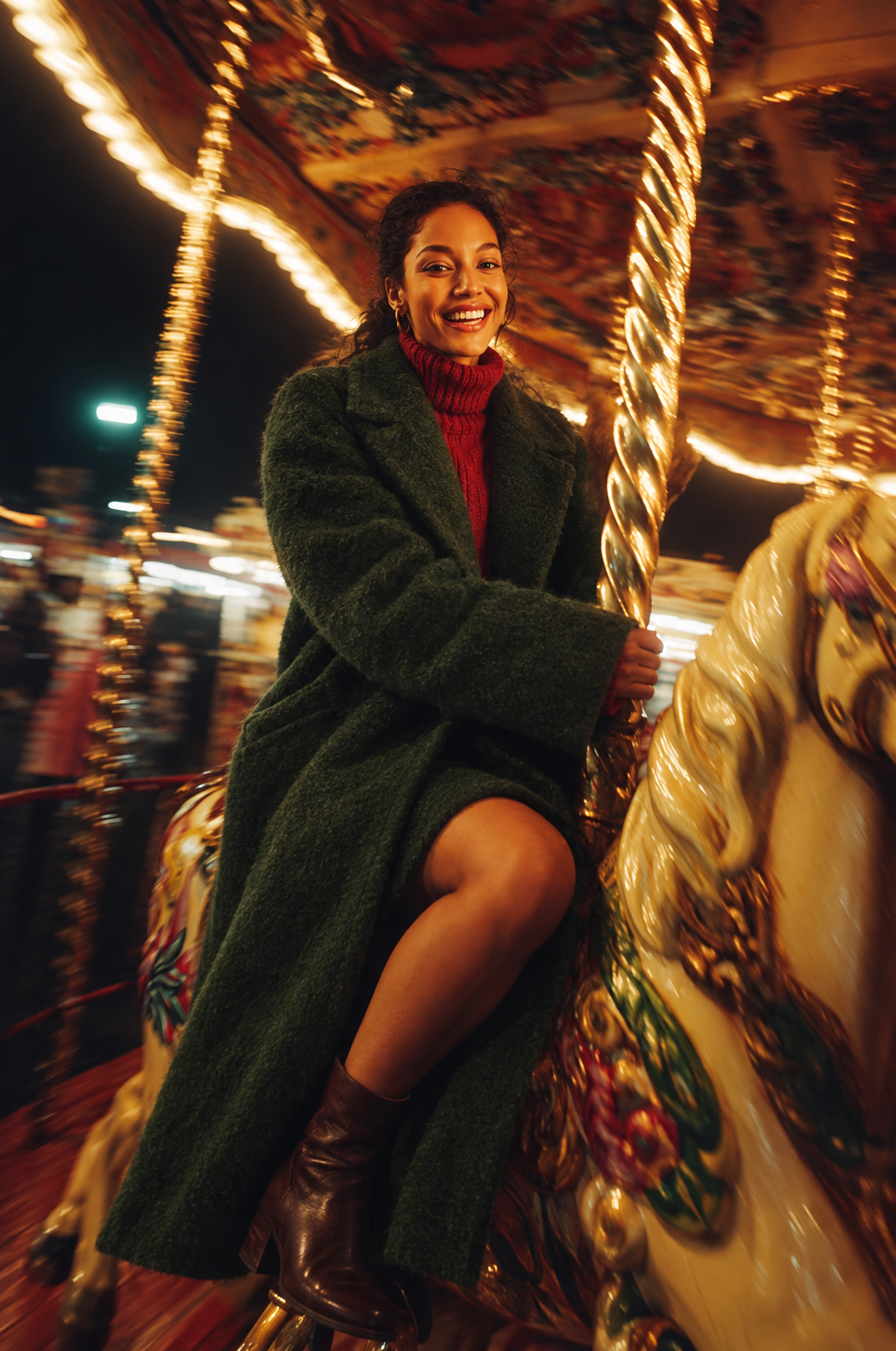
The full-body framing keeps both the rider and carousel horse readable, while “shallow depth of field” and “golden bokeh” push the glowing fairground behind her into a soft, dreamy backdrop. The festive warmth comes from the specific combination of “warm Christmas lights,” “glowing carousel bulbs,” and “dreamy warm highlights,” reinforced by the deep green coat, red sweater, and gold light palette. “Subtle motion blur” adds movement without losing the woman’s smiling expression, and “clean natural skin tones” keeps the photorealistic editorial finish grounded.
FAQ
→How do I make the carousel horse and rider feel more dynamic?
Replace “full body shot” with “low-angle three-quarter full-body shot, carousel horse prominent in the foreground,” and change “subtle motion blur” to “stronger directional motion blur on the background and horse legs, face and torso sharply focused.” Keep “shallow depth of field” so the rider remains the visual anchor.
→How do I shift this from warm and dreamy to a colder, more dramatic night scene?
Replace “warm Christmas lights,” “golden bokeh,” and “dreamy warm highlights” with “cool blue winter lighting, crisp white carousel bulbs, and restrained amber accents.” Change “festive fairground atmosphere” to “quiet winter fairground atmosphere” and add “deep blue shadows” while retaining “clean natural skin tones.”
→How do I create a series of variations without losing the original identity?
Keep “photorealistic cinematic editorial photo,” the “deep green wool overcoat,” “red turtleneck sweater,” and “clean natural skin tones” unchanged. Vary only the setting and action phrases, such as replacing “riding a carousel horse at a Christmas fair at night” with “standing beside the carousel beneath falling snow” or “laughing while reaching for a brass carousel pole,” while preserving “full body framing,” “golden bokeh,” and “shallow depth of field.”
Learn the technique behind this
- Why can't AI spell, and how do I get readable text in an image? — Older diffusion models had no character-level representation of text, so they produced letterform-shaped texture instead of words.
- How should a prompt be structured, and does word order matter? — A prompt that behaves predictably names one subject first, then what it is doing, then where, then the light, then the lens or medium, then the style.
- Do negative prompts work, and what should go in one? — Negative prompts work on models that support a separate negative conditioning channel — mainly Stable Diffusion and FLUX-family models.
Related prompts
Modern minimalist Christmas tree with cool lighting
Cozy Night Portrait at Christmas Market

Emerald jeweled Christmas ornament with blue gems

Tabby Cat Reaching for Green Ornament Under Tree