Why this works
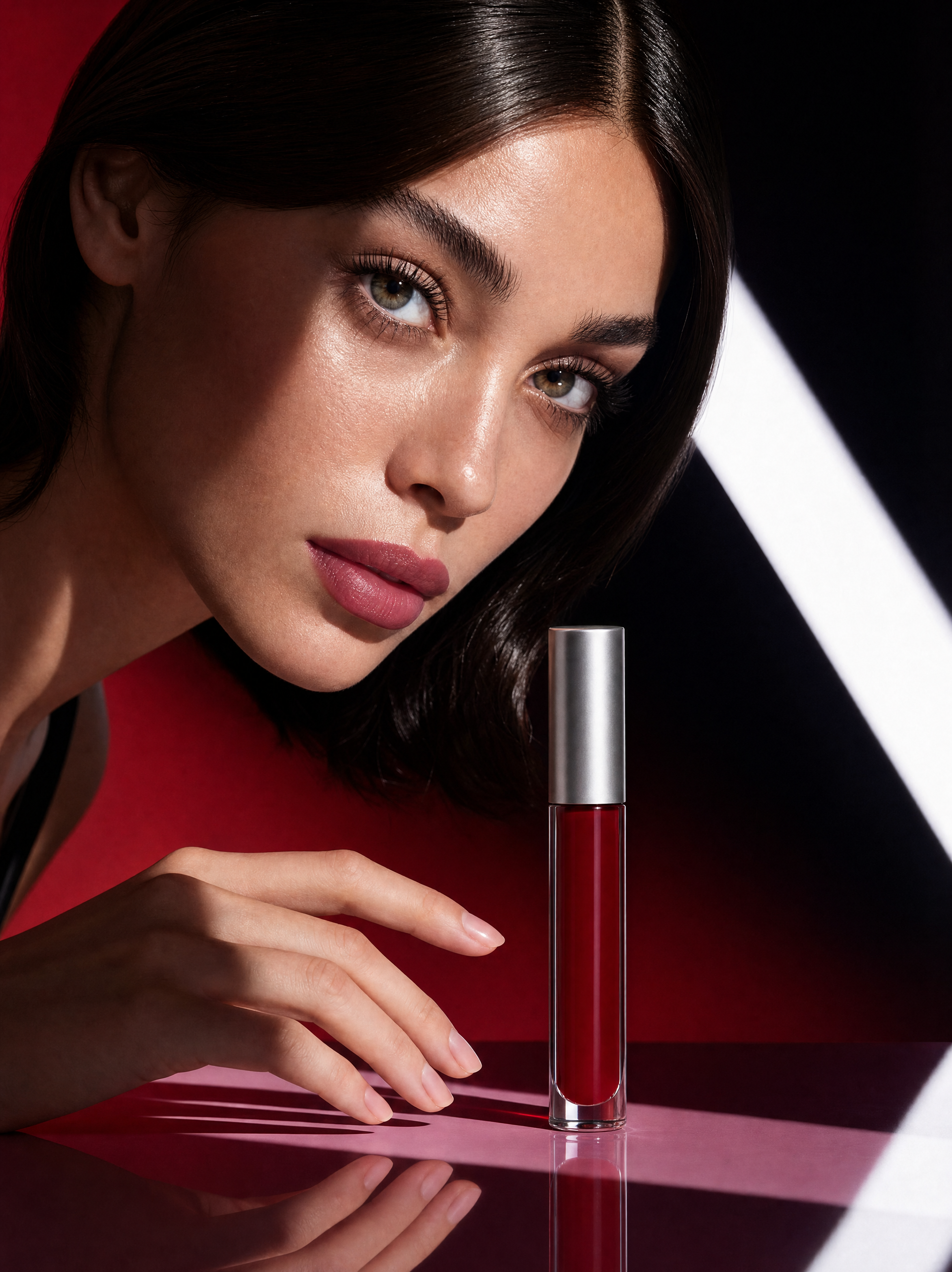
The close editorial portrait framing makes the woman and clear lip gloss tube immediate, while “leaning close beside” links the face to the product instead of treating it as a separate still life. “Sweeping diagonal cool-white light beam” supplies the dramatic direction and “deep burgundy-to-black background gradient” gives the red liquid and satin rose-pink lipstick a controlled, luxurious color field. “Glossy reflective dark plum surface,” “fine specular highlights,” and “sharp focus” carry the polished cosmetics-advertising finish through both the product and realistic skin texture.
FAQ
→How do I make the lip gloss more central and prominent?
Replace “leaning close beside a clear lip gloss tube” with “holding the clear lip gloss tube upright in the foreground, centered beside her lips,” and add “product larger than the face, label fully visible.” Keep “sharp focus” but change “editorial portrait framing” to “tight product-led beauty close-up” so the tube controls the composition.
→How do I shift this from dramatic luxury to a softer, romantic campaign?
Replace “dramatic studio lighting,” “high contrast,” and “deep burgundy-to-black background gradient” with “diffused rose-gold studio lighting,” “low contrast,” and “blush-pink to warm cream background gradient.” Change “glossy reflective dark plum surface” to “matte blush-pink surface” to reduce the hard, dark reflections while preserving the rose-pink lipstick.
→How do I create a matching variation with a different product color?
Replace “ruby-red liquid” and “soft satin rose-pink lipstick” with a coordinated pair such as “caramel-nude liquid” and “soft satin peach-nude lipstick.” For a cooler series, use “berry-plum liquid” and “soft satin mauve lipstick,” while changing “red and pink” in the color direction to “plum, mauve, and cool white” so the palette follows the new product.
Learn the technique behind this
- Why can't AI spell, and how do I get readable text in an image? — Older diffusion models had no character-level representation of text, so they produced letterform-shaped texture instead of words.
- Why does AI get hands and faces wrong, and how do I fix it? — Hands fail because they're small in frame, extremely variable in pose, and self-occluding — the model has less usable signal per pixel than for any other body part.
- How do I keep the same character across multiple images? — Text prompts alone won't hold a face across images — a description defines a type, not a person.
Related prompts
Playful brunette beauty ad portrait
Red Lip Balm with Lychee Freshness
Premium wellness pouch with golden spices

Teal-Accented Bunny Toy Studio Portrait