Why this works
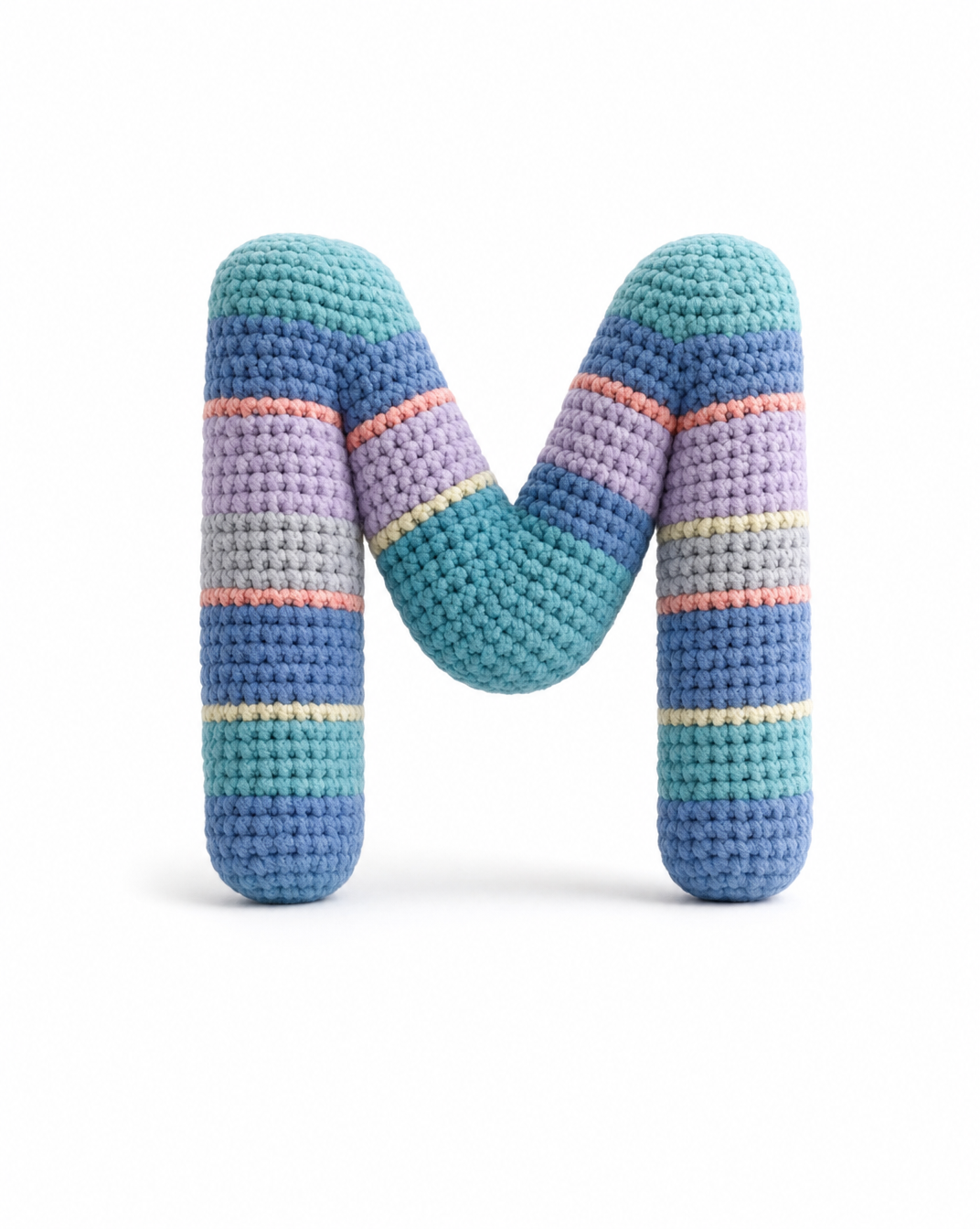
The phrase “rounded, voluminous, toy-like shape standing upright” gives the centered letter a friendly sculptural presence, while “3D product-shot framing” and “upright figure centered” keep the composition orderly and isolated. “Cool gradient of teal, blue, lavender, and silver” establishes the dominant teal, purple, and gray harmony, with “thin warm accent threads (coral and pale yellow)” adding small beige-warm highlights without overpowering it. “Visible crochet-like stitch pattern” and “high-detail textile/crochet stitch texture” carry the tactile realism, while “diffused lighting and gentle soft shadows” preserves the clean, cheerful studio mood and dimensional volume.
FAQ
→How do I make the letter feel more dramatic and premium instead of playful?
Replace “Playful, bright, cheerful” with “quiet, refined, premium,” and change “clean white background with soft shadows” to “charcoal-gray studio background with controlled rim lighting and a crisp grounding shadow.” Keep “cool gradient of teal, blue, lavender, and silver,” but replace “thin warm accent threads (coral and pale yellow)” with “subtle metallic silver and deep indigo accent threads” for a less toy-like finish.
→How do I make the crochet texture and yarn structure more prominent?
Replace “3D product-shot framing” with “macro product photography, close three-quarter view,” and change “visible crochet-like stitch pattern” to “extremely enlarged crochet loops, individual fuzzy fibers, and sharply resolved stitch intersections.” Replace “diffused lighting” with “soft directional side-lighting” while keeping “gentle soft shadows,” so the stitches catch highlights without losing the plush form.
→How do I build a matching series of letters from this prompt?
Replace “letter ‘M’” with another character such as “letter ‘A’” or “number ‘8’,” and retain “rounded, voluminous, toy-like shape standing upright” to preserve the series identity. Keep the exact palette phrase “cool gradient of teal, blue, lavender, and silver with thin warm accent threads (coral and pale yellow)” and vary only the pose or crop, such as “slight three-quarter rotation” or “tighter centered crop,” for controlled variations.
Learn the technique behind this
- Why can't AI spell, and how do I get readable text in an image? — Older diffusion models had no character-level representation of text, so they produced letterform-shaped texture instead of words.
- Why does the model ignore parts of my prompt? — Ignored instructions are almost always conflicts, counts, or spatial relationships — three things current models handle badly — rather than the model failing to read you.
- Do negative prompts work, and what should go in one? — Negative prompts work on models that support a separate negative conditioning channel — mainly Stable Diffusion and FLUX-family models.
Related prompts
Playful brunette beauty ad portrait
Red Lip Balm with Lychee Freshness
Premium wellness pouch with golden spices
Teal-Accented Bunny Toy Studio Portrait